Artificial production of the rare natural compound 'herpotrichone' has become possible. Herpotrichone is highly effective in suppressing inflammation in the brain and protecting nerve cells, and it is considered to have significant potential as a treatment for degenerative brain diseases such as dementia and Parkinson's disease.
Until now, herpotrichone could only be obtained in extremely small quantities from fungi that live in symbiosis with bean beetles. However, with the recent success in artificially producing herpotrichone through chemical reactions in Korea, it is expected that next-generation drugs for neurodegenerative diseases using herpotrichone will become possible in the future.
KAIST announced on the 31st that the research team led by Professor Han Soonkyu from the Department of Chemistry has succeeded, for the first time in the world, in chemically synthesizing the natural anti-neuroinflammatory compounds 'herpotrichone A, B, and C'.
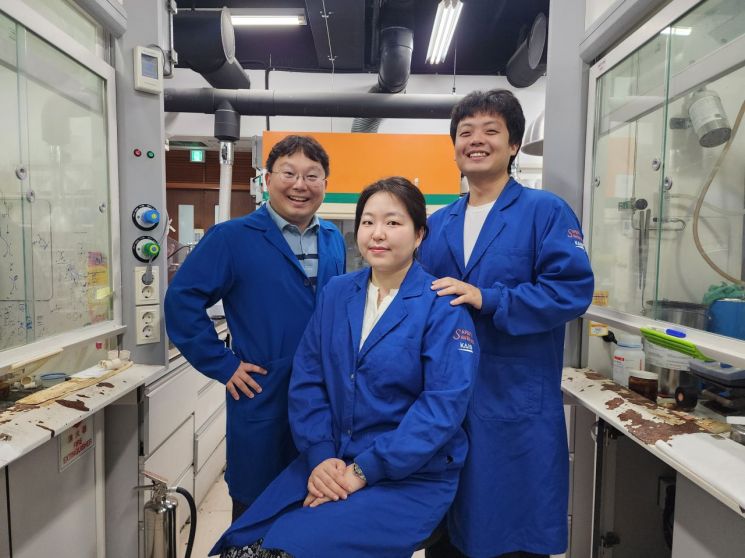 (From left) Professor Han Sungkyu, Department of Chemistry, KAIST; Yujin Lee, Integrated MS-PhD Program; Taewan Kim, Integrated MS-PhD Program. Provided by KAIST
Chemical synthesis refers to the process of creating a desired compound through chemical reactions. Until now, natural herpotrichone could only be obtained in trace amounts from the symbiotic fungus 'Herpotrichia sp. SF09' found in bean beetles. This compound has a multi-ring structure consisting of five rings (four hexagons and one triangle), specifically a 6/6/6/6/3 ring system.
This compound is known to have excellent anti-neuroinflammatory effects by suppressing inflammatory responses in the brain. Recently, it has also been found to protect nerve cells by inhibiting ferroptosis, a form of iron-mediated cell death, which has further raised expectations for its use as a drug for treating brain diseases.
To utilize this compound, the research team predicted the biosynthetic pathway of herpotrichone in fungi and devised a method to chemically construct its complex structure in the laboratory.
The key to this process was the 'Diels-Alder reaction', a chemical reaction that, much like fitting two puzzle pieces together to form a ring, enables carbon-based partners to form new bonds and create a hexagonal ring structure.
The research team also focused on the phenomenon of 'hydrogen bonding', which is a weak attraction between molecules. By delicately designing and controlling these hydrogen bonds, they were able to precisely guide the reaction to occur only in the desired direction and position, thereby successfully synthesizing herpotrichone through chemical synthesis.
During the research process, the team solved the problem where, without the key hydrogen bond, the target natural compound was barely produced or only unwanted byproducts were formed. In addition, they were able to accurately synthesize all three complex structures: herpotrichone A, B, and C.
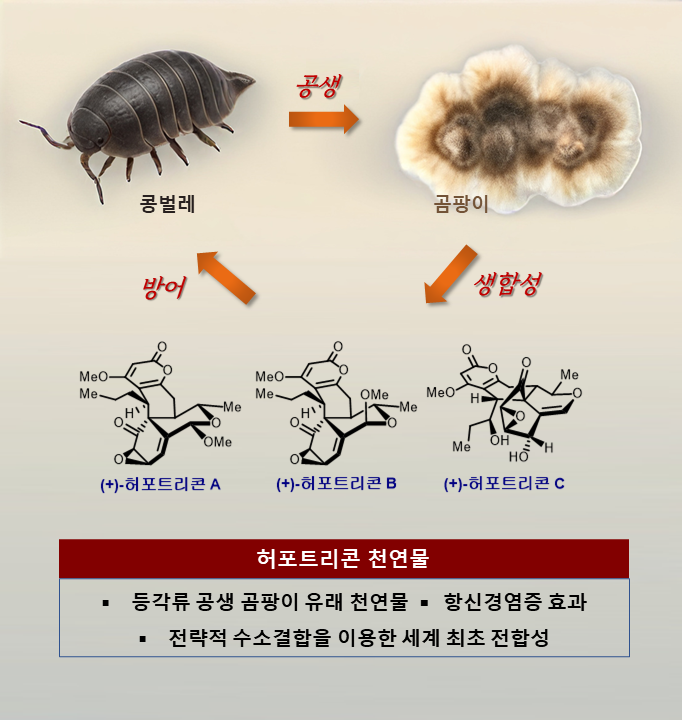
In particular, the team precisely analyzed the structures of the key starting materials 'delitpyrone C' and 'epoxyquinol monomer' to determine under what structural conditions the crucial hydrogen bonding could occur during the synthesis of herpotrichone.
Thanks to the induced hydrogen bonding, the reacting molecules could approach each other at the correct positions and pass through an ideal transition state, making it possible to synthesize herpotrichone C. The research team also applied this reaction principle to herpotrichone A and B, successfully synthesizing these natural compounds as well.
Most notably, during the Diels-Alder reaction process, new molecular structures that do not occur in nature were also formed, and some of these are believed to be new natural compounds with excellent pharmacological activity. This adds significance to the research in terms of predicting natural products through synthesis.
Professor Han Soonkyu stated, "This study is the first to synthesize rare natural compounds found in nature and systematically present a biomimetic synthesis principle for natural products. The results will be widely used in the development of anti-neuroinflammatory drugs based on natural products and in research on the biosynthesis of this class of compounds."
Meanwhile, Lee Yujin, a combined master's and doctoral student from the Department of Biological Sciences, participated as the first author in this research. The results of the study (paper) were also introduced on July 16 in the Journal of the American Chemical Society (JACS), a leading journal in the field of chemistry.
© The Asia Business Daily(www.asiae.co.kr). All rights reserved.