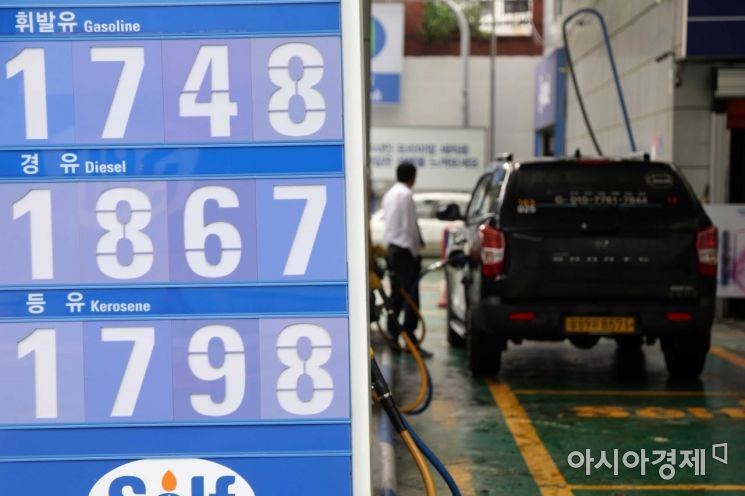
 The diesel price at domestic gas stations, which had been falling for eight consecutive weeks, has turned upward. The weekly gasoline price continued a slight decline for the ninth week. According to the Korea National Oil Corporation's oil price information system, Opinet, the average gasoline selling price at gas stations nationwide in the fifth week of August (August 28 to September 1) was 1,740.3 KRW per liter, down 3.5 KRW from the previous week, while diesel was 1,844.6 KRW per liter, up 1 KRW from the previous week. A gas station in downtown Seoul on the 4th. Photo by Moon Honam munonam@
As the Chuseok holiday approaches, domestic fuel prices, which had surged since the beginning of this year, are showing signs of stabilization. This is expected to somewhat ease the burden on drivers traveling for the holiday.
According to Opinet, the oil price information site operated by the Korea National Oil Corporation, as of the previous day, the average nationwide gasoline price at gas stations fell by 0.05 KRW to 1,740.56 KRW per liter, while the diesel price rose by 0.14 KRW to 1,854.03 KRW per liter.
Gasoline prices have shown a slight upward trend ahead of the holiday travel period, rising from a low of 1,737.77 KRW on the 26th of last month, but overall they are stabilizing downward. However, diesel prices have shown a smaller decline compared to gasoline.
Gasoline and diesel prices, which are directly linked to consumer prices, have been declining due to the expanded fuel tax reduction implemented since July and the drop in international petroleum product prices. Although the downward trend paused from the last week of last month, gasoline was priced at 2,113 KRW per liter and diesel at 2,148 KRW per liter on July 7, two months ago. This means gasoline prices have dropped by about 373 KRW (-17.6%) and diesel by about 296 KRW (-13.7%) per liter over two months.
Notably, this is a significant change from the situation after the outbreak of the Russia-Ukraine war in February this year, when prices continuously rose to around 2,140 KRW per liter for gasoline by the end of June.
Breaking down nationwide gasoline prices by region, Seoul had the highest gasoline price among the 17 metropolitan cities and provinces at 1,814 KRW, followed by Jeju (1,811 KRW), Gangwon (1,760 KRW), and Chungbuk (1,754 KRW). For diesel, Jeju was the most expensive at 2,029 KRW per liter, followed by Seoul (1,927 KRW), Gangwon (1,871 KRW), Jeonnam (1,859 KRW), and Chungbuk (1,858 KRW).
Due to demand contraction caused by lockdowns in major Chinese cities and concerns over a global economic downturn in the second half of the year, oil prices continue to decline. On the 7th (local time), West Texas Intermediate (WTI) crude oil for October delivery closed at $81.94 per barrel on the New York Mercantile Exchange (NYMEX), down 5.7% ($4.94) from the previous trading day. This is the lowest closing price since January 11, before Russia's invasion of Ukraine.
At 7:40 PM, Brent crude for November delivery on the London ICE Futures Exchange was trading sharply down 5.5% ($5.08) at $87.75 per barrel. This is the first time Brent crude has fallen below the $90 per barrel mark since February 8.
A representative from the Korea Petroleum Association stated, "International gasoline prices have plunged due to concerns over demand contraction caused by lockdowns in major Chinese cities. Domestic gasoline prices may rise slightly in the short term, but the overall trend is not expected to rebound."
© The Asia Business Daily(www.asiae.co.kr). All rights reserved.