Westinghouse Executives Visit Korea on 8th for Talks with Power Public Enterprises
KEPCO Joint Declaration Schedule Canceled... "Westinghouse Reluctant to Sign"
Inevitable Export Leadership Struggle... Korean-Style Nuclear Power IP Conflict Remains Unresolved
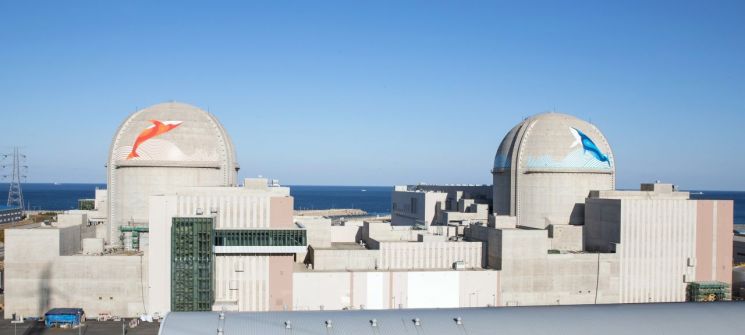
[Asia Economy Sejong=Reporter Lee Jun-hyung] The delegation of Westinghouse, a U.S. nuclear power company visiting Korea to discuss cooperation plans for nuclear power plant exports, canceled the originally scheduled signing of a joint declaration with Korea Electric Power Corporation (KEPCO), drawing attention to the background. It is analyzed that the competition for leadership between the representative companies of the two countries has intensified ahead of the "nuclear alliance" agreed upon by the South Korean and U.S. presidents.
According to related ministries on the 8th, the Westinghouse delegation visiting Korea decided to temporarily postpone the signing of the joint declaration on cooperation in overseas nuclear power plant markets, which was scheduled for 11 a.m. with KEPCO President Jeong Seung-il, and only held talks. A government official stated, "It is understood that Westinghouse was reluctant to sign, which led to the cancellation of the joint declaration schedule." Although the official reason is that further coordination of opinions between the two sides is needed regarding joint cooperation matters, the industry interprets this as Westinghouse's move to secure export leadership.
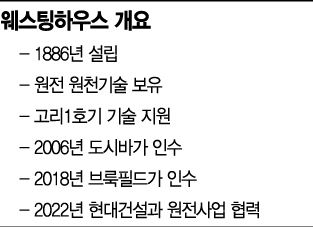
Founded in 1886, Westinghouse is a company with world-class technology, having provided core technology to more than half of the nuclear power plants worldwide. Its core business is the high value-added reactor design business. Korea's first commercial nuclear power plant, Kori Unit 1, was constructed by receiving technology transfer from Westinghouse. It is also a company competing with Korea in the Eastern European nuclear power plant market. Considering these points, the cooperation structure desired by Westinghouse is analyzed to be one where Westinghouse directly holds the leadership of the core business, while Korean companies support by handling construction and parts supply.
There is also an analysis that the intellectual property (IP) conflict between KEPCO and Westinghouse caused setbacks in signing the joint declaration. KEPCO and Westinghouse have not yet resolved the conflict that arose in 2017 over the IP of the Korean-type nuclear power plant (APR-1400). The South Korea-U.S. High-Level Bilateral Commission on Nuclear Energy (HLBC) has not functioned properly since 2018, partly due to the conflict between the two companies escalating into a diplomatic tension between the two countries.
The industry views that competition for leadership is inevitable in the process of cooperating with Westinghouse on nuclear power plant exports. Jeong Yong-hoon, a professor in the Department of Nuclear and Quantum Engineering at KAIST, said, "If Korea only participates as a subcontractor in projects led by the U.S., nuclear cooperation will have little significance," adding, "It is necessary to emphasize the cost competitiveness of the Korean-type nuclear power plant."
Meanwhile, the Westinghouse delegation visiting Korea for a one-night, two-day schedule included Patrick Fragman, President and CEO, Gavin Ryu, President of the Asia region, and Kim Jeong-eun, Head of the Korea branch. This is the first time in three years since 2019 that the Westinghouse CEO has visited Korea in person. The delegation plans to hold talks with the Ministry of Trade, Industry and Energy, which is the main government department for nuclear power, as well as KEPCO, Korea Hydro & Nuclear Power, and KEPCO KPS, among other electric power public enterprises.
© The Asia Business Daily(www.asiae.co.kr). All rights reserved.