Korean and Math Consist of Common + Elective Subjects... Calculated Using Standard Scores
Because Common Subjects Have a Higher Weighting Ratio Than Elective Subjects
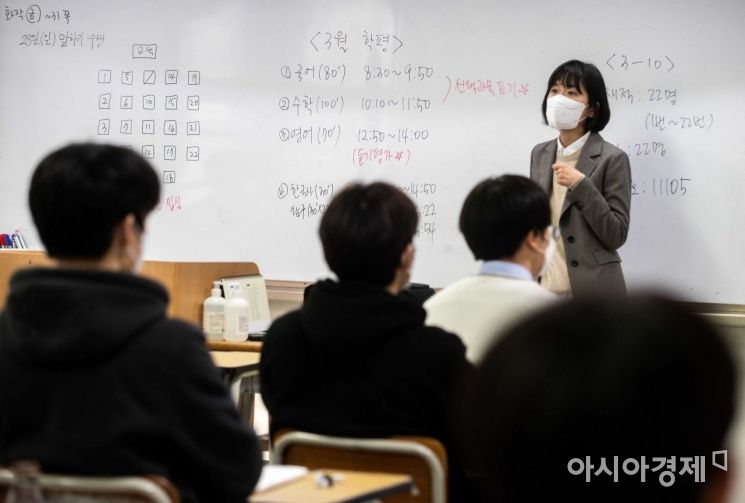 On the 25th, the day when third-year high school students take the National Joint Academic Achievement Test, students at Gyeongbok High School in Jongno-gu, Seoul, are listening to exam instructions. Photo by Jinhyung Kang aymsdream@
[Asia Economy Reporter Han Jinju] The Korea Institute for Curriculum and Evaluation has disclosed the scoring method for the Korean and Mathematics sections of the 2022 College Scholastic Ability Test (CSAT).
On the 2nd, the institute announced that it uploaded study methods, preparation guidelines, and a Q&A booklet for the 2022 CSAT on the official CSAT website and will distribute them to schools early this month.
Starting this year, the Korean and Mathematics sections have changed to a 'common subject + elective subject' structure, resulting in changes to the scoring method. For Korean, out of 45 questions, 34 are common subjects, and for the 11 elective questions, students must choose one from Speech and Writing, or Language and Media. For Mathematics, 22 out of 30 questions are common subjects, drawn from Mathematics I and II, and for the 8 elective questions, students select one from Probability and Statistics, Calculus, or Geometry.
In line with the 2015 revised curriculum's intent to eliminate the division between humanities and sciences, the CSAT no longer distinguishes between tracks. The foundational learning content is covered by common subjects, while other learning content is covered by elective subjects. When choosing elective subjects, students should consider the subjects required by the university departments or majors they wish to enter.

Korean and Mathematics scores are expressed as standard scores, which include grades and percentiles. This is because using raw scores could affect admission outcomes depending on which elective subject was chosen. The standard score indicates the position of an individual's raw score relative to others. Standard scores are calculated based on the common subject scores, a method also used in past CSATs. The standard score is derived by combining the weighted ratios of common and elective subjects. The standard scores for Korean and Mathematics range from 0 to 200 points.
The institute explained, "Even if two students have the same raw scores in both common and elective subjects, their final standard scores may differ if their elective subjects differ," adding, "This is because the composition of test-takers by elective subject (distribution of common subject scores) is reflected in the final standard score."
The institute also stated, "Even if the elective subjects are the same and the sum of raw scores is tied, the final standard scores can differ," noting, "Students with higher raw scores in the common subjects will have higher final standard scores because the weighting for common subjects is greater than that for elective subjects."
The institute emphasized that rather than focusing on advantages or disadvantages of elective subjects, it is important to choose subjects in which one can perform better.
The institute explained, "There are many factors influencing the final standard scores for each section, which are difficult to control, including which students take the test and the difficulty level of the questions."
© The Asia Business Daily(www.asiae.co.kr). All rights reserved.