Starmer Observes Second-Grade Class at Elementary School
Laughs Erupt as He Joins Student in Chanting "Six Seven"
Popular Gen Z Catchphrase Draws Reprimand from Teacher
UK Prime Minister Keir Starmer recently tried to mimic the popular youth catchphrase "6-7 (six seven)" and was humorously reprimanded by an elementary school principal, prompting laughter. On November 25 (local time), Yonhap News quoted the British daily The Guardian, reporting that "Prime Minister Starmer visited an elementary school in Peterborough, England, the previous day with Education Secretary Bridget Phillipson to observe a second-grade class."
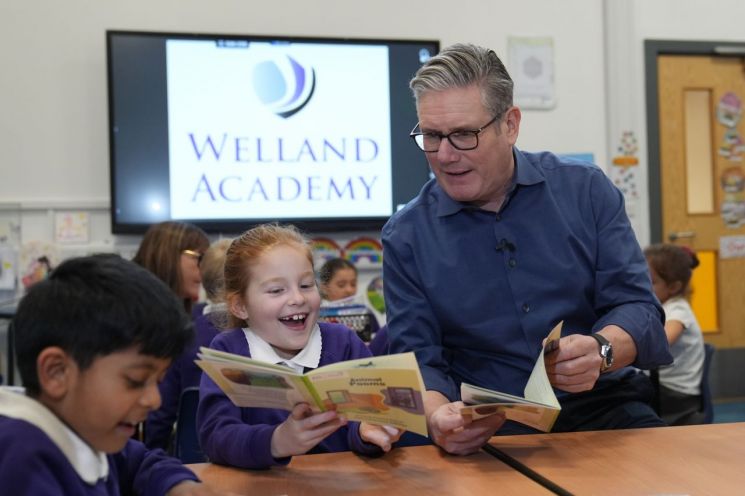 UK Prime Minister Keir Starmer is reading a book together with students during a classroom observation at an elementary school in Peterborough. Photo by AP Yonhap News
During the visit, Prime Minister Starmer sat with the students, looking through a book and chatting together. At one point, an elementary student said, "I'm on page 6, 7 now," referencing "six seven." Starmer immediately joined in, making the accompanying hand gesture, and this quickly spread throughout the classroom as other students also began chanting "six seven." Soon, everyone was laughing and performing the hand gesture together.
After leaving the classroom, Starmer joked, "That got a bit out of hand, didn't it?" Principal Jo Anderson then pointed out, "You know, at our school, children get told off for saying that." Looking a bit embarrassed, Starmer touched his forehead and replied, "Oh, really?" As he walked down the corridor, he added, "Sorry. I wasn't the one who started it, ma'am."
"Six seven" is a catchphrase that has become popular this year, especially among Gen Z in English-speaking countries. It involves repeatedly moving both hands up and down as if juggling while saying "six seven." There is no clear meaning behind the phrase or gesture. Earlier this year, the American online dictionary site Dictionary.com selected "six seven" as its word of the year, describing it as "a symbolic expression showing how the younger generation communicates and forms a sense of belonging through meaninglessness."
Meanwhile, Prime Minister Starmer is facing political difficulties due to historically low approval ratings. In an Ipsos poll conducted in September, Starmer's approval rating was 13%, the lowest among all prime ministers since Margaret Thatcher. The Labour Party's approval rating is also only around 20%. As a result, there are growing calls within the party for a change in leadership.
However, in an interview with the British media outlet Daily Mirror on November 17, Starmer responded "yes" to the question of whether he would lead the party in the next general election. He emphasized, "Any time not spent discussing and seeking solutions to issues affecting people's lives is wasted," and added, "I am fully focused on reducing the cost of living so that people can live better lives."
The New York Times commented, "For Prime Minister Starmer, who is facing a sharp drop in approval ratings and internal calls for leadership change due to economic and political issues, the lighthearted moment at the elementary school must have been a welcome break."
© The Asia Business Daily(www.asiae.co.kr). All rights reserved.

















