Korea Agro-Fisheries & Food Trade Corporation Report
Distribution Costs Rise by 4 Percentage Points Over the Past Decade
It has been found that 'distribution costs,' which refer to the amount left after subtracting what producers receive from consumer prices for domestic agricultural products, account for about half of the total price.
According to a report released on September 14 by the Korea Agro-Fisheries & Food Trade Corporation (aT), the distribution cost rate for agricultural products in 2023 was 49.2%, up 4.2 percentage points from 45.0% in 2013, ten years earlier. This means that if a consumer purchases 10,000 won worth of agricultural products, distribution companies take 4,920 won of that amount.
The increase in the distribution cost rate is even more pronounced compared to about 20 years ago. It has risen by more than 10 percentage points from 38.7% in 1999. However, the distribution cost rate in 2023 was 0.5 percentage points lower than the previous year. aT explained that this was because, due to abnormal weather conditions, poor harvests led to a greater increase in producer prices than in consumer prices.
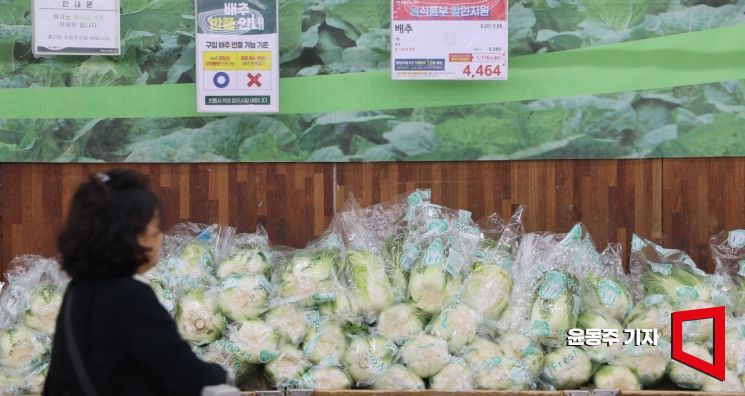
There was also significant variation in distribution costs by product category. For staple crops like rice, the rate was relatively low at 35.9%, but for seasoning vegetables such as onions and green onions, it reached 60.8%, and for leafy and root vegetables like napa cabbage and radish, it was as high as 64.3%. Among specific items, winter radish (78.1%), onion (72.4%), and sweet potato (70.4%) all exceeded 70%. For fruits, fruit vegetables, and livestock products, the rate was around 50%.
Jung Eunmi, head of the Distribution Innovation Research Division at the Korea Rural Economic Institute, explained, "For radish and napa cabbage, the distribution cost rate can reach 70%," and added, "The shorter the shelf life due to freshness requirements, the higher the distribution cost rate." She also pointed out that the actual share producers receive is much less than what is revealed by the distribution cost figures. Jung noted, "In Korea, products are auctioned by subdividing grades, so the proportion of products that cannot be shipped as goods is high," and added, "The share that producers take from the total consumer price is likely the lowest."
The rise in distribution costs has been influenced not only by increased labor costs but also by a rise in distribution profits themselves. Excluding direct and indirect costs, profit accounted for 14.6% of distribution costs in 2023, up 1.2 percentage points from ten years ago. The Bank of Korea also reported last year that "the cumulative increase in farm sale prices is lower than the increase in consumer prices, and the gap is widening," adding, "Compared to small-scale farms, wholesalers and retailers have much greater market dominance."
The government has begun efforts to improve the distribution structure. Ahead of the Chuseok holiday, President Lee Jaemyung instructed, "Food prices in Korea are high," and called for "accelerating reforms of the unreasonable distribution structure so that both consumers and producers can feel the difference." The Ministry of Agriculture, Food and Rural Affairs plans to shift the distribution structure for agricultural products from offline to online. At a recent Cabinet meeting, Minister Song Miryeong stated, "We will shift the distribution structure to focus on online wholesale markets and ease the qualification requirements for market participants."
© The Asia Business Daily(www.asiae.co.kr). All rights reserved.