Review of Achievements in AI Phase 1 and Discussion of Phase 2 Implementation Strategy
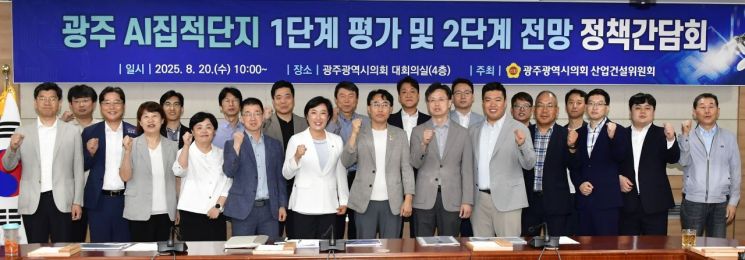 The Industry and Construction Committee of Gwangju City Council held a policy meeting titled "Gwangju AI Phase 1 Evaluation and Phase 2 Outlook" for the establishment of Gwangju as a national AI pilot city on the 20th at 10 a.m. in the main conference room. Provided by Gwangju City Council
The Industry and Construction Committee of Gwangju City Council, chaired by Park Pilsoon, held a policy meeting titled "Gwangju AI Phase 1 Evaluation and Phase 2 Prospects" for the establishment of Gwangju as a national AI pilot city at 10 a.m. on the 20th in the main conference room.
This meeting was organized to comprehensively review the achievements of Phase 1 of the AI project (establishment of the AI Integrated Complex) and to discuss the implementation plan for Phase 2 (creation of the AX Demonstration Valley). The meeting was attended by Chairperson Shin Sujeong, Industry and Construction Committee Chair Park Pilsoon, Special Budget and Accounts Committee Chair Cho Seokho, officials from the city's AI Industry Office, the AI Industry Convergence Project Group, representatives from local universities and research institutes, and business stakeholders.
On August 18, the government approved an exemption from the preliminary feasibility study for the "Gwangju AI Phase 2 (AX Demonstration Valley) Development Project" with a total budget of 600 billion KRW during a Cabinet meeting, providing a significant stepping stone for Gwangju to advance as a national AI pilot city.
The meeting was chaired by Park Pilsoon, Chair of the Industry and Construction Committee, and the head of the AI Industry Convergence Project Group presented the achievements of Gwangju AI Phase 1 and the plans for Phase 2. The subsequent discussion covered a range of topics, including the functions and achievements of the Phase 1 AI Data Center, directions for R&D and business model development, strategies for regulatory easing and government support related to personal data, implementation plans for citizen participation in AI Living Labs, and the necessity of strengthening collaboration among industry, academia, research, and government sectors.
Additionally, representatives from major institutions and companies-including the Gwangju Industry-Academia Convergence Institute, AI Industry-Academia-Research Association, Gwangju Technopark, Gwangju Research Institute, GIST, Korea Photonics Technology Institute, Korea Electronics Technology Institute, Korea Institute of Industrial Technology, NHN CLOUD, Miso Information Technology, Hangyeol Information Technology, Zendive, Soltilab, and Mahatech-attended the meeting to explore the future vision for Gwangju's AI industry together.
Park Pilsoon, Chair of the Industry and Construction Committee, emphasized, "For Gwangju to successfully advance as a national AI pilot city and ensure the success of Phase 2, it is crucial to conduct a thorough evaluation based on the achievements of Phase 1 and to establish an effective implementation strategy for Phase 2." He added, "The City Council will continue to provide support for building the AI ecosystem and securing government funding."
© The Asia Business Daily(www.asiae.co.kr). All rights reserved.

















