7th Plenary Session of the Minimum Wage Commission Held
Management: "It Must Be Applicable Across All Industries"
Labor: "Demand Level Is Half Compared to Previous Years"
As discussions to determine next year's minimum wage are underway, labor and management have expressed differing opinions, each insisting that the minimum wage level they proposed should be met. The difference between the minimum wage figures suggested by labor and management stands at 1,470 won, and the tug-of-war to narrow this gap has now entered a full-fledged phase.
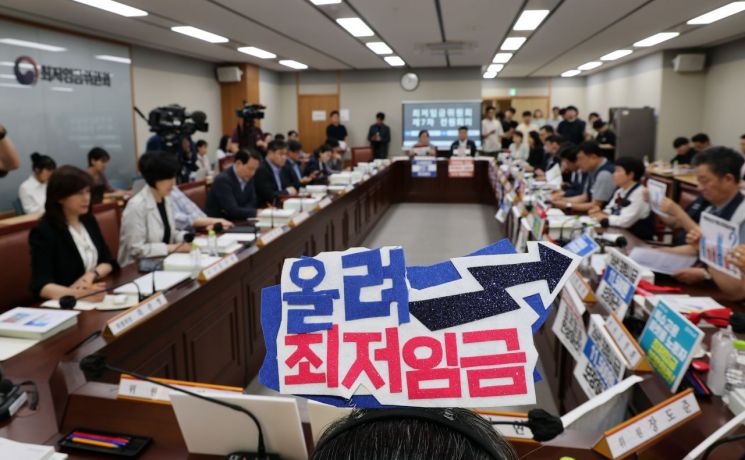 The scene of the 7th plenary meeting of the Minimum Wage Commission held at the Government Complex Sejong on the 26th. Photo by Yonhap News
The Minimum Wage Commission held its 7th plenary meeting at the Government Complex Sejong on the 26th. A total of 26 members attended the meeting, including 9 labor representatives, 9 management representatives, and 8 public interest representatives.
At the meeting, management and labor each insisted that next year's minimum wage should be set at 10,030 won (the same as this year) and 11,500 won, respectively, taking opposing stances.
Management argued that, since the discussion on differentiated minimum wages by industry was scrapped at the previous plenary meeting, a single minimum wage applicable to all industries should be set.
Ryu Kijeong, Executive Managing Director of the Korea Employers Federation, stated, "Since a single minimum wage must be set without industry-specific distinctions, next year's level should be determined based on the most difficult business sectors." He continued, "When considering the four legal criteria for wage determination?corporate payment capacity, cost of living, wage levels of similar workers, and income distribution ratio?it is difficult to raise next year's minimum wage above this year's level."
He also emphasized, "The payment capacity of small business owners and micro-enterprises is facing its limits." He added, "In terms of income distribution, key indicators such as the Gini coefficient, relative poverty rate, and income quintile ratio, which were used to assess the impact of the steep minimum wage hikes in 2018 and 2019, showed almost no improvement based on market income. Therefore, it is not appropriate to further increase the minimum wage, which could have significant negative ripple effects for the purpose of income distribution."
The labor side explained that their demand for next year's minimum wage, set at 11,500 won?a 14.7% increase from this year?reflects current economic conditions.
Ryu Giseop, Secretary-General of the Federation of Korean Trade Unions, said, "11,500 won is a very reasonable and rational level." He continued, "As shown in the cost of living report submitted as reference material for this year's minimum wage review, the living expenses required for households of minimum wage workers with multiple members are much higher than the current minimum wage level."
He also noted, "The initial demand from labor representatives is about half the level of previous years." He explained, "We actively considered and reflected the sharply contracted domestic market resulting from the harsh political climate last winter." He added, "We hope that this year's minimum wage decision will establish a level that reflects the intent and purpose of the Minimum Wage Act, which is to ensure the livelihood stability of low-wage workers, and the cost of living for workers."
© The Asia Business Daily(www.asiae.co.kr). All rights reserved.






![The Special Connection Between the Statue of Martyr Lee Jun in Jangchungdan Park and Mayor Oh Sehoon ③ [Current Affairs Show]](https://cwcontent.asiae.co.kr/asiaresize/319/2026012110001599450_1768957215.jpg)