Position Expressed Through Opinion Piece
Former Supreme Court Justice Kim Seonsu, a prominent progressive figure in the legal community, expressed concerns about the ruling party's push to increase the number of Supreme Court justices, stating that "this runs counter to the fundamental direction of judicial reform, which should focus on strengthening lower courts." He also pointed out that the introduction of the 'jaepanso-won' (appeal for retrial) system would "in effect create a four-tier court system."
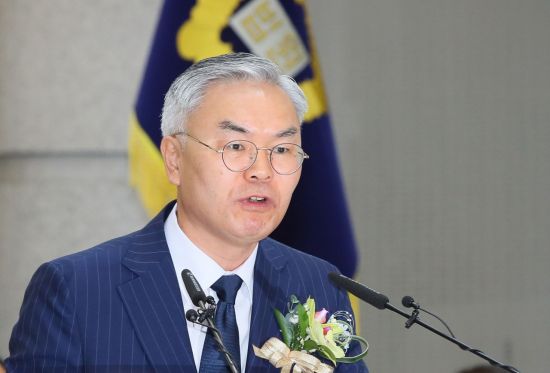 Former Supreme Court Justice Seonsu Kim. Yonhap News
On June 12, in a special contribution titled "Opinions on Judicial Reform Measures, Implementation System, and Timeline" published in the Law Times, former Justice Kim shared his views on judicial reform bills, including the increase in Supreme Court justices and the introduction of the jaepanso-won system.
He explained that attempts to increase the number of Supreme Court justices have been made several times, but concerns have been raised about the potential decline in the status of the highest court and the weakening of its policy-making function. Former Justice Kim stated, "The rate at which parties accept court rulings is proportional to the amount of time judges spend on each case. To increase the time judges can devote to each case, more judges are needed." He argued, "From this perspective, the urgent priority is to increase the number of lower court judges, especially those in the first instance."
He added, "When deciding whether to increase the number of Supreme Court justices, it is important to consider not only the scale but also how many justices should form each panel, whether the panels should operate as specialized divisions, and whether the Supreme Court should prioritize the unification of legal interpretation or the protection of rights, among other factors."
Based on these considerations, former Justice Kim suggested that options regarding the number of Supreme Court justices could include maintaining the current number, increasing by four to add one panel, or increasing by twelve to add three panels. He further explained that if one panel is added by increasing four justices, there would be no need to operate the panel as a specialized division, and it would still be possible to operate a full bench with seventeen justices.
He also opposed the proposal to expand eligibility for Supreme Court justices to non-lawyers. He stated, "Expanding eligibility to non-lawyers is not the only way to achieve diversity in the composition of the Supreme Court." He added, "In Japan, which is often cited as an example, the Supreme Court also serves as the Constitutional Court because Japan does not have a separate constitutional court, which is why it is possible to appoint non-lawyer justices there."
Regarding the proposed amendment to the Constitutional Court Act to introduce the jaepanso-won system, former Justice Kim stated, "Introducing the jaepanso-won system by amending only the Constitutional Court Act under the current Constitution would be unconstitutional," and argued that a constitutional amendment would be necessary. On the introduction of the jaepanso-won system, he expressed concern that "it is essentially the introduction of a four-tier court system," and said, "Giving more opportunities to the losing party means increased time and cost burdens for the winning party, and prolongs disputes, which leads to legal uncertainty and other negative effects."
Former Justice Kim ranked first in the 27th bar exam but chose to become a lawyer. He served as president of Lawyers for a Democratic Society. During the late President Roh Moo-hyun's administration, he served as secretary for judicial reform, leading practical judicial reform efforts for the Participatory Government. He later headed the planning and implementation team for the Judicial Reform Promotion Committee, following his work with the Judicial Reform Committee. Under former President Moon Jae-in, he was appointed as a Supreme Court justice upon the recommendation of former Chief Justice Kim Myeongsu, serving from August 2018 to 2024.
© The Asia Business Daily(www.asiae.co.kr). All rights reserved.