EU May Resume Suspended Tariffs
China Expected to Face Limited Impact from New Measures
Trump Plans to Impose Reciprocal Tariffs Around the 11th or 12th
U.S. President Donald Trump has once again pulled out the tariff card on steel and aluminum, which he weaponized during his first term. By announcing plans to impose ‘reciprocal tariffs’ on the 11th and 12th, signs are emerging that the tariff war is escalating globally. There are growing concerns that if other countries retaliate with counter-tariffs, the uncertainty surrounding each nation’s tariff policies could increase, potentially triggering a new trade war.
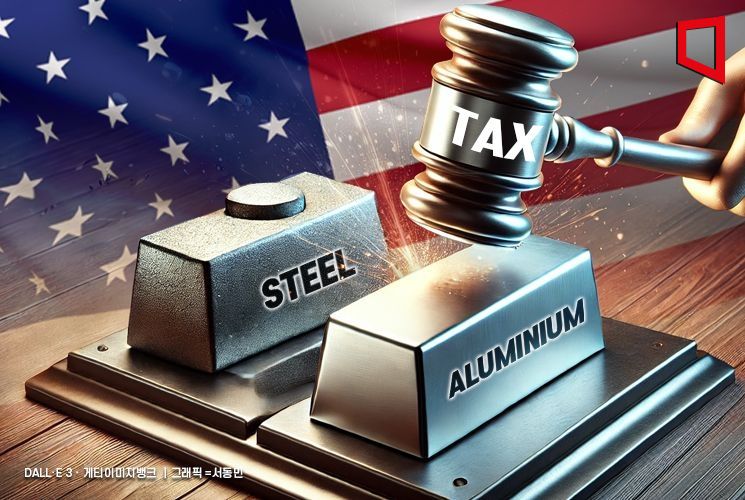
Trump Imposed Steel and Aluminum Tariffs During First Term... Three Years of Tensions with the EU
Foreign media including Bloomberg reported on the 9th (local time) that President Trump said, "On the 10th, a 25% tariff will be imposed on all steel and aluminum imported into the United States." President Trump revealed this plan to reporters aboard his private plane en route to New Orleans, where the NFL Super Bowl was being held. He stated, "Any steel entering the United States will be subject to a 25% tariff." When asked about aluminum, he replied, "Yes." The discussion about tariffs arose as President Trump responded to questions regarding Japan Steel’s acquisition of the U.S. steel company US Steel.
During his first term, President Trump imposed a 25% tariff on steel and a 10% tariff on aluminum, citing ‘national security threats.’ At that time, South Korea negotiated with the U.S. to be exempted from steel tariffs in exchange for accepting a quota system limiting export volumes. White House spokesperson Karoline Leavitt explained that the newly announced tariffs would be in addition to the existing tariffs on steel and aluminum.
This move is also interpreted as a card to further pressure the European Union (EU), which has remained unmoved despite President Trump’s tariff threats. Trump had previously pressured the EU with aluminum and steel tariffs during his first term. The EU did not accept these measures and retaliated with counter-tariffs. There is a possibility that Europe may resume retaliatory tariffs on U.S. goods, which had been suspended in response to the U.S. tariff measures. The EU had imposed 10% retaliatory tariffs on U.S. products such as Levi’s jeans, bourbon whiskey, and Harley-Davidson motorcycles but lifted them following a tariff agreement with the U.S. These tariffs were scheduled to be reimposed in January 2024 but have been postponed until March 2025. However, China is expected to be less affected by the new steel and aluminum tariffs. Although China is the world’s largest steel producer, the volume of Chinese steel imported by the U.S. is small. Chinese steel accounts for only 0.6% of U.S. steel demand.
‘Reciprocal Tariffs’ Imposed... Auto Tariffs Under Review?Is South Korea Also a Target?
President Trump also announced his intention to introduce reciprocal tariffs as another tariff weapon. He plans to announce the reciprocal tariffs on the 11th or 12th, and they will be applied almost immediately.
President Trump said, "If they impose a 130% tariff on us and we impose nothing, that situation (imposing nothing) will not continue." Reciprocal tariffs are one of President Trump’s pledges for ‘mutually beneficial and fair trade.’ The aim is to reform the tariff system to reduce the U.S. trade deficit and create jobs and wealth.
President Trump pledged to introduce the ‘Reciprocal Trade Act’ during his candidacy. The core idea is that the U.S. would impose the same tariff rates on imported goods from abroad as foreign countries impose on U.S. exports. The current average U.S. tariff rate is about 3%, which is very low compared to other countries. Along with tariff increases on the EU, President Trump has also announced plans to impose tariffs on industrial sectors such as semiconductors and steel.
He told reporters that he is particularly considering imposing tariffs on automobiles. After the U.S.-Japan summit with Japanese Prime Minister Ishiba Shigeru at the White House on the 7th (local time), President Trump said to reporters, "That is always a topic of discussion and a very big issue," emphasizing, "We have to make it (auto tariffs) equal."
With President Trump’s indiscriminate tariff attacks, the world has entered the early stages of a trade war. Since taking office for his second term on the 20th of last month, President Trump has been pushing aggressive tariff increase policies. On the 1st, he signed an executive order imposing a 25% tariff on all imports from Canada and Mexico, and an additional 10% tariff on all Chinese imports on top of existing tariffs, citing failure to stop illegal immigration and drugs entering the U.S. from Canada and Mexico. Although tariffs on Canada and Mexico were abruptly postponed for one month a day before enforcement, the tariff increase on China took effect from midnight on the 4th.
In response to the U.S. 10% general tariff increase on China, China also began imposing retaliatory tariffs on certain products starting at midnight on the 10th (local time). Although early negotiations between the two countries were anticipated, the second round of the ‘trade war’ began without concrete progress in discussions. Earlier, the Chinese government immediately announced countermeasures after President Trump imposed an additional 10% tariff on Chinese imports at midnight on the 4th (U.S. Eastern Time), citing China’s insufficient response to the fentanyl opioid issue. China plans to impose a 15% tariff on U.S. coal and liquefied natural gas (LNG), and a 10% tariff on crude oil, agricultural machinery, large vehicles, and pickup trucks.
© The Asia Business Daily(www.asiae.co.kr). All rights reserved.