Marine Bio Research Center Paper Published in International Journal
Supported by Wando County... Study on Gompih, Cheonggak, and Gamtae Seaweeds
It has been confirmed that extracts from seaweed inhabiting the waters of Wando in South Jeolla Province have effects in suppressing or alleviating inflammation caused by fine dust.
The Wando County government announced on the 5th that the results of the "Study on the Discovery of Seaweed-Derived Substances Reducing Fine Dust Toxicity," conducted by the Marine Bio Research Center of the Jeonnam Bioindustry Foundation, have been published in the international journal Medicina.
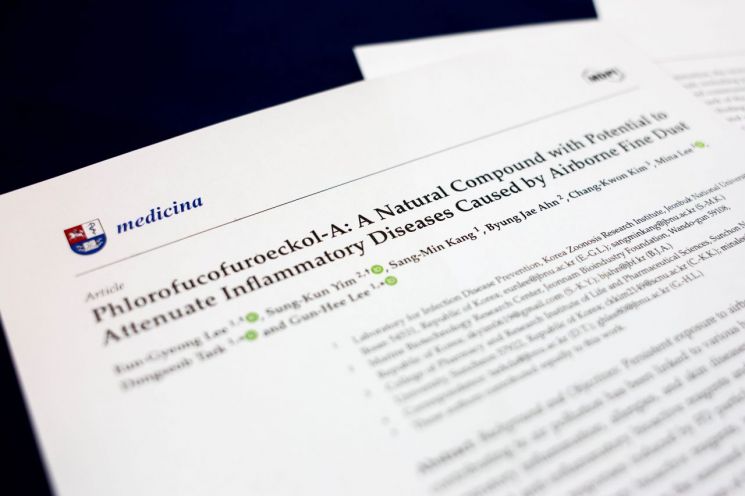 The results of the "Research on the Discovery of Substances to Reduce the Toxicity of Microdust Derived from Seaweed" conducted by the Marine Bio Research Center have been published in the international academic journal Medicina. Provided by Wando County
In this study, jointly conducted by the Marine Bio Research Center with support from Wando County and in collaboration with Chonbuk National University and Suncheon National University, it was confirmed that extracts from seaweeds such as Gompih, Cheonggak, and Gamtae have effects in suppressing or alleviating inflammation caused by fine dust.
The research team extracted and purified four substances: fucoxanthin from Gompih, siphonaxanthin from Cheonggak, dieckol and phlorofucofuroeckol-A from Gamtae. They then studied the effects of these substances on inflammatory responses induced by fine dust-like substances in RAW 264.7 cells (a cell line derived from mouse peritoneal macrophages).
As a result, all substances showed a decrease in the expression levels of inflammation-related substances. In particular, phlorofucofuroeckol-A from Gamtae was found to suppress the expression of genes related to inflammation and cell death. Notably, phlorofucofuroeckol-A from Gamtae not only inhibited the expression of IL-1β induced by fine dust-like substances but also reduced the expression levels of genes related to inflammation and cell death in cells.
Park Heeyeon, head of the center, explained, "Phlorofucofuroeckol-A could be a potential therapeutic material for inflammation induced by fine dust. However, further studies such as non-clinical research are needed for the development of therapeutics."
Shin Woochul, the county governor, stated, "This research result once again confirms the excellence of seaweed. Through continued research support, we will prove the value of seaweed and promote seaweed consumption, as well as contribute to the development of a seaweed-specialized marine bioindustry."
Meanwhile, Wando County, the largest seaweed production area in Korea, recently visited the National Aeronautics and Space Administration (NASA) in the United States to promote the excellence of seaweed and discuss blue carbon certification and research, which recognizes seaweed as a carbon sink in the marine ecosystem.
© The Asia Business Daily(www.asiae.co.kr). All rights reserved.



![The Special Connection Between the Statue of Martyr Lee Jun in Jangchungdan Park and Mayor Oh Sehoon ③ [Current Affairs Show]](https://cwcontent.asiae.co.kr/asiaresize/319/2026012110001599450_1768957215.jpg)