Announcement of the 1st Basic Plan for Supply Chain Stabilization
Reducing Dependence on Specific Countries by Over 20%
Tax Incentives Under Review for Overseas Development
Introduction of the 'Supply Chain Stabilization Support Program'
The government has decided to reduce dependence on specific countries for economic security items in the supply chain to below 50% by 2030 to stabilize the supply chain. To this end, it plans to provide more than 55 trillion won in fiscal and financial support from next year until 2027. The government will promote public-private joint investments of around 50 billion won annually to activate overseas mineral investments led by the private sector. It is also considering strengthening tax incentives to support overseas resource development related to key minerals needed for advanced industries.
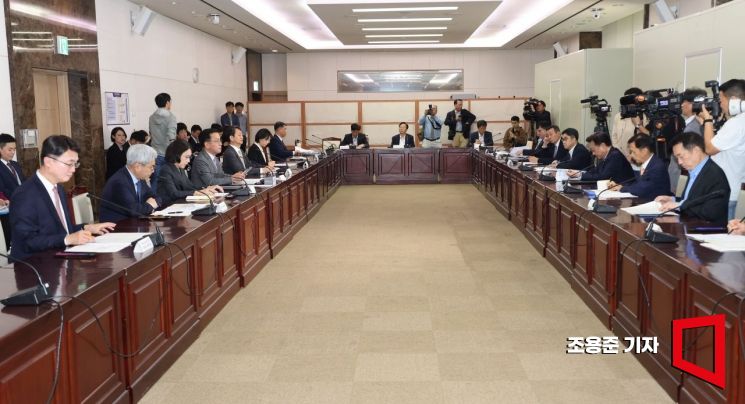 The scene of the 2nd Supply Chain Stabilization Committee held last October at the Government Seoul Office Building
On the 19th, the government held the 3rd Supply Chain Stabilization Committee jointly with the Ministry of Economy and Finance, the Ministry of Trade, Industry and Energy, and other related ministries, and announced the '1st Basic Plan for Supply Chain Stabilization (draft)'. The government aims to implement the basic plan from next year until 2027 to reduce the dependence on specific countries for economic security items to 50% or less by 2030. It also set an interim goal to reduce dependence from 70% last year to around 60% by 2027.
The government will promote 10 major policy tasks centered on four key policy directions: ▲stabilizing supply and demand of economic security items ▲strengthening supply chain resilience ▲advancing the economic security foundation ▲establishing a position within the global supply chain. More than 55 trillion won in fiscal and financial support, including research and development (R&D) support through the Supply Chain Stabilization Fund, will be included by 2027. Lee Hyung-ryeol, Director of Economic Supply Chain Planning at the Ministry of Economy and Finance, said, "We have boldly included policies that we have not attempted before for various reasons."
Overseas Resource Development Led by the Private Sector, Supported by the Public Sector
The government will systematize detailed indicators for item designation to stabilize the supply and demand of economic security items. It will conduct regular inspections by grade in line with the renewal of about 300 economic security items. Also, it will prepare operational guidelines for the supply chain Early Warning System (EWS) to unify the EWS operated by each ministry. To analyze supply chain shocks in advance and support companies, a 'K-Supply Chain Support Platform' linked to the supply chain EWS will also be established.
In strengthening supply chain resilience, the first step is to advance public stockpiling. Stockpiling is a key measure for immediate response in supply chain crises. The government will establish criteria for selecting and releasing public stockpiled items and build an integrated management system. It will also establish stockpiling standards by sector. Incentive systems to expand private stockpiling will be prepared. If the private sector builds stockpiling facilities or increases quantities, necessary financial and fiscal support will be provided.
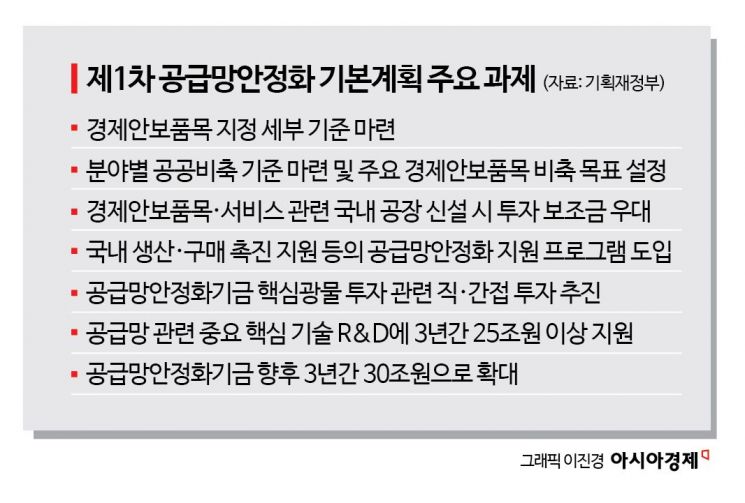
Next, the domestic production base will be expanded. At the investment stage, support for foreign investment and local investment subsidies will be expanded when new or expanded domestic factories related to economic security items and services are established. At the production stage, a 'Supply Chain Stabilization Support Program' will be introduced to stabilize supply and demand of high-risk economic security items. When small and medium-sized enterprises engaged in supply chain stabilization projects expand production facilities during the creation of the domestic supply chain ecosystem, preferential guarantees from the Korea Credit Guarantee Fund and Korea Technology Finance Corporation will be supported.
The final task is to build overseas supply chains such as diversifying import sources. For economic security items with high dependence on specific countries and potential domestic supply instability, support will be provided for import price differences or transportation costs. Items related to economic security items and services will be added to the corporate tax credit targets when acquiring shares of foreign corporations or business transfers occur. A 'Core Minerals Investment Council' will be established jointly by the public and private sectors to provide package support for necessary funds such as loans, investments, and guarantees.
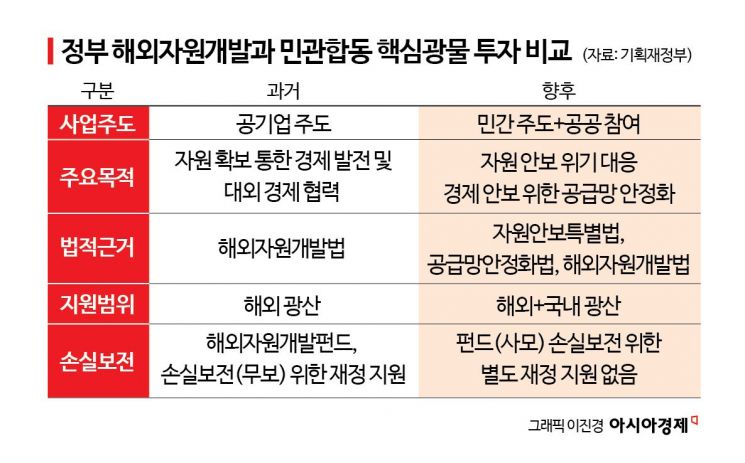
In this process, the government will promote public-private joint investments with about 50 billion won from the Supply Chain Stabilization Fund. It plans to promote medium- to long-term investments of about 50 billion won annually by identifying yearly demand. Supply Chain Stabilization Fund and private direct investments will share some risks through export credit insurance to encourage active investments. Direct investment plans by the Korea Mining and Resources Corporation related to key minerals will also be prepared. Strengthening tax incentives related to overseas resource development of key minerals needed for advanced industries such as semiconductors is also under consideration.
Bae Byung-gwan, Supply Chain Policy Officer at the Ministry of Economy and Finance, said, "Currently, domestic companies receive a 3% tax credit on investment amounts when investing overseas in minerals, but going forward, additional support measures will be sought for key minerals in important industries." He explained, "In the past, public enterprises led overseas resource development, but from now on, the private sector will lead and the public sector will participate and support."
20 Billion Won Scale SME Supply Chain Preferential Guarantee Also Available
To advance the economic security foundation, the government will strengthen supply chain infrastructure such as logistics and cybersecurity. Regarding maritime infrastructure, it plans to share information with the private sector on alternative routes and risks during navigation in case of blockade of specific routes. To diversify the air network, if domestic airlines invest in overseas cargo terminals, supply chain funds will support them. A public-private consultative body will also be operated to strengthen the security of submarine communication cable systems.
To strengthen and protect core technological competitiveness, more than 25 trillion won will be supported over three years until 2027 for R&D of core technologies with strategic value. It will expand the scope of supply chain stabilization-related technologies within the preferential R&D investment tax credit targets, including new growth and original technologies and national strategic technologies. Also, it will promote commercialization by supporting funding based on intellectual property (IP) of small and medium-sized enterprises and establish preferential treatment for companies related to economic security items.
To establish a position within the global supply chain, the government plans to upgrade the one-sided dependence relationship with resource-rich countries into a bilateral cooperative relationship. It will identify items such as technologies and materials, parts, and equipment (SoBuJang) for which the counterpart country has high dependence on Korea and prepare cooperation plans to build a mutually complementary partnership. It will also strengthen the linkage between foreign policy and official development assistance (ODA) policies and strategically utilize ODA in the supply chain stabilization process.
The scale of support from the Supply Chain Stabilization Fund will be expanded to 30 trillion won over the next three years. In diversifying support methods, the Export-Import Bank will establish a dedicated organization for direct supply chain investments, strengthen screening capabilities, and discover indirect investment products such as securing overseas key minerals. A 1 trillion won scale supply chain specialized private equity fund will be formed in the first half of next year, and support will continue to discover indirect investment products by major industries.
A 'Supply Chain Preferential Guarantee Program' linking fund loans and guarantees for small and medium-sized enterprises and mid-sized companies will be newly established to expand corporate credit and reduce financial costs. The guarantee scale will be up to 200 billion won next year and is planned to be expanded after 2026.
The director said, "We will form a working group and a private cooperation network for the linked implementation of the three supply chain laws (Supply Chain Stabilization Act, SoBuJang Special Act, Resource Security Special Act) centered on the Supply Chain Stabilization Committee," adding, "We will invest 55 trillion won plus alpha in fiscal and financial resources by 2027 through linkage between the Supply Chain Stabilization Fund (30 trillion won) focused on loans and investments and the SoBuJang Competitiveness Enhancement Special Account focused on contributions and subsidies."
© The Asia Business Daily(www.asiae.co.kr). All rights reserved.



















