Exercise Invented by Track Athlete Imitating Monkey Movements
Established as Subculture Among Russian Youth
Controversy Over Dressing as Animals and Acting Like Them
Among Russian teenagers, the so-called 'Quadrobing,' which involves acting like four-legged animals, is becoming popular, and the State Duma (lower house) has stepped forward to prepare legislation to regulate it. On the 15th (local time), Russian media such as TASS reported that Denis Maydanov, the first deputy chairman of the State Duma's Culture Committee, announced plans to draft a law to control Quadrobing. Chairman Maydanov stated, "At first, it seemed like a game, but when children start to accept it as a way of life, it is no longer just a game."
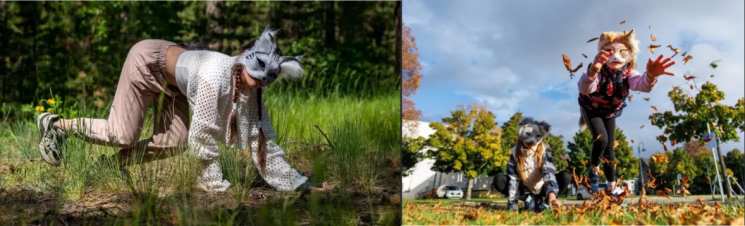 Amid the trend of so-called 'Quadrobing,' where Russian teenagers behave like four-legged animals, the State Duma has announced plans to draft legislation to regulate it.
 [Photo by X (formerly Twitter)]
Currently popular in Russia and Uzbekistan, Quadrobing refers to activities that imitate the movements of animals such as foxes, wolves, dogs, cats, and lions by crawling or running on all fours. Some teenagers wear animal masks, fake tails, and fake ears as accessories while roaming the streets. Among Russian teenagers, Quadrobing has mainly established itself as a kind of 'subculture.'
Meanwhile, on the 8th, Russian Foreign Minister Sergey Lavrov caused a stir by asking Armenian officials visiting Russia, "Do you have Quadrobers (people who practice Quadrobing) in Armenia?" Andrey Kotchenov, chairman of the Russian mass movement group 'Fathers of Russia,' criticized the phenomenon, saying that there are cases where children acting like cats are led around on leashes by their grandmothers or mothers, calling it "completely unnatural" and "close to madness."
"Negative Impact on Youth Mental Health" vs. "Exercise That Can Develop Body and Brain"
Originally, Quadrobing was a form of exercise created by Japanese track athlete Kenichi Ito, who imitated the movements of animals like monkeys. However, recently, teenagers called Quadrobers have gone beyond exercise to dress up as animals and behave like real animals, sparking controversy. In particular, a recent incident in Uzbekistan where a teenager dressed as a dog bit a passerby has made concerns a reality. As a result, Uzbekistan has warned that fines will be imposed due to concerns that it could negatively affect children's mental health and physical safety.
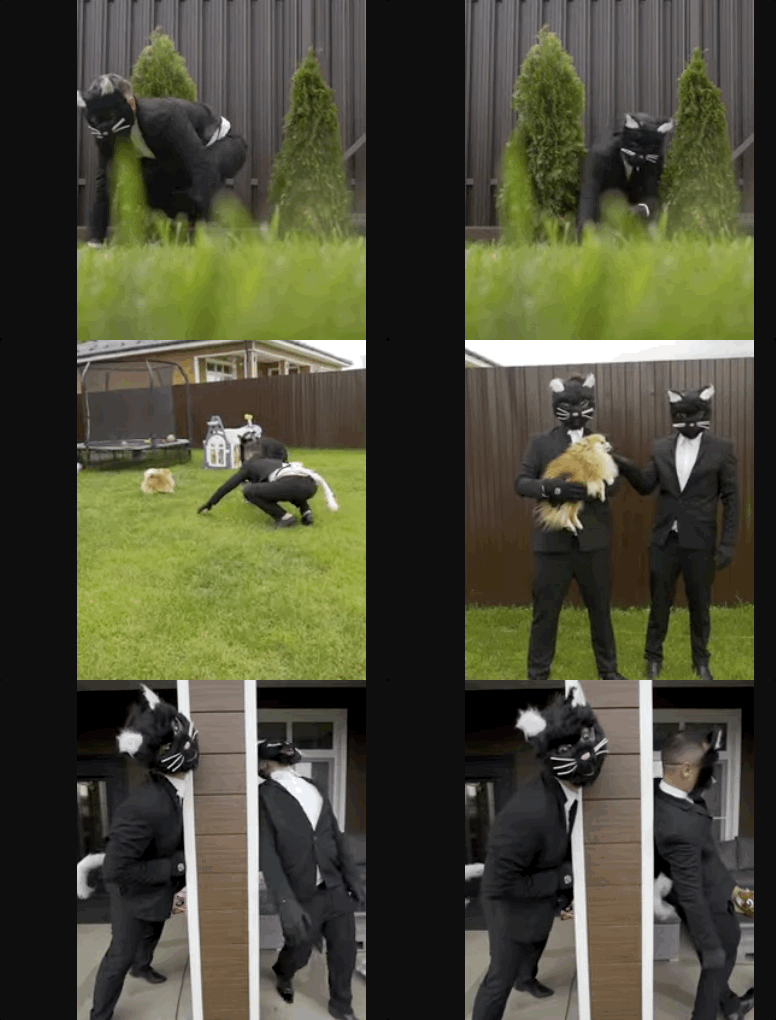
Especially as hypotheses have emerged that mature children imitating aggressive animals may experience identity confusion and social isolation, Quadrobing has sparked social controversy. Some have claimed that this culture originated within communities related to sexual minorities (LGBT). Russia, which values traditional family values, strictly prohibits LGBT, considering it extremist.
On the other hand, there are also advocates who argue that Quadrobing is just a hobby and can provide exercise benefits through increased physical activity compared to usual. Russian psychologist Larisa Okulik told RIA Novosti that Quadrobing can develop children's bodies and brains but cautioned, "It is important to note that acting like an animal and believing oneself to be an animal are different things."
© The Asia Business Daily(www.asiae.co.kr). All rights reserved.


















