Amid the failure of the ruling and opposition party leaders to reach an agreement on key contentious bills during their meeting on the 1st, there are expectations that conflicts between the two sides over these bills will continue in the regular September National Assembly session. Tensions could escalate immediately as the Democratic Party has announced plans to reintroduce the Special Prosecutor Act, including a proposal for a third-party special prosecutor recommendation, concerning the Chae Sang-byeong Special Prosecutor Act.
According to political circles on the 2nd, the ruling and opposition parties agreed on eight items, including the formation of a 'Common Pledge Consultation Body,' through their leaders' meeting. The two party leaders met for three hours, exceeding the scheduled one hour and 30 minutes. However, they failed to reach an agreement on pressing livelihood issues such as the Financial Investment Income Tax (Geumtu Tax) and measures to respond to the medical crisis. Negotiations on the 250,000 won support fund law and the Chae Sang-byeong Special Prosecutor Act, which the Democratic Party had requested, fell through, and discussions on deepfake crime response, AI and semiconductor support laws, and low birthrate countermeasures ended at the level of consultation and review, which drew criticism.
The Democratic Party plans to actively cooperate with the ruling party on non-contentious issues first. Lee Jae-myung, leader of the Democratic Party, said at the Supreme Council meeting held at the National Assembly that day, "There was considerable progress in dialogue and mutual understanding on parts that were not disclosed during the meeting," adding, "I hope this will be a good opportunity for frank and honest conversations, cooperating where cooperation is needed and competing where competition is necessary." This implies a willingness to quickly consult with the ruling party to ease burdens on self-employed individuals and household debt.
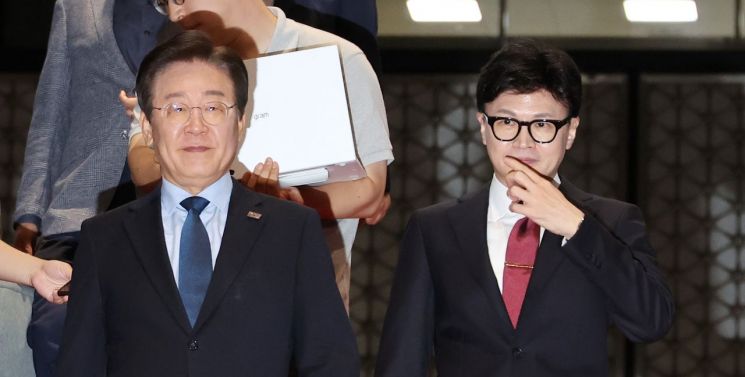
Within the People Power Party, although there are aspects where Lee Jae-myung gained strategic advantages, such as highlighting the Chae Sang-byeong Special Prosecutor Act and legislative conflicts, the meeting is seen as fortunate for opening the way to handle livelihood bills. A ruling party lawmaker said, "Although Lee framed malicious narratives such as pro-Japanese and Dokdo erasure last week and martial law," he added, "Since there was an agreement to form a livelihood consultation body, I hope it leads to tangible results such as bill passage and economic revitalization."
The problem is that tensions remain high over unresolved major contentious bills. The Democratic Party has announced plans to hold a re-vote at the National Assembly plenary session on the 26th on six bills, including the nationwide 250,000 won support fund law, the four broadcasting laws, and the Yellow Envelope Act, all of which President Yoon Seok-yeol exercised his veto power against. If the re-vote proceeds, conflicts between the People Power Party, which will try to block it, and the Democratic Party, which will push for it, are bound to resurface.
The Democratic Party is also likely to pressure the government and ruling party, focusing on the medical crisis. The medical crisis issue shows a difference in perception between the government and ruling party, which could be used as a card to exploit divisions within the ruling camp.
The People Power Party actively refuted criticisms that the leaders' meeting was fruitless and reaffirmed their commitment to restoring livelihoods. At the Supreme Council meeting that day, a party leader said, "We place significance on the fact that we reached a consensus to restore politics and focus on livelihoods." Although there are differences in priorities across various contentious areas, the meeting formed a broad consensus on livelihood issues.
© The Asia Business Daily(www.asiae.co.kr). All rights reserved.

















