Korea Institute of Geoscience and Mineral Resources Successfully Measures and Analyzes the Most Powerful Gamma-Ray Burst in Human Observation History
Proving South Korea's Scientific Excellence in Deep Space Exploration
A research paper on the observation results of a gamma-ray burst by the Gamma-Ray Spectrometer (KPLO Gamma-Ray Spectrometer: KGRS) onboard Korea's first lunar probe, Danuri, has been published. This is regarded as a milestone proving the excellence of our science and technology in the field of deep space exploration, as it is the most powerful gamma-ray burst ever observed in human history.
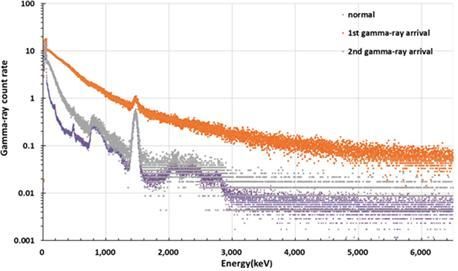 Comparison of gamma-ray spectra measured during gamma-ray bursts. Data provided by Korea Institute of Geoscience and Mineral Resources
The Korea Institute of Geoscience and Mineral Resources (Director Lee Pyeong-gu, KIGAM) announced on the 20th that the research team led by Dr. Kim Kyung-ja at the Space Resource Development Center published a research paper titled "The GRB221009A gamma-ray burst as revealed by the gamma-ray spectrometer onboard the KPLO (Danuri)" in the August 17 issue of Scientific Reports (IF=4.6). The paper analyzes the gamma-ray burst observed by the KGRS gamma-ray spectrometer onboard the lunar orbiter (KPLO).
Gamma-ray bursts are among the most powerful and mysterious phenomena in the universe, providing deeper understanding of the origin and evolution of the cosmos. In particular, gamma-ray bursts play a crucial role in studying the composition and evolutionary processes of matter in the early universe and offer valuable information about the formation and properties of black holes, making them highly significant for research.
This research paper analyzes the results of measuring the strongest gamma-ray burst of this century (GRB20221009A), which occurred on October 9, 2022. The photon energy, estimated to have been continuously emitted for 10 hours, reached up to 18 TeV (teraelectronvolts), marking the first observation of energy exceeding 10 TeV. Depending on the energy range, the gamma rays increased by up to 49 times.
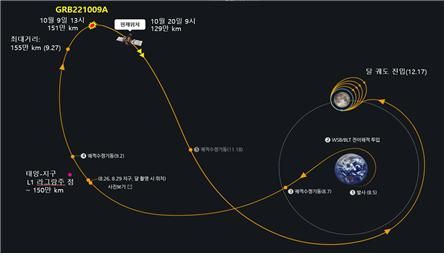 The location of KPLO when KGRS measured the gamma-ray signal of GRB221009A. Photo by Korea Institute of Geoscience and Mineral Resources
The research team began collecting gamma-ray data on August 9, 2022, the fourth day after the launch of Danuri. The KGRS spectrometer detected the gamma-ray burst twice at 1:21 PM and 1:25 PM on October 9, 2022, at a distance of approximately 1.51 million km from Earth. The burst's origin is estimated to be in the constellation Sagittarius, about 2.4 billion light-years away, and the gamma-ray burst duration was 7 minutes. These results are similar to those measured by NASA's Fermi Gamma-ray Space Telescope in Earth orbit. Despite the intense gamma-ray exposure, the KGRS spectrometer was confirmed to have sustained no damage. The data used in this study will be publicly available on the Danuri data release site after December 7.
The gamma-ray spectrometer collects gamma-ray data every 10 seconds, measuring gamma-ray bursts and gamma-ray background observable in deep space. Currently, it aims to create a "Lunar Space Radiation Environment Map" and a "Lunar Surface Element Map" of more than five elements on the lunar surface, including water, oxygen, and helium-3, through gamma-ray observations in lunar orbit.
Dr. Kim Kyung-ja, the center director, stated, "This research result marks the first case where a gamma-ray spectrometer for planetary geology exploration contributed to astronomical observations," adding, "We will focus more on research to enhance Korea's space resource exploration competitiveness by advancing space exploration and space resource development technology capabilities and securing resources."
Dr. Kim Kyung-ja has been dedicated to advancing Korea's lunar exploration research technology through continuous technological development and domestic and international research cooperation in the previously unexplored field of planetary remote sensing research. She has also been appointed as a member of the National Space Committee.
© The Asia Business Daily(www.asiae.co.kr). All rights reserved.


















