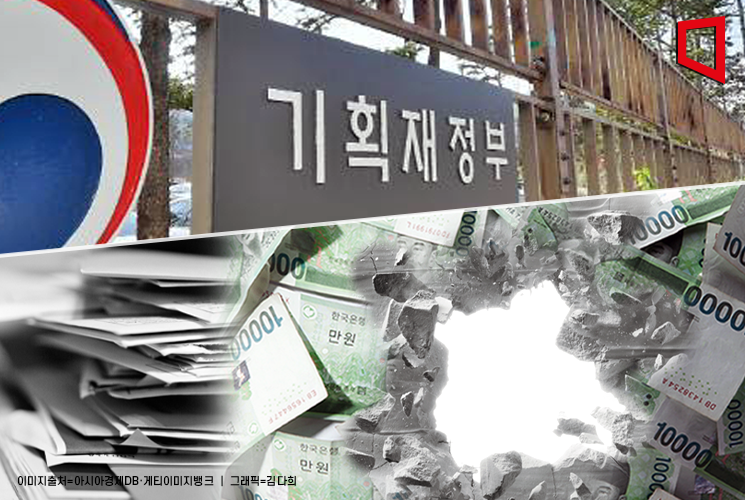
The government’s total amount borrowed from the Bank of Korea to cover budget shortfalls in the first half of this year has been tallied at 91.6 trillion won. This is the largest amount recorded since related statistics began.
According to the "Details of Temporary Loans and Interest Amounts to the Government" data submitted by the Bank of Korea to Representative Yang Bu-nam (Democratic Party) of the National Assembly’s Public Administration and Security Committee on the 7th, the cumulative loan amount borrowed by the government from the Bank of Korea over the six months of the first half of this year (as of the end of June) was 91.6 trillion won. This is the largest scale in 14 years since the Bank of Korea started compiling these statistics in 2011. Of this, 71.7 trillion won has been repaid, and the outstanding balance yet to be repaid is 19.9 trillion won.
The cumulative loan amount borrowed by the government from the Bank of Korea in the first half of this year far exceeded the 73.3 trillion won in the first half of 2020, when fiscal spending was large due to the spread of COVID-19. It is also more than the 87.2 trillion won in the first half of last year, when a large-scale tax revenue shortfall became a reality.
The total interest amount paid by the government to the Bank of Korea due to the large-scale loans was 129.1 billion won (63.8 billion won in the first quarter, 65.3 billion won in the second quarter), marking the highest interest accrued to date.
The Bank of Korea’s temporary loan system to the government is a means used to cover temporary funding shortages arising from timing differences between revenue and expenditure during the fiscal year.
A representative from Representative Yang Bu-nam’s office stated, "The fact that the government frequently uses what is called the ‘Bank of Korea overdraft account’ means that tax revenue (income) collected is insufficient compared to spending (expenditure), causing frequent temporary financial adjustments. If the government relies on easy temporary borrowing from the Bank of Korea, which is not disclosed in real time, instead of issuing fiscal bonds to cover the shortfall, it may be difficult for the National Assembly and the public to transparently understand the fiscal situation."
Representative Yang Bu-nam pointed out, "The government unilaterally reduced local allocation tax last year due to an unprecedented tax revenue shortfall," adding, "With future decreases in local allocation tax and the easing or abolition of comprehensive real estate tax, local finances could suffer even more, so fiscal measures should be prepared accordingly."
© The Asia Business Daily(www.asiae.co.kr). All rights reserved.

















