NIS "Caution Needed When Traveling to Regions Where Cannabis Is Legal"
Be Careful with Cannabis Labeling and More
Among food and beverages legally distributed overseas, those containing cannabis ingredients are illegal for Koreans to consume, so special caution is required.
Cannabis Soju, Displayed with Korean-style Design Alongside Regular Beverages, Warning Against Misidentification
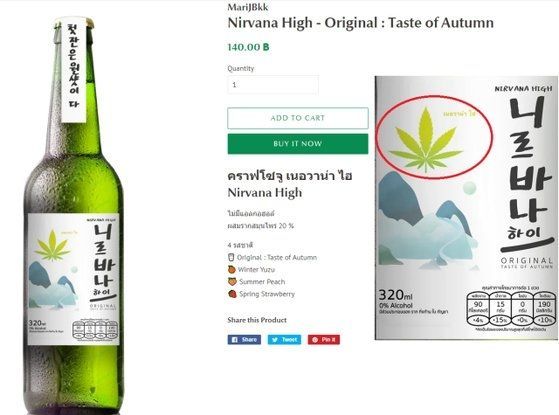 Non-alcoholic soju containing hemp ingredients sold in Thailand. It features a Korean-style design with a Hangul label, which can easily be mistaken for regular soju if not examined closely. [Image source=National Intelligence Service]
On the 4th, the National Intelligence Service (NIS) warned that Koreans traveling in regions where cannabis is legalized or countries where cannabis-containing products are prevalent may unknowingly become involved in drug crimes. In areas where cannabis is legal, such as Thailand, Canada, and some U.S. states, cannabis-infused cookies and beverages are easily available at restaurants and convenience stores. For example, in Thailand, 'non-alcoholic cannabis soju' made to resemble Korean soju design is displayed and sold alongside regular beverages, but the phrase 'contains cannabis ingredients' is only written in Thai, which may lead Koreans to mistake it for regular soju. Additionally, this cannabis beverage is displayed together with regular drinks popular among children, making it more likely to be perceived as a regular beverage, so extra caution is necessary.
The NIS advised that since the indication of cannabis content is often written only in the local language, when purchasing unfamiliar local food and beverage products, one should check for the distinctive seven- or nine-pointed leaf design symbolizing cannabis and English words such as 'cannabis', 'marijuana', or 'weed'.
Beware of Cannabis Leaf-wrapped Samgyeopsal, Drug Candies, and Hallucinogenic Mushrooms
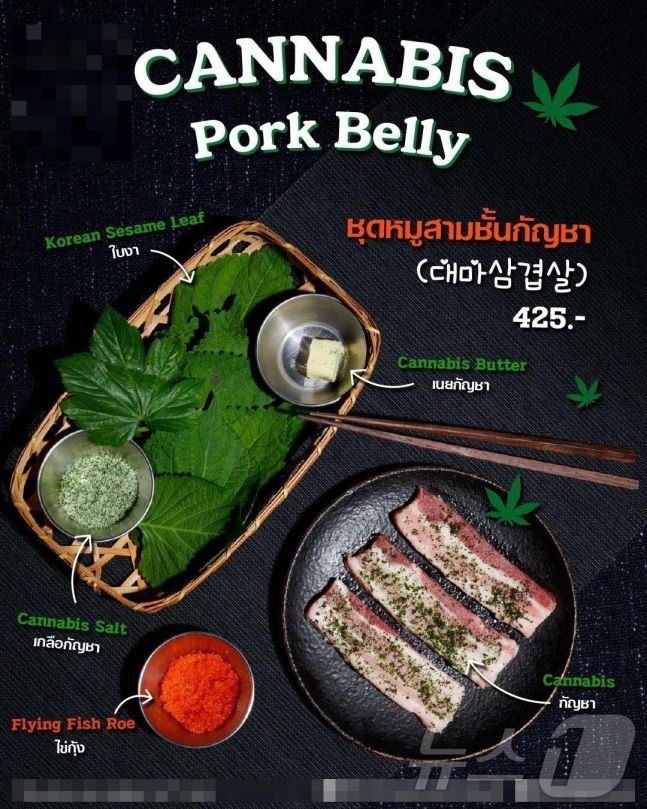 An advertisement for hemp pork belly featuring a table setting made with hemp leaves and other cannabis ingredients in Thailand.
 [Image source=National Intelligence Service]
Along with the Korean Wave, Korean food culture has spread widely, and samgyeopsal can be found in overseas restaurants. The problem is that some places serve 'cannabis samgyeopsal' where cannabis leaves are used as wraps or cannabis-infused salt is served, so caution is also necessary.
Additionally, in some Southeast Asian countries, various illegal hallucinogenic substances such as 'drug candies' are distributed in clubs and entertainment venues frequented by tourists. In Canada, hallucinogenic mushrooms, classified as narcotics in Korea, are sold in many places.
Cases of Secondary Crime Attempts After Drug Consumption or Administration... Emphasizing Caution Not to Consume Drug-containing Food and Beverages While Traveling Abroad
There is also a risk of 'setup crimes' targeting overseas travelers using drugs, so caution is needed. Cases include attempts at secondary crimes such as kidnapping or confinement after administering or causing consumption of drugs, or extortion of money under the pretext of reporting to investigative authorities. The NIS stated, "Earlier this year, there was a case in Thailand where a person experienced pain after eating jelly received as a gift and tested positive for drugs at the hospital," emphasizing the need to always be cautious not to consume drug-containing food and beverages while traveling abroad.
© The Asia Business Daily(www.asiae.co.kr). All rights reserved.


















