Korea Railroad Corporation (hereinafter Korail) and KAIST have established and will operate a contract department to train specialized railway personnel.
On the 3rd, Korail announced that it held a signing ceremony the day before with KAIST to establish the "Korail-KAIST Railway Standard Mobility Department." The newly established department will be operated as a master's program within the Cho Cheon-sik Graduate School of Mobility at KAIST. The curriculum (majors) is divided into four areas: ▲ Railway Vehicles ▲ Railway Facilities ▲ Railway Electrical Engineering ▲ Railway Management.
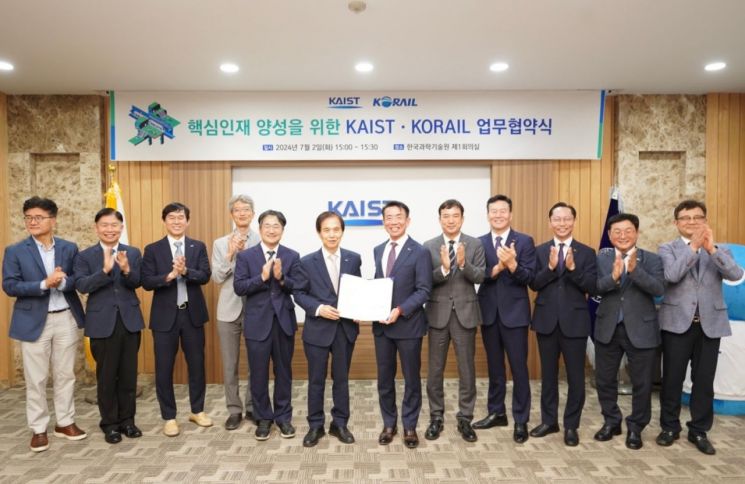 Han Moon-hee, President of Korail (sixth from the right), is taking a commemorative photo with Lee Kwang-hyung, President of KAIST (seventh from the right), after signing an agreement to establish the Department of Railway Standard Mobility at the KAIST Daejeon Headquarters on the 2nd. Photo by Korea Railroad Corporation
The Cho Cheon-sik Graduate School of Mobility, where the Railway Standard Mobility Department was established, was founded in 2010 with a donation of 15 billion KRW from the late Chairman Cho Cheon-sik (former Deputy Director of the Banking Supervision Authority). This graduate school focuses on developing new mobility means and services by integrating mechanical engineering and transportation engineering.
Before establishing the Railway Standard Mobility Department at KAIST, Korail designed railway-tailored courses based on a preliminary survey of employees to foster field-oriented specialized personnel. The main subjects include ▲ Railway System Interface ▲ Transportation System Artificial Intelligence ▲ Energy Power Engineering.
The Railway Standard Mobility Department will operate from March next year until 2029. Korail plans to dispatch 20 employees annually during this period, training a total of 100 specialized railway personnel. Tuition fees will be fully supported by Korail.
Additionally, by holding research project performance report meetings and providing follow-up management programs, Korail plans to support trained employees in practically applying research outcomes in the field.
Han Moon-hee, President of Korail, said, “I hope the Railway Standard Mobility Department will become a new cradle for training future railway specialists,” and added, “Korail will continue to strive to expand cooperative relationships with KAIST in various fields such as research and development and new business discovery.”
© The Asia Business Daily(www.asiae.co.kr). All rights reserved.

















