Presidential Office Refutes Each Statement by Medical School Professors Association
Increase of 2,000 Medical School Quotas Still Necessary
Official Letter Resent to Universities on Possible Increase Scale... Deadline April 4
On the 25th, the Presidential Office actively refuted the statement by the National Council of Medical School Professors claiming that "the government did not discuss with essential medical practitioners before announcing the increase in medical school admissions," stating that it is "not true." In particular, it criticized the doctors engaged in collective action, saying, "In no country in the world have doctors taken extreme actions such as submitting collective resignation letters or medical students collectively taking leave of absence as leverage over patient lives regarding the increase in medical school quotas."
After President Yoon Suk-yeol's inauguration, the Presidential Office listed in detail over 130 consultations with the medical community and government, 28 rounds of negotiations, and the timing of the announcement of essential medical reinforcement measures, interpreting this as a stance not to give any justification or initiative to the doctors' collective actions.
Kim Soo-kyung, spokesperson for the Presidential Office, held a briefing at the Yongsan Presidential Office in the afternoon and stated, "The claim by the National Council of Medical School Professors that 'the government never asked essential medical practitioners what they needed before announcing the increase in medical school quotas' and 'has not presented any solutions recently for pediatrics' is not true."
She added, "Furthermore, the claim that the government suddenly announced an increase of 2,000 medical school admissions without any efforts to address low medical fees, inadequate medical delivery systems, medical accidents, and legal protection systems?which are causes of the collapse of essential and regional medical care?is also not true."
Direct Response to National Council of Medical School Professors' Statement by Mentioning President Yoon's Medical Activities and Policy Announcement Timing
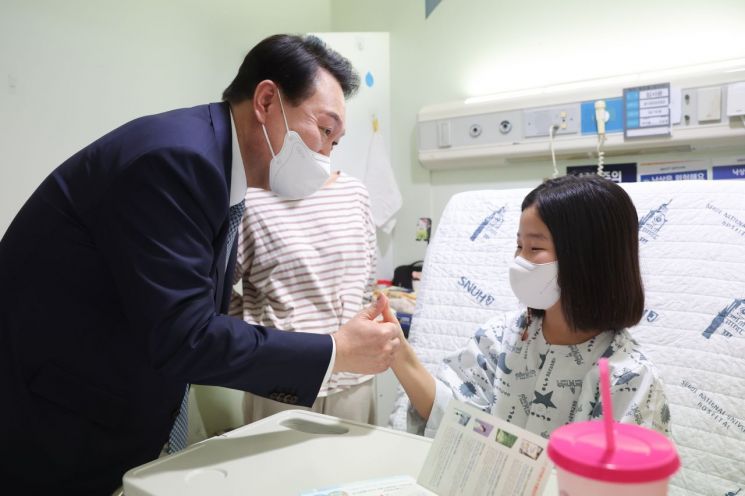 President Yoon Suk-yeol visited the Pediatric Surgery Ward at Seoul National University Children's Hospital in Jongno-gu, Seoul, on February 22 last year, encouraging hospitalized children and their guardians.
 [Image source=Yonhap News]
The Presidential Office also enumerated specific examples of President Yoon's visits to medical sites and presiding over public meetings related to medical policies after his inauguration, including Seoul National University Children's Hospital, Chungbuk National University Hospital, and Bundang Seoul National University Hospital. Contrary to the doctors' claims, it emphasized that strengthening essential and regional medical care has been a core area of government interest and that related policies have been continuously announced, aiming to undermine the credibility of the doctors' claims.
Earlier, in February last year, President Yoon visited Seoul National University Children's Hospital, held a meeting with medical staff, patients, and guardians, and instructed the government to establish a 24-hour pediatric care system to improve pediatric medical care. In October last year, he visited Chungbuk National University Hospital and presided over an essential medical innovation strategy meeting to foster essential medical institutions in national university hospitals, gathering opinions from hospital directors, university presidents, and representatives from the medical and educational sectors. This month, he presided over a public discussion on medical reform at Bundang Seoul National University Hospital, listened to opinions from doctors in essential medical fields, firefighters, families of medical accident patients, and civic groups, and announced a four-policy package for medical reform.
The four-policy package includes plans for over 10 trillion won in essential medical compensation to strengthen regional medical care, such as mitigating judicial risks related to medical accidents and improving the medical delivery system, which were emphasized by the National Council of Medical School Professors. Additionally, the Presidential Office stated that investments such as the 900 billion won health insurance fund investment approved in November last year for strengthening essential medical care and the 310 billion won pediatric medical investment decision are being implemented.
Spokesperson Kim pointed out, "President Yoon has shown more interest in the medical field than any previous president, listening to doctors, patients, guardians, and experts, and emphasizing measures to strengthen regional and essential medical care. When the government announced pediatric medical measures, the Korean Pediatric Society also expressed its welcome, and the Medical Association issued a statement agreeing with the direction of the essential medical innovation strategy and essential medical package."
Undermining the Justification for Doctors' Collective Action... Presidential Office Highlights "Over 130 Consultations and 28 Negotiations"
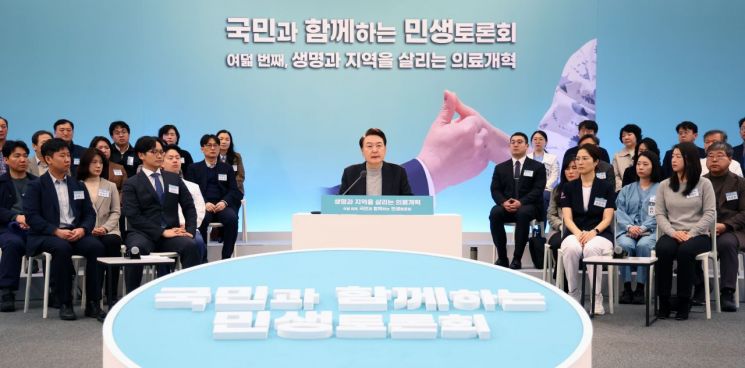
Spokesperson Kim also emphasized that the government has conducted over 130 consultations with various sectors including the medical community and formed a separate consultative body with the Medical Association to hold 28 negotiations regarding regional and essential medical policies and the expansion of medical personnel.
Regarding this, an official from the Presidential Office criticized, "Even when we repeatedly asked the doctors to specify the appropriate scale they wanted, there was no significant response. They continued to respond very defensively and passively, but when the government announced an estimate of 2,000, they reacted extremely." He added, "In this situation, the government kept the door open for dialogue, but now saying that if it is not withdrawn, they will not engage in dialogue?that is somewhat difficult."
The office firmly denied the doctors' associations' claims that the collective action is the government's responsibility. Spokesperson Kim raised his voice, saying, "The government holds the greatest responsibility for the resignation of residents and the leave of absence of medical students, and such incidents have never occurred in any other country. According to our understanding, nowhere in the world have doctors taken extreme actions such as submitting collective resignation letters or medical students collectively taking leave of absence as leverage over patient lives regarding the increase in medical school quotas."
Regarding the National Council of Medical School Professors' self-appointment as a mediator between the government and doctors, the official said, "The government is willing to engage in dialogue. However, setting conditions that make dialogue impossible and saying that dialogue will only proceed if those conditions are met is practically refusing to engage in dialogue," adding that such demands are difficult to accept. The demand by doctors to reduce or withdraw the increase in medical school admissions as a condition for dialogue is essentially a refusal to engage in dialogue.
Presidential Office Reaffirms Position to Maintain Medical School Admission Increase at 2,000
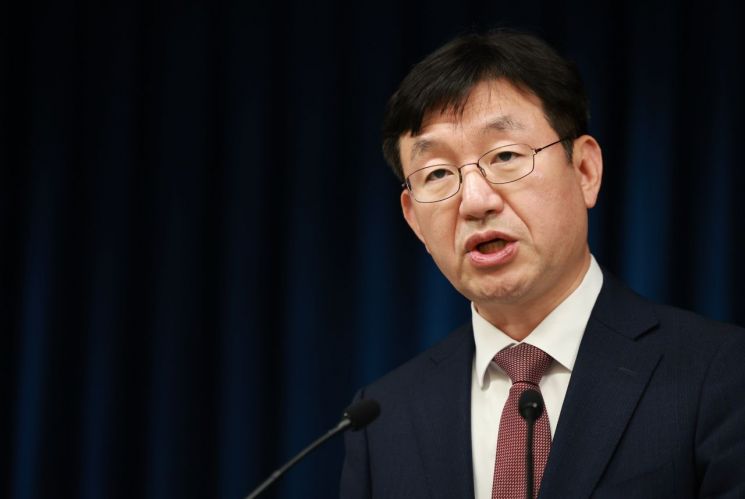
The Presidential Office maintains that the increase in medical school admissions cannot be reduced from 2,000. Considering the future shortage of doctors, various studies, and the educational capacity of medical schools, 2,000 is considered the minimum. Sung Tae-yoon, Director of Policy at the Presidential Office, said at a separate briefing held at the Yongsan Presidential Office in the afternoon, when asked by a reporter if there is a possibility of adjusting the scale downward through coordination with the doctors, "The increase of 2,000 medical students is based on various estimates and analyses. The basic required number of doctors to be added is around 3,000, but considering various conditions, the government thinks about 2,000."
The government recently sent official letters to 40 universities with medical schools requesting responses by the 4th of next month and plans to re-aggregate the acceptable increase scale by each university, Sung said. When the government recently inquired about the possible increase scale from each university, it is known that the universities responded with a minimum of 2,100 and a maximum of 3,500.
Sung explained, "Currently, about 17 medical schools in Korea are small-scale with fewer than 50 students. Therefore, for the smooth operation of these medical schools, some increase in numbers is necessary." He added, "This decision reflects the fact that for about 30 years, the number of medical students has not increased at all, and the cumulative decrease in the number of doctors has reached about 7,000."
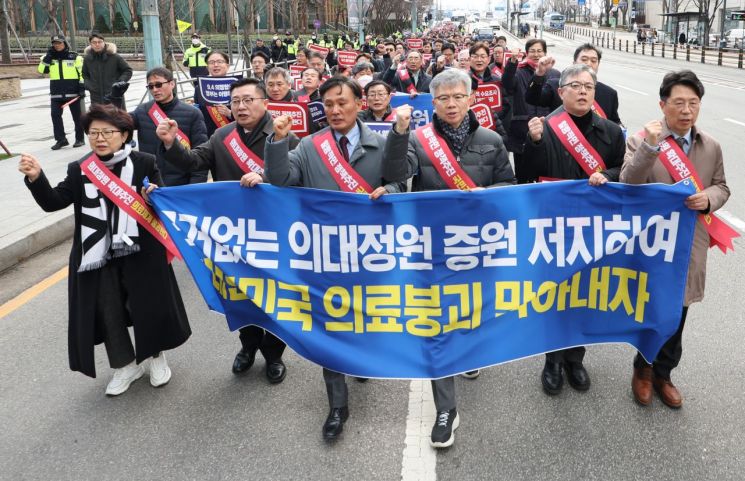 On the afternoon of the 25th, participants at the "National Doctors' Representatives Expanded Meeting and March Event" held at the Korea Medical Association in Yongsan-gu, Seoul, marched toward the Presidential Office, shouting slogans opposing the increase in medical school quotas. [Image source=Yonhap News]
© The Asia Business Daily(www.asiae.co.kr). All rights reserved.



















