Special Speech at Davos Forum
First Mention of Growth Rate by China's Top Leadership
Emphasizes Improvement of Foreign Investment Environment
Chinese Premier Li Qiang attended the World Economic Forum Annual Meeting (WEF·Davos Forum) held in Davos, Switzerland, and announced that China’s economic growth rate last year was 5.2%. He further expressed China’s firm commitment to openness and pledged to improve the investment environment for foreign companies.
According to China’s state-run Xinhua News Agency on the 17th, Premier Li delivered a special speech at the Davos Forum the previous day, stating, “China’s economy is generally recovering and improving,” and “last year’s gross domestic product (GDP) growth rate is expected to be 5.2%, higher than the initial target of about 5% set at the beginning of the year.” This is the first time China’s top leadership has directly mentioned last year’s growth rate, and the official figure is scheduled to be released by the National Bureau of Statistics on the same day (17th).
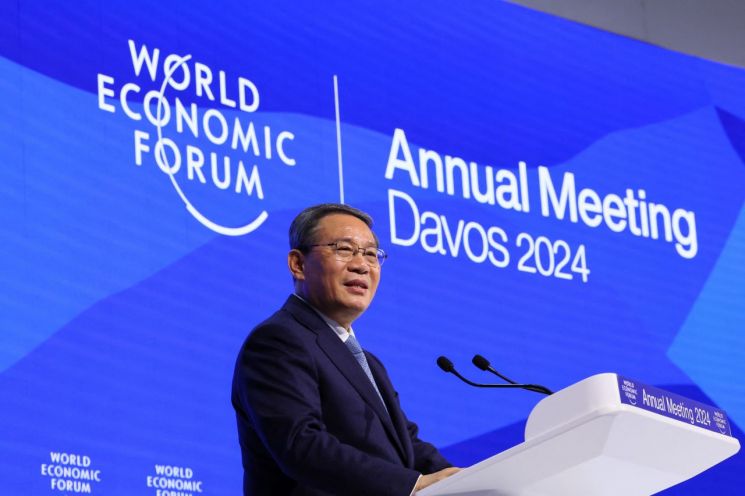
Premier Li said, “In promoting economic development, we did not use strong stimulus measures nor accumulate long-term risks at the expense of short-term growth; instead, we focused on strengthening endogenous development momentum,” adding, “Even if China’s economy experiences some setbacks, the overall long-term positive trend will not change.” He stated, “China’s ‘demographic dividend’ is improving into a ‘talent dividend,’” and argued, “In a situation where global aggregate demand is still insufficient, the Chinese market will inevitably play an important role.”
Li then reiterated China’s commitment to opening up and emphasized the necessity of investment. He said, “Over the past five years, China’s return on foreign direct investment has been about 9%, which is relatively high internationally,” and added, “Choosing the Chinese market is not a risk but an opportunity.” He also expressed, “We sincerely welcome companies from around the world to continue investing in China and will strive to create a market-oriented, lawful, and international business environment.”
He emphasized, “We will steadily expand institutional openness, continuously reduce the negative list for foreign investment, fully lift restrictions on foreign investment in the manufacturing sector, and guarantee national treatment for foreign-invested enterprises,” adding, “We will regularly listen to the opinions of foreign-invested enterprises and actively pursue solutions to reasonable demands.” He further stated, “No matter how the global situation changes, China will adhere to the fundamental national policy of opening up, and the door to openness will become increasingly wider.”
Regarding the United States, which has been strengthening sanctions against China, Li raised indirect cautionary remarks. He pointed out, “From 2020 to 2022, more than 5,400 discriminatory trade and investment measures emerged worldwide each year,” and said, “Industrial chains and supply chains are the vascular system of economic development, and interference and damage become obstacles to economic circulation, reducing development efficiency and causing various economic risks and social problems.” He stressed, “We must promote trade and investment liberalization, strengthen cooperative ties to enlarge the pie of benefits,” and “continuously improve the stability of global supply chains to meet the common interests of all parties.”
However, Premier Li did not mention armed conflicts and disputes such as the Ukraine war and the Gaza Strip war during his speech.
Meanwhile, Bloomberg News cited statistics from a survey of economists forecasting that China’s GDP growth rate will slow to 4.5% this year. Bloomberg diagnosed, “Recent data show continuous declines in consumer prices, slowing import growth, and deceleration in lending speed,” and “all of this suggests that weak domestic demand will be the biggest challenge for the national economy this year.”
© The Asia Business Daily(www.asiae.co.kr). All rights reserved.

















