2022 Housing Supply Rate 102.1%
Seoul at 93.7%... Down 0.5%P from Previous Year
This Year's Move-in Volume Down 9%
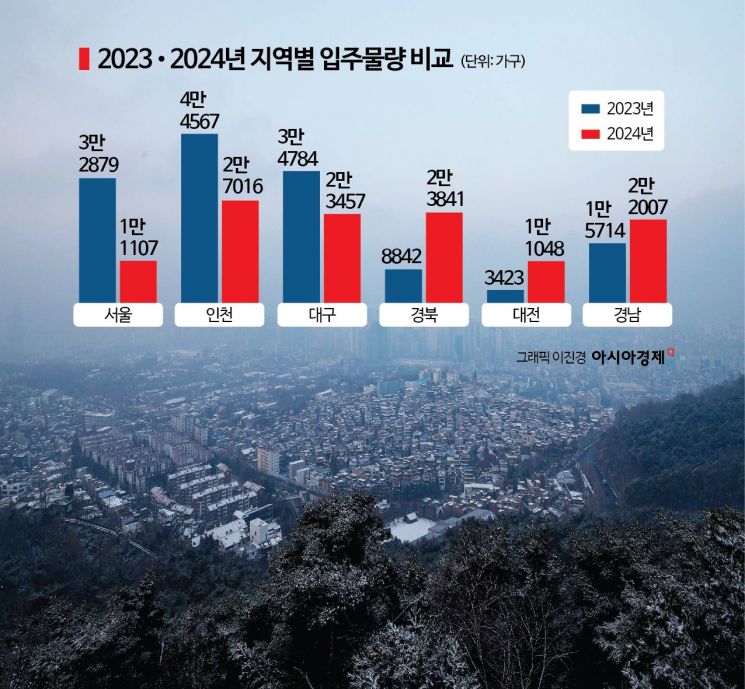
Seoul Only 11,107 Households
Seoul Average Price per Pyeong Nears 34.95 Million KRW

The housing supply rate in Seoul has been found to have decreased compared to the previous year. With the expected number of move-ins this year also projected to decline from last year, concerns over the shortage of housing supply have intensified. In particular, as the prices of newly built apartments continue to rise, it is anticipated that the path to homeownership for those without homes will become even more challenging.
Seoul Housing Supply Rate at 93.7%, Declines from Previous Year
According to the Ministry of Land, Infrastructure and Transport on the 16th, the nationwide housing supply rate in 2022 was recorded at 102.1%, a decrease of 0.1 percentage points from the previous year. Seoul, which ranks lowest nationwide, had a housing supply rate of 93.7%, down 0.5 percentage points from the previous year.
The concentration in the metropolitan area and the extinction of local regions have combined to create a clear gap in housing supply rates between the metropolitan area and other regions. The metropolitan area’s housing supply rate was 96.6%, showing a 0.9 percentage point difference from the provinces (107.5%). Daegu, which has the highest number of unsold units nationwide, saw its housing supply rate rise by 0.7 percentage points to 101.4% from 100.7% the previous year. The housing supply rate is calculated by dividing the number of houses by the number of general households, indicating whether there is a shortage of housing stock. Compared to countries like the United States or Japan, where the rate exceeds 110%, South Korea’s housing supply rate is relatively low.
With the expected number of move-ins this year also projected to decrease compared to last year, the housing supply rate indicator for Seoul is likely to worsen further. According to Real Estate R114, the number of move-ins in Seoul this year is expected to be around 11,107 households, a decrease of 21,771 households. Since most of Seoul’s supply comes from reconstruction and redevelopment, considering the move-in volume for association members, the actual number of units available for sale is expected to decrease even more.
The expected number of apartment move-ins nationwide this year is 331,729 households, a 9% (34,224 households) decrease from the previous year. In particular, the number of move-ins in the metropolitan area is expected to drop significantly. The metropolitan area’s move-ins are projected at 150,271 households, more than 40,000 fewer than the previous year’s 192,000 households.
Market Slowdown Following the 2022 Crash
The worsening supply shortage is analyzed to be a result of the recent decline in real estate prices. From the second half of 2022, real estate prices plummeted simultaneously. With the base interest rate rising to the 3% range, the nationwide housing sales market reversed into a downward trend. Last year, real estate prices showed a slight increase.
According to the Korea Real Estate Board, nationwide apartment prices fell by 17.2% in 2022 but rose by 5.7% last year. Compared to the decline in 2022, the increase was only about half. However, the outlook for the real estate market this year is somewhat bleak. Since the end of last year, sales prices have turned downward, lending credibility to forecasts of a prolonged market slump.
Choi Sang-yang, a research fellow at the Housing Finance Research Institute, stated, "Seoul’s housing prices, which rose last year, have reached a high level again, and considering the current monetary policy stance, the number of households that can afford this is estimated to be small." He added, "With the continuation of high interest rates and high inflation, overall housing demand is expected to shrink. Demand for new housing will be limited due to high sale prices, and demand for existing housing will be constrained by the re-elevated prices."
Greater Difficulties for Non-Homeowners to Purchase Homes
Additionally, the soaring prices of newly built apartments are another factor causing hesitation among non-homeowners to enter the market. According to the Housing and Urban Guarantee Corporation, as of December last year, the sale price of private apartments in Seoul was 34.95 million KRW per 3.3㎡, up 2.36% from the previous month. Nationwide private apartment sale prices have doubled over the past 10 years.
The liquidity crisis potentially deepening due to construction companies’ project financing (PF) failures is also one of the factors hindering non-homeowners from purchasing homes. Recently, Taeyoung Construction completed negotiations with creditors and entered workout proceedings. However, the industry is closely monitoring the possibility of a second Taeyoung Construction emerging.
Moreover, due to the real estate market slowdown, there is also a possibility that supply policies such as the 3rd New Town development could be stalled. The current government’s plan to supply 2.7 million households is based on permits, so it is criticized as insufficient to stabilize the market in the short term.
Doosung Kyu, head of the Mokmin Economic Policy Research Institute, explained, "Given the high market volatility so far, combined with supply shortages in the metropolitan area, rising sale prices, market contraction, and PF risks, all indicators are moving in a bleak direction." He added, "With U.S. interest rates entering a decline phase and the number of move-ins decreasing, there is also a risk that prices will rise, leading to an even more unstable market situation."
© The Asia Business Daily(www.asiae.co.kr). All rights reserved.


















