Monthly Rent Surpasses Jeonse for 20 Consecutive Months
Average Jeonse Deposit Rises by 28.5 Million Won This Year
Despite the continued avoidance of Jeonse due to the increase in Jeonse fraud and the high-interest rate trend, Jeonse deposits have actually risen.
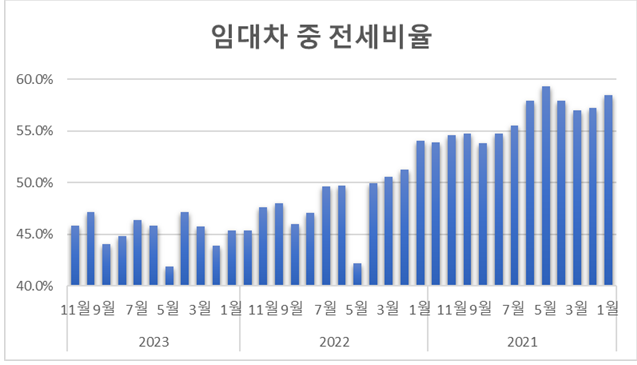
On the 11th, Real House, a specialized company in sales evaluation, analyzed the confirmed dates from the Court Registry Information Plaza and found that the total number of lease contracts with confirmed dates up to November this year was 2,328,492, of which monthly rent accounted for 54.8% (1,276,996 contracts). As of the 8th, this monthly rent surpassing Jeonse phenomenon has continued for 20 months.
The dominance of Jeonse began to collapse starting from April last year. Since the data collection began in 2010, the Jeonse ratio, which once reached a high of 71%, has been below 50% continuously since April last year. In particular, in Jeju-do, 4 out of 5 lease contracts this year were monthly rent transactions, and in Chungnam and Gyeongnam, monthly rent transactions accounted for more than 60% of housing leases.
Although Jeonse transactions decreased, deposits increased. In November, the average Jeonse deposit nationwide was 267.75 million KRW, up 28.5 million KRW from January. This appears to be because tenants flocked to relatively less risky apartments, prompting landlords to raise deposits.
In fact, the number of complexes setting new Jeonse price records is increasing. In Gaepo-dong, Gangnam-gu, the 84㎡ unit of 'Gaepo Xi Residence' was traded for 1.54 billion KRW on the 15th of last month, rising about 500 million KRW compared to the Jeonse price in January. The 84㎡ unit of 'Raemian One Bailey' in Banpo-dong also set a new record by signing a Jeonse contract for 2 billion KRW in October.
Looking at the regions, Seoul has had a preference for monthly rent for 22 months, but Jeonse prices have increased the most. In November, the average Jeonse deposit in Seoul was 371.43 million KRW, up 46.83 million KRW compared to the beginning of the year (January). On the other hand, Incheon, where the Jeonse ratio is higher than monthly rent, saw an increase of 4.4 million KRW, about one-tenth of Seoul’s level, and Gyeonggi-do saw an increase of 22.5 million KRW.
Jeonse prices in the central region also rose significantly. Daejeon increased by 41.92 million KRW this year, Sejong by 24.8 million KRW, and Chungbuk by 17.73 million KRW.
The only place where Jeonse prices fell was Jeju. With a monthly rent ratio reaching 77.5% due to short-term living, Jeju’s Jeonse price dropped by 42.29 million KRW this year, resulting in an average of 155.85 million KRW in November.
Elsewhere, Ulsan and Gangwon saw an average increase of 20.39 million KRW, Jeonbuk 18.03 million KRW, Gwangju 17.93 million KRW, Gyeongnam 13.17 million KRW, Jeonnam 13 million KRW, Busan 12.57 million KRW, Chungnam 9.27 million KRW, Gyeongbuk 7.24 million KRW, and Daegu 4.16 million KRW.
© The Asia Business Daily(www.asiae.co.kr). All rights reserved.

















