Seoul City Announces 'Seoul-style Construction Innovation Measures' on 7th
8 Core Tasks Selected Across 3 Sectors
Oh Se-hoon: "Prepare Comprehensive Measures and Execute Persistently"
The Seoul Metropolitan Government is implementing innovative measures to achieve a 'Zero Defective Construction Seoul.' For public construction projects, construction work directly related to building quality and safety will be carried out 100% by the primary contractor, not subcontracted. In the private sector, the city plans to closely manage and support all stages of construction, from cracking down on illegal subcontracting to ensuring the independence of supervision.
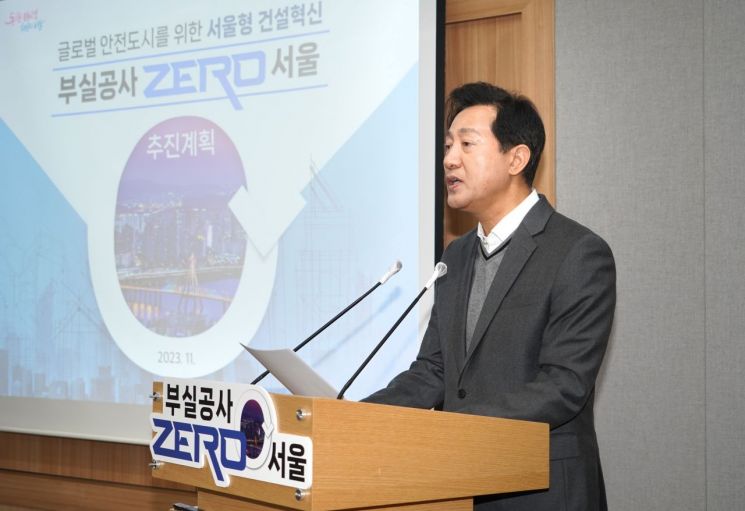
On the 7th, Seoul announced the 'Seoul-type Construction Innovation Measures' centered on these points, pledging to create a 'Safe Seoul without Defective Construction.' The core is to move away from fragmented measures taken each time defective construction occurs, to change the industrial structure, and to break the cycle of defects ingrained as a custom.
At a press briefing held that day, Seoul Mayor Oh Se-hoon said, "The internal structure of the construction industry is very complexly intertwined, not only in design, construction, and supervision but also in the awareness of the client, so fragmented and partial solutions cannot achieve fundamental innovation in the construction industry." He added, "We must prepare comprehensive measures for the entire construction industry and persistently implement them." He introduced the purpose of the measures by stating, "Seoul has reviewed the construction project process step-by-step from planning to completion to identify what problems exist and how these problems are interconnected."
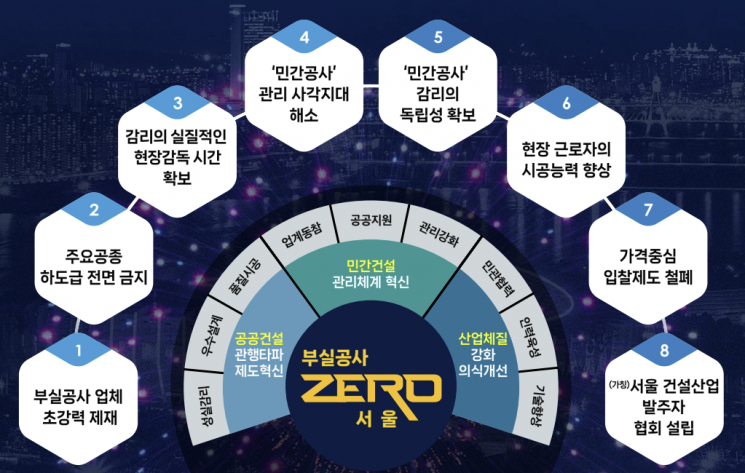
Based on various defective construction issues that have occurred so far, the city has selected and will promote eight core tasks across three sectors (public construction, private construction, and industrial structure). Specifically, the eight core tasks include public construction (strong sanctions on defective construction companies, complete prohibition of subcontracting for major trades, securing supervision time on-site), private construction (eliminating blind spots in private construction management, ensuring independence of private construction supervision), and industrial structure (improving on-site workers' construction skills, abolishing price-centered bidding systems, and establishing a tentative Seoul Construction Industry Client Association). The city plans to implement measures that can be carried out independently first and will propose and negotiate with the government on matters requiring legal amendments.
Prohibition of Subcontracting for Major Public Construction Works... Expansion of 'Video Recording' to All Public Construction Sites
First, in the public construction sector, to impose the obligation of 'responsible construction' on the primary contractor, immediate reconstruction will be mandatory in case of accidents caused by defects. In this regard, the city will add provisions related to 'mandatory reconstruction' to the 'Special Conditions for Construction Contracts of Seoul Metropolitan Government,' aiming to complete the revision and implement it by the first half of next year.
Companies responsible for defective construction will be restricted from participating in large turnkey and technical bidding projects ordered by Seoul for two years. Furthermore, depending on the nature of the defects, if designated as a disqualified contractor, they will be barred from bidding on public construction projects for up to two years, and their names will be publicly disclosed.
To eradicate the widespread problem of low-price illegal subcontracting at construction sites, the city mandates that major trades in projects ordered by the city be directly constructed 100%. In the future, bidding announcements for projects ordered by Seoul and its affiliated investment and foundation institutions will specify the major trades that must be directly constructed and the prohibition of subcontracting. Major trades refer to core trades such as rebar, concrete, and bridge works that significantly affect the structural safety of facilities and account for a large portion of construction costs.
The city is also negotiating with the Ministry of the Interior and Safety to add 'direct construction ratio' as an evaluation item in the 'Criteria for Determining Successful Bidders in Local Government Bidding (hereinafter Local Contract Regulations)' so that direct construction status can have a practical impact on winning bids. In cases where subcontracting is unavoidable due to technical supplementation, the threshold for 'subcontract contract appropriateness review' will be strengthened from less than 82% of the primary contract amount to less than 90%, strictly verifying subcontract contracts that leave a commission of 10% or more.
At the briefing, Yoo Chang-soo, Seoul's Deputy Mayor for Administration, addressed concerns about rising construction costs due to the suspension of subcontracting, stating, "Major processes such as temporary works, rebar, and concrete works are directly related to safety, so even if construction costs are expected to rise, they must be implemented." He added, "When ordering public construction, we will implement budgeting that takes costs into account."
To secure actual on-site supervision time for supervisors who must comprehensively manage and oversee construction under the responsible supervision system, excessive paperwork will be eliminated. Additionally, video recording management of construction sites, which can compensate for supervision gaps, will be expanded to all public facility construction sites, and filming equipment for construction records will be lent to small-scale construction sites. The proportion of resident supervisors in ordered projects will be maximized to strengthen inspections of labor-intensive trades such as rebar placement and concrete pouring.
Support for 'Subcontract Contract Appropriateness Review' in Private Construction... Ensuring Independence of Supervision
In the private construction sector, which accounts for more than 70% of domestic construction orders, subcontract management and supervision will be significantly strengthened, and the independence of supervision will be guaranteed. The crackdown on illegal subcontracting, previously implemented only in the public sector, will be expanded to private construction. When requested by associations or building owners, the Regional Building Safety Center (city and district) will support 'subcontract contract appropriateness review.' To manage construction quality, concrete pouring during rainfall will be prohibited in principle, and if pouring is unavoidable, mandatory strength testing will be conducted. Following the 'Measures to Eradicate Illegal Subcontracting' announced by the Ministry of Land, Infrastructure and Transport in September this year, local governments will be granted enforcement authority, and Seoul plans to conduct thorough crackdowns centered on the Regional Building Safety Center.
To enable supervision of housing construction projects to operate independently from clients, the city will directly manage 'supervision contract appropriateness' and plans to request the government to revise related regulations to introduce the 'public deposit and payment system for supervision fees,' which has been applied only to housing construction, to general building projects as well. Furthermore, supervision will be jointly conducted not only by architects but also by structural engineers or construction engineers with expertise in structure and safety. The city will propose the introduction of a 'supervision qualification exam' for construction, structure, and safety quality to secure supervision specialized in safety.
Enhancing On-site Workers' Skills and Strengthening Management... Establishment of Client Association
The city will also change the chronic practices and industrial structure rooted in the construction industry for decades, such as poor construction skills and dumping bids (low-price winning bids). To cultivate skilled craftsmen, Seoul will support 'skill grade promotion training' and plans to propose to the government the introduction of a 'differential wage system' where higher grades receive higher wages. Before employing foreign workers, functional tests such as understanding design drawings and rebar assembly, as well as quality and safety education through professional interpreters, will be conducted. In the future, 'mid-level' workers will be assigned to trades related to structural safety such as concrete and rebar in Seoul-ordered projects, and detailed placement standards by trade will be specified in individual bidding announcements.
Improvements to the bidding system, where the winning bidder is determined by bid price, will also be pursued. The city will propose to the Ministry of the Interior and Safety to raise the 'full score standard for technical performance evaluation' in the Comprehensive Evaluation Bidding System (hereinafter Comprehensive Evaluation System) to secure technical differentiation and to expand the Comprehensive Evaluation System, currently applied only to projects over 30 billion KRW, to projects over 10 billion KRW. The 'qualification review,' applied to projects under 30 billion KRW, has had side effects such as inducing low-price bids and the proliferation of paper companies because the lowest bidder is selected if a certain score is exceeded. Therefore, the city aims to expand the Comprehensive Evaluation System, which awards the highest total score bidder. Additionally, the city plans to raise the qualification review winning rate, currently about 86%, to over 90% and to request the standard market price used for estimating construction project prices be updated (currently about 86% of the standard unit price).
Since the awareness of clients who prioritize construction quality is more important than any regulation or system to prevent defective construction, the city plans to form the tentative 'Seoul Construction Industry Client Association,' where public institutions, private maintenance project associations (developers), and experts will work together to change the construction industry culture and enhance expertise. The association will provide education for clients, consulting for private maintenance project associations, subcontract and supervision contract appropriateness reviews, specialized training for on-site workers, and briefings on new project orders, among other construction industry support functions.
Deputy Mayor Yoo said about the client association, "Clients turning a blind eye to defective construction is like ignoring defects in building their own homes." He added, "Associations at redevelopment and reconstruction apartment sites lack knowledge, information, and technical skills. Therefore, if a client association, which provides information, is created to play a leading role, I believe the overall awareness of clients can change."
© The Asia Business Daily(www.asiae.co.kr). All rights reserved.


















