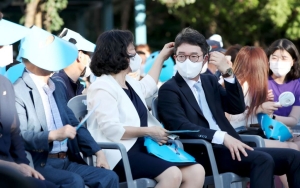
On the 24th of last month, the Financial Supervisory Service (FSS) announced the results of a reinvestigation into private equity fund scandals such as Lime and Optimus, revealing new illegal activities. The Financial Services Commission (FSC) has entered the final review stage for sanctions against CEOs of financial firms, which had been suspended since the end of March last year. Consequently, attention is focused on the level of sanctions against CEOs of securities firms involved in the incidents, including KB Securities, NH Investment & Securities, and Daishin Securities. However, if the securities firms challenge the sanctions through lawsuits, the responsibility disputes among parties surrounding the private equity funds are expected to be prolonged.
![[Unresolved Cases Lime·Optimus] ① Authorities Facing Securities Firm Sanctions... Litigation Expected to Prolong](https://cphoto.asiae.co.kr/listimglink/1/2023091614141178104_1694841252.png)
The 'Lime scandal,' which the FSS recently announced the reinvestigation results for, began when Lime Asset Management suspended redemptions on some funds in October 2019. Lime promised returns of 5-8%, higher than market interest rates, and at one point managed nearly 6 trillion won, but as investors massively withdrew amid suspicions of fund recycling, the redemption suspension occurred. The number of affected investors reached about 4,500, with damages amounting to approximately 1.6 trillion won, making it known as the "largest financial fraud case since the founding of Korea." The following June, the Optimus scandal broke out. Introduced as a safe product investing in public institution accounts receivable, the investment funds were actually misused for acquiring bonds of insolvent companies and fund recycling, leading to redemption suspension. About 1,000 investors suffered damages of around 500 billion won due to the Optimus scandal.
Court Rules "Some Sanctions Against NH Securities for 'Optimus Sales' by Financial Authorities Are Unjust"
The final sanctions by financial authorities against CEOs of securities firms involved in the product sales process are currently at a standstill. Regarding the Lime fund, the FSS imposed job suspensions on former Daishin Securities President Na Jae-cheol, former Shinhan Financial Investment President Kim Hyung-jin, and former KB Securities President Yoon Kyung-eun, and issued a reprimand to KB Securities CEO Park Jung-rim. NH Investment & Securities CEO Jung Young-chae received a reprimand related to the Optimus scandal. These are all severe disciplinary actions, and if finalized, these former and current CEOs will be barred from reemployment in the financial sector for the next 3 to 4 years. The final level of sanctions will affect the CEOs' positions and the companies' operational directions. However, sanctions against financial company executives and institutional business suspensions must be finalized through resolutions at regular FSC meetings. Meanwhile, CEO Jung succeeded in a third term last March, and CEO Park has been serving as KB Securities CEO for four years. Yang Hong-seok, then Daishin Securities CEO, who received a reprimand related to the Lime fund, was promoted to vice chairman in 2021.
In this context, a recent court ruling declared that the sanctions imposed by financial authorities on NH Securities, the largest seller of the Optimus fund, were unjust. According to the legal community on the 15th, the Seoul Administrative Court Administrative Division 2 (Presiding Judge Shin Myung-hee) ruled in an administrative lawsuit filed by NH Securities against the FSC and FSS, ordering the cancellation of the FSC's three-month partial business suspension and the FSS director's employee reprimand. NH Securities sold 432.7 billion won, 84% of the unredeemed Optimus fund principal, and when sanctions were imposed on the company by financial authorities, it filed a lawsuit arguing that it did not provide investors with definitive judgments as alleged in the sanction reasons.
The court stated, "Although NH Securities' duty of care to protect investors may have been insufficient, it is difficult to see that it provided investors with 'definitive judgments' as stated in the sanction reasons. At that time, NH Securities did not have the authority to actively request fund operation information from the asset management company," adding, "The seller only needs to clearly understand the explanations and documents received from the manager and explain them so that investors can properly understand. There is no obligation to separately verify the truthfulness of the content and inform investors." The court further noted, "NH Securities appeared to believe that public institution accounts receivable were included in the Optimus fund's managed assets."
![[Unresolved Cases Lime·Optimus] ① Authorities Facing Securities Firm Sanctions... Litigation Expected to Prolong](https://cphoto.asiae.co.kr/listimglink/1/2023091515214077745_1694758900.jpg)
Complex Fund Structures Obscure Responsibility... "Legal Basis Needed for CEO Internal Control Responsibility"
Ultimately, financial authorities' sanctions against CEOs and others for "negligent internal control" are also likely to be challenged by financial firms through administrative lawsuits. At the end of last year, the Supreme Court confirmed the cancellation of severe disciplinary action against Sohn Tae-seung, former chairman of Woori Financial Group, in a lawsuit against the FSS related to derivative-linked funds (DLF), ruling that "whether internal control was neglected under the Corporate Governance Act is not a reason for sanctions." The supervisory responsibility of financial authorities, incomplete sales by sellers, and monitoring responsibility of custodians are also key issues in related lawsuits. Typically, asset managers find custodians to hold large funds when setting up funds; custodians receive money from sellers, store it, and operate funds according to managers' instructions. Custodians review various factors such as the manager's reputation and fund size. The more complex the fund's product structure, the harder it is to distinguish responsibility.
Although the FSS announced through reinvestigation that it "newly detected circumstances of preferential redemptions," the financial authorities at the time, who created policies and supervised the market, cannot escape responsibility related to the private equity fund scandal, making finalizing sanctions difficult. In fact, the Audit Board of Korea pointed out in 2021 that financial authorities initially did not require significant remedial measures regarding the private equity fund scandal. The FSC increased the risk of accidents by relaxing investment requirements without considering investors' risk tolerance, and the FSS did not use asset managers' financial data for supervision despite increased risks due to deregulation. It also criticized the failure to conduct proper inspections or measures regarding some suspicious activities. The financial authorities' responsibility was also mentioned in NH Securities' winning court ruling. NH Securities argued, "The FSS also judged that there were no contradictions between the trust contract and investment proposal regarding the Optimus fund," and the court noted, "Even the FSS official in charge during the Optimus audit testified that they had no choice but to believe Optimus's explanations."
Consequently, there is a strong call for legally strengthening CEOs' responsibility for 'internal control.' Financial authorities are pinning hopes on the amendment to the 'Financial Company Governance Act' proposed by Yoon Hang-hong, a member of the People Power Party, on the 11th. The amendment introduces a clause on the 'duty of overall management of internal control by the CEO, etc.,' and also establishes special provisions for sanctions related to violations of internal control duties. It clarifies the legal basis for sanctioning financial company CEOs for violations of internal control duties and specifies the responsibilities of financial company CEOs more concretely. The current law only stipulates the obligation to establish internal control standards, and there have been many criticisms that specific duties for each executive are not defined.
© The Asia Business Daily(www.asiae.co.kr). All rights reserved.




![③The Special Connection Between the Statue of Lee Jun in Jangchungdan Park and Mayor Oh Se-hoon [Current Affairs Show]](https://cwcontent.asiae.co.kr/asiaresize/319/2026012110001599450_1768957215.jpg)