Approval of the 1st National Carbon Neutrality Green Growth Basic Plan
Enactment of Climate Change Adaptation Act, Building Energy Consumption Assessment
Innovation Plans Including Early Use of Carbon-Related Technologies and Business Expansion
The government is promoting the enactment of the so-called 'Climate Change Adaptation Act' to facilitate a smooth transition to a carbon-neutral society. It also announced plans to evaluate energy consumption by building and to initiate the development of low-carbon fuel technologies. Through eco-friendly policies, the government aims to achieve the 2030 greenhouse gas reduction target (436.6 million tons CO2e). Prime Minister Han Deok-su emphasized that "all available means will be mobilized" for the success of carbon neutrality.
On the 10th, the 2050 Carbon Neutral Green Growth Committee reviewed and approved the first national carbon neutrality green growth basic plan at the 3rd plenary meeting of 2023 held at the Government Seoul Office, chaired by Prime Minister Han Deok-su. The plan is the first statutory plan established following the enactment of the Carbon Neutrality Basic Act, which came into effect on the 25th of last month, and includes sectoral and annual reduction targets, measures, and implementation plans.
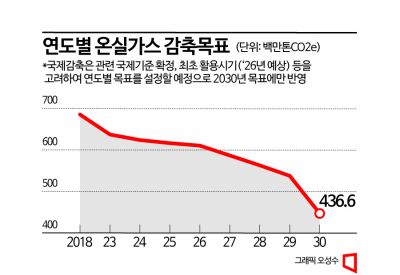
The approved plan supplements the government proposal announced on the 21st of last month. Through meetings, opinions from stakeholders including the scientific community, labor sector, local communities, youth, and civic groups were collected. Laws and systems related to carbon neutrality implementation have been strengthened, and the plan reflects the need to supplement sectoral reduction policies such as buildings and transportation, as well as to expand regional and public participation in carbon neutrality.
According to the plan, the government intends to enhance national climate change response capabilities through the Climate Change Adaptation Act. The previous plan only included revising the Carbon Neutrality and Green Growth Basic Act. The new separate law will mandate the incorporation of climate crisis adaptation measures into national policies and establish a foundation for monitoring, forecasting, and evaluation. Infrastructure to respond to extreme weather, such as mountain weather observation networks, will also be strengthened.
To improve the energy efficiency of buildings, a 'Building Energy Consumption Evaluation System' will be newly established. Currently, only energy efficiency targets are set for large buildings. To supplement this, a consumption evaluation system will be introduced, and if targets are not met, improvement orders and fines will be imposed. Building performance information will also be disclosed, with the public sector taking the lead in reducing greenhouse gases.
Along with strengthening legal and institutional foundations, sectoral greenhouse gas reduction policies have also been supplemented. The government is currently implementing policies such as scrapping old diesel vehicles to transition internal combustion engine vehicles to zero-emission vehicles. To distribute 4.5 million electric and hydrogen vehicles by 2030, purchase incentives and mandatory public sector procurement will be enforced. More than 1.23 million electric vehicle charging stations and over 660 hydrogen charging stations will be established. Additionally, the development of lightweight materials and parts, as well as low-carbon fuels, will be promoted.
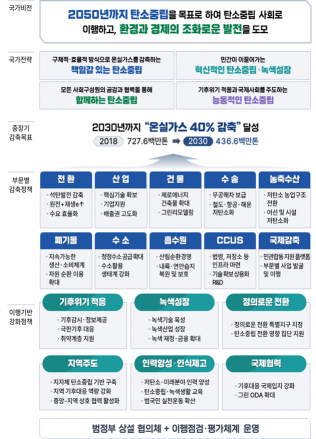
In the agriculture, livestock, and fisheries sectors, various renewable energies will be utilized, such as small hydropower generation using aquaculture farm discharge water, and for waste, target rates for the use of recycled raw materials will be set even for final products like PET bottles.
The committee also discussed a joint public-private initiative to promote carbon capture, utilization, and storage (CCUS) industry and technological innovation. CCUS refers to technologies that capture, store, and utilize carbon emitted during fossil fuel use. It is considered one of the key technologies to achieve greenhouse gas reduction targets while simultaneously enhancing industrial competitiveness.
The committee plans to secure commercial CO2 capture technologies and conduct large-scale demonstrations. To this end, innovative technologies that can reduce capture costs by more than 30% compared to current levels will be developed by 2030. The government will pursue securing CO2 storage sites with a capacity of 1 billion tons domestically and strengthen international cooperation with overseas state-owned enterprises. The plan also includes early commercialization and business expansion of related technologies, fostering Korean-style export models, and establishing foundational and core technologies.
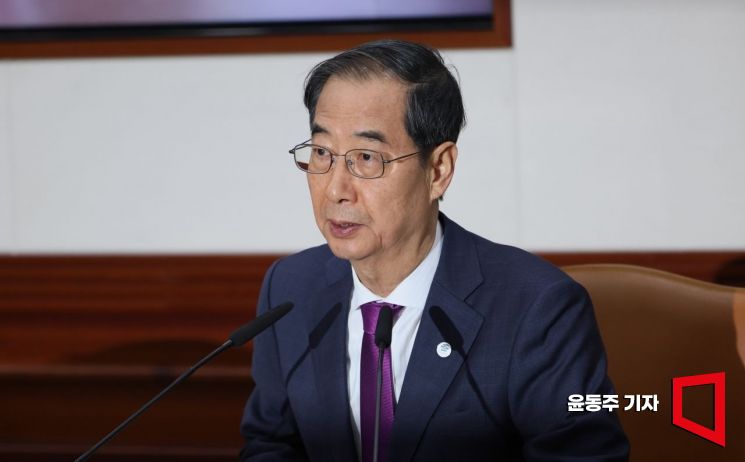
Prime Minister Han Deok-su stated, "The government will communicate with all sectors of society to concretize policies and projects and implement them swiftly," adding, "The government will mobilize all available policy tools such as finance, taxation, R&D, finance, and regulatory innovation to support the private sector and local regions as agents of change and innovation to practice carbon neutrality and create growth engines." He also said, "Support measures for vulnerable sectors and groups during the industrial structure transition process will be proactively prepared."
© The Asia Business Daily(www.asiae.co.kr). All rights reserved.



















