The Korea Employers Federation published a regular periodical under the theme of 'Exploring Sustainable Wage Systems.'
On the 1st, the Federation announced the release of the 'Wage & HR Research 2023 First Half Issue.' This periodical contains expert opinions and corporate case studies on major issues related to HR, organization, and wage systems in domestic and international companies.
The Federation chose 'Exploring Sustainable Wage Systems' as the theme for this issue. It presented a direction for rational wage system reforms that can accommodate rapidly changing management environments and new demands from members. At the same time, it introduced the latest domestic and international trends in HR and wage system reforms to provide practical implications.
Kim Jusu, Vice President of Mercer Korea, who delivered the keynote presentation, stated, "Due to the recent limitations of seniority-based pay, job-based pay is mainly being discussed," and emphasized, "Rather than finding one perfect wage system, each company should gradually reform it considering their management environment, business characteristics, and member preferences."
In the research forum, articles were published on the topics of ▲Legal and institutional improvement plans to activate wage system reforms ▲Directions for office worker compensation system reforms in the post-COVID era ▲Rational improvement directions for production worker wage systems by Lee Jung, Professor at Hankuk University of Foreign Studies Law School; Kim Seunghae, Senior Manager at Conperi; and Jeon Myunghwan, CEO of Eon Consulting Group.
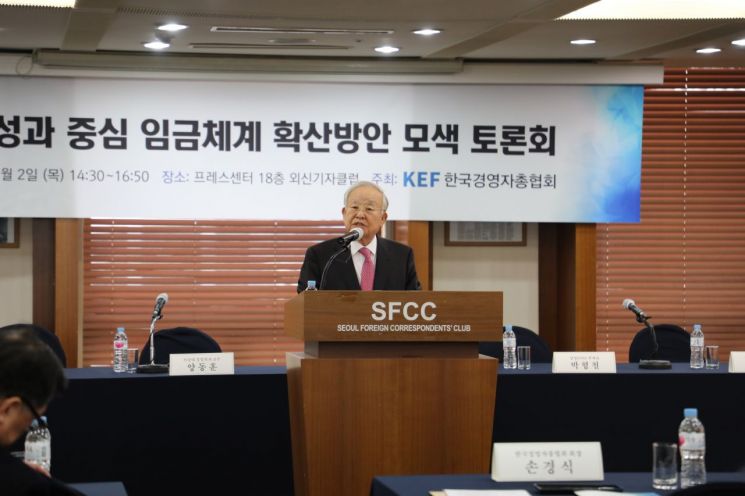 At the discussion forum on expanding job- and performance-based wage systems held on the 2nd of last month, Son Kyung-sik, Chairman of the Korea Employers Federation, delivered the opening remarks.
 [Photo by Korea Employers Federation]
In the case studies, the latest domestic and international HR and wage system reform cases were introduced, including SK Innovation, which is continuously promoting HR innovation, and NTT (Nippon Telegraph and Telephone), which recently introduced a job-centered wage system.
Kim Myungjoong, Senior Researcher at Japan’s Nissei Basic Research Institute, introduced recent wage system reform trends in major Japanese companies where job-based employment is spreading. Kim cited NTT as a representative example. In September 2021, NTT announced a 'Transformation to a New Management Style.' It carried out a reform of the HR system by moving away from the existing seniority-based personnel system and determining treatment based on a six-level 'Job Grade' according to the importance of the job.
Meanwhile, in the issue forum, various opinions from the discussion held by the Federation on the 2nd of last month regarding the expansion of job- and performance-based wage systems were recorded in a live broadcast format.
Ha Sangwoo, Head of the Economic Research Department at the Federation, said, "This publication includes legal and institutional improvement plans for wage system reforms as well as recent domestic and international trends in wage system reforms," and added, "We hope it will help companies find sustainable wage systems."
© The Asia Business Daily(www.asiae.co.kr). All rights reserved.

















