
[Asia Economy Reporter Choi Dong-hyun] "Vietnam is the optimal country to benefit from the ‘China Run’?the global capital exodus from China?following Xi Jinping’s third term in power."
Kim Deok-ryong, head of the ASEAN Office at the Korea Federation of SMEs, said, "Vietnam has an outstanding level of education among Southeast Asian countries and a market of 100 million people with cultural affinity to us." He added, "China is internalizing a significant portion of exports from domestic SMEs, and the average monthly wage is relatively high at $600. In contrast, Vietnam’s wage level is still around $250, making it highly competitive."
Since 2019, Kim has been assisting Korean SMEs in expanding overseas in cities like Ho Chi Minh and Hanoi. Established in 2016, the ASEAN Office supports the establishment of local networks for domestic SMEs and SME organizations aiming to enter Southeast Asia. It also provides vivid local information to lay the foundation for SME globalization. This year, marking the 30th anniversary of diplomatic relations with Vietnam, the office opened the ‘Korea-Vietnam SME Exchange Support Center’ within its premises.
The Vietnamese export market is broadly divided into the ‘production market’ for parts exports used in manufacturing and the ‘consumer market’ for local sales of consumer goods. Kim noted, "The production market still holds traditional strengths such as a competitive labor market, market-friendly policies, and various free trade agreements (FTAs)." However, he advised, "Due to industrial upgrading demands, local governments are increasingly restricting foreign direct investment (FDI) to focus on high-tech industries." He continued, "The consumer goods distribution market, with its young population and high demand for Korean products, has seen many changes among middlemen (buyers) due to COVID-19. Our office has discovered over 60% of its buyers this year as new contacts." He also emphasized the need to strengthen local branding efforts by leveraging Vietnam’s rapidly growing mobile shopping market post-COVID-19.
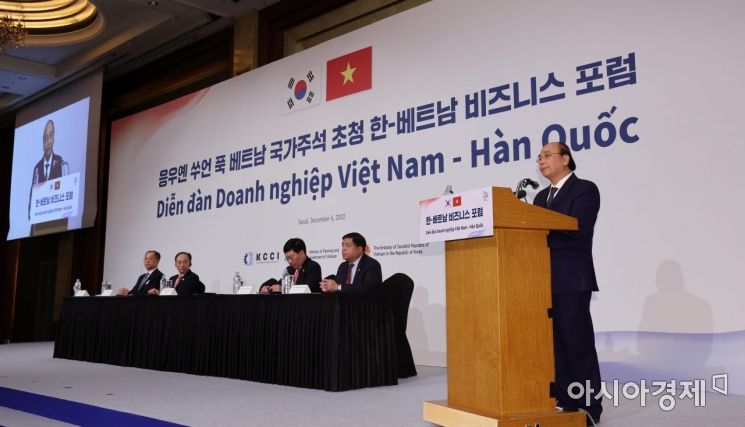 Nguyen Xuan Phuc, President of Vietnam, is delivering the keynote speech at the Korea-Vietnam Business Forum held on the 6th at Lotte Hotel in Jung-gu, Seoul.
The Korea Federation of SMEs’ ASEAN Office has recently been supporting domestic SME brand promotion activities locally in Vietnam. Big data solution company Datastreams participated in ‘Smart City Asia 2022’ held in Ho Chi Minh this year with the help of the ASEAN Office. Through this, they signed a contract with FTP, a major local IT company. They are also in discussions regarding smart city projects with Vingroup, known as the ‘Samsung of Vietnam.’ Currently, they are continuing business consultations in cooperation with the Korea International Cooperation Agency (KOICA) local office. When Vietnam seeks companies producing specific products, the ASEAN Office directly discovers and connects Korean companies. For example, health functional food manufacturer Dongindang secured contracts worth $960,000 in 2020 through this support.
Kim warned that many Korean SMEs entering Vietnam for the first time have failed by applying the same approach used in the Chinese market. He said, "Vietnam is still a developing country with a per capita income in the $3,000 range. Although order volumes are only about 10% of China’s, many products from other countries are already widely distributed, leading to numerous order requirements and fierce price competition due to proximity to China." He emphasized, "Local buyers should be approached not merely as product sales clients but as partners who can grow alongside our products. Through them, we can mutually receive significant support in marketing collaboration, distribution channel development, and local permits."
He advised that since Vietnam is a distinct individual market, different from China and other Southeast Asian countries like Indonesia and Thailand, thorough consideration of business culture differences and local market characteristics by product category is essential for market entry. Kim said, "To compensate for insufficient brand recognition, package premiumization, preparation of local language promotional content for SNS use, and flexibility in minimum order quantities according to market size are crucial. Selecting specialized products suited to the Vietnamese market and meticulously managing local permits, FTAs, and official export documents are also necessary."
© The Asia Business Daily(www.asiae.co.kr). All rights reserved.


















