5th Five-Year Economic Development 60th Anniversary Meeting
Over 30 Former Deputy Prime Ministers, Ministers, and KDI Presidents Gather
"Next Year's Economy Will Be Weak... We Are No Exception"
High Interest Rates, High Exchange Rates, High Inflation, and Widening Wealth Gap
Need for Government-Led Regulatory Reform and Other Countermeasures
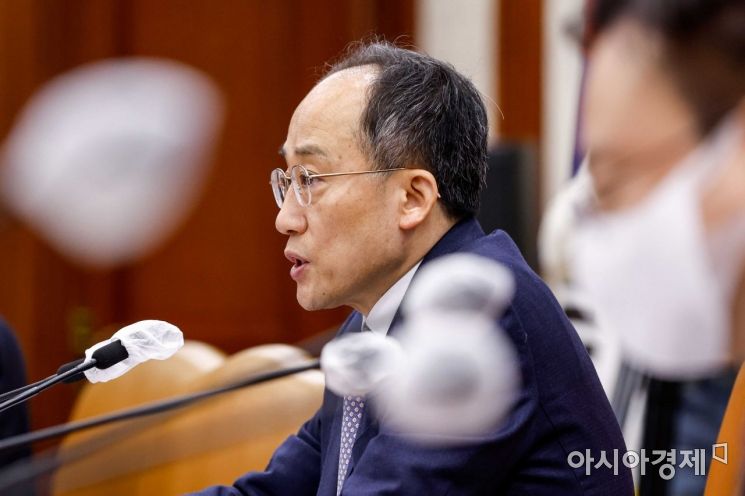 Deputy Prime Minister and Minister of Economy and Finance Choo Kyung-ho is delivering opening remarks at the Emergency Economic Ministers' Meeting held at the Government Seoul Office in Jongno-gu, Seoul on the 18th. Photo by Kang Jin-hyung aymsdream@
Although the South Korean economy has grown remarkably over the past 60 years through the 'Five-Year Economic Development Plans,' its future outlook is not bright. Due to rapid interest rate hikes by major countries such as the United States, an economic slowdown is expected to begin in earnest from next year. Additionally, domestic and international conditions such as consumption contraction caused by a decrease in real income, income polarization, export slowdown, and low birthrate and aging population are worsening. Former economic leaders who have driven the South Korean economy have emphasized the need for reforms that align with changes in the global economic environment and have called for proactive government responses.
At a commemorative meeting held on the 21st at the Hongneung Global Knowledge Cooperation Complex in Seoul to mark the 60th anniversary of the Five-Year Economic Development Plans, former Deputy Prime Ministers and Ministers gathered to objectively evaluate the achievements of the past 60 years and stressed the need to establish a new national future strategy amid the restructuring of the global economic system. While rapid growth was achieved in the past through an efficient export-oriented economic structure centered on large corporations, it is difficult to guarantee such growth in the future due to increasing geopolitical uncertainties and protectionist trade policies.
"An Ordinary Country in 5 Years"... Darkening Future Outlook
A survey conducted by the Korea Development Institute (KDI) targeting 1,000 general citizens aged 20 and above found that when asked about South Korea's position in terms of economy, industry, and politics in five years, 37.7% answered 'ordinary.' The proportion who responded that the situation would be 'somewhat poor' was as high as 19.9%. In contrast, only 5.5% said it would be 'very excellent.' Amid expanding global uncertainties, a significant number of citizens evaluated the outlook for the South Korean economy negatively.
Song Hee-yeon, Chairman of the Asia Development Institute and former KDI President, told Asia Economy on the day, "Since the global economy is expected to be weak, we cannot be an exception," adding, "I expect some difficulties next year." Deputy Prime Minister and Minister of Economy and Finance Choo Kyung-ho also expressed a sense of crisis, saying, "For 60 years, South Korea has achieved the Miracle on the Han River, like a rose blooming from a garbage can," but warned, "Due to the global economic slowdown and China's lockdown policies, it is highly likely that we will face difficult times until the first half of next year."
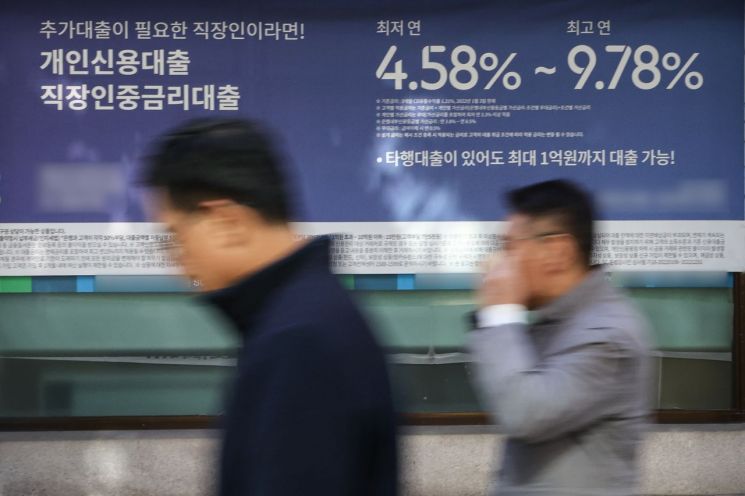
Full-scale 3 Highs Crisis
In fact, many analyses inside and outside the government and financial markets predict that the economic slowdown in South Korea will worsen from next year. In its 'Second Half Economic Outlook' released on the 10th, KDI sharply lowered the economic growth forecast for next year from 2.3% to 1.8%. The Bank of Korea is also expected to present a revised economic outlook on the 24th, forecasting growth in the 1% range, lower than the August forecast of 2.1%. This growth rate, which does not even reach the potential growth rate (2%), is exceptionally low, except during the COVID-19 pandemic, the global financial crisis, and the International Monetary Fund (IMF) foreign exchange crisis.
With the U.S. Federal Reserve (Fed) expected to continue raising interest rates and maintain high rates in the first half of next year, South Korea is also likely to keep its final benchmark interest rate at a high level of at least 3.5%, making an economic contraction inevitable. In particular, due to the slowdown in China's growth, exports to China may decrease further next year, making it difficult to guarantee a current account surplus. Additionally, the prolonged Russia-Ukraine war and recent increased volatility in international oil prices and exchange rates also pose burdens on the South Korean economy.
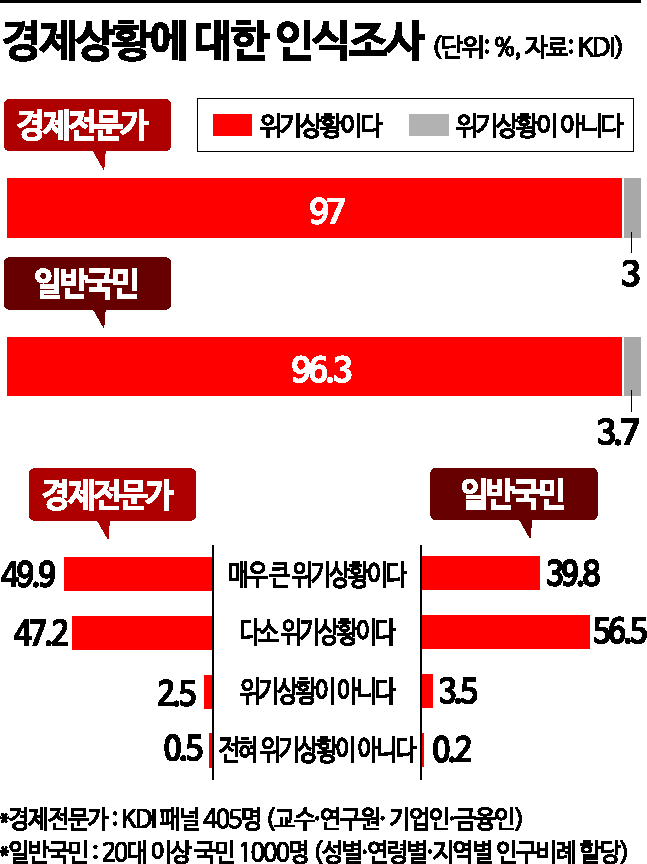
Another problem is the widening wealth gap amid inflation shocks. According to a KDI survey, 405 domestic economic experts, including professors and businesspeople, identified the widening wealth gap (40.5%) as the most insufficient aspect of South Korea's economic and social development over the past 60 years. Recently, with rising prices reducing the real income of ordinary citizens, increasing interest burdens on mortgage loans, and reduced COVID-19 support funds, polarization is intensifying. This leads to reduced consumption, which could accelerate the economic slowdown.
Experts: "Addressing Low Birthrate and Aging Population Is Most Important"
Domestic economic experts emphasize that to overcome such mid- to long-term crises, South Korea must establish detailed mid- to long-term responses focused on government-led reforms. In the KDI survey, a significant number of economic experts highlighted the importance of regulatory reforms (32.6%) to revitalize corporate investment and labor reforms (23.2%). Other priority tasks mentioned included responding to low birthrate and aging population (37%) and cooperative politics beyond factionalism (29.1%).
Hyun Oh-seok, Chairman of the GS ESG Committee and former inaugural Deputy Prime Minister and Minister of Economy and Finance under the Park Geun-hye administration, told Asia Economy, "Looking back, South Korea has overcome multiple crises and experienced stages of leapfrogging thanks to a combined will to compete and desire to develop," adding, "As the only country to have simultaneously achieved economic development and democracy, I believe South Korea can overcome difficulties, turn crises into opportunities, and succeed."
© The Asia Business Daily(www.asiae.co.kr). All rights reserved.



















