Safety Concerns Held Hostage by Price
[Asia Economy Reporter Park Sun-mi] Korea Railroad Corporation (KORAIL) is facing intense controversy over the possibility of foreign companies participating in the bidding announcement for the distributed power high-speed trains to be deployed on the KTX Pyeongtaek~Osong line, scheduled to open in 2027.
According to the railway industry on the 9th, KORAIL plans to announce a bid for 136 distributed power high-speed train cars to be deployed on the Pyeongtaek~Osong line within this month, or by early next month at the latest, and complete the selection of the operator within the year. To establish criteria for selecting qualified companies, KORAIL has currently requested consulting from the Board of Audit and Inspection regarding the high-speed train bidding system. It is known that once the consulting results are received around mid-month, they will be reflected in the bidding announcement.
In addition to Hyundai Rotem, the Spanish high-speed train manufacturer Talgo is expected to participate in the bid by forming a consortium with the domestic mid-sized company Woojin Industrial Systems. Woojin Industrial Systems is a mid-sized company that has recently ranked first with a 53% market share in domestic electric train orders over the past three years, surpassing Hyundai Rotem’s 15%. Its recent orders have rapidly increased, including 260 cars for Seoul Subway Line 4 this year and 200 cars for Busan Line 1 last year, quickly raising its market share in the railway sector.
The industry is paying attention to the possibility that Hyundai Rotem’s monopoly structure in domestic high-speed train orders may be broken through this bidding. Hyundai Rotem created the KTX-Sancheon in 2008 after decades of trial and error and research and development, starting from a time when domestic high-speed train technology and infrastructure were nonexistent, and has exercised monopolistic influence over high-speed train orders ever since.
There have been continuous concerns about side effects such as price increases, delivery delays, and collusion due to the monopoly system. KORAIL’s decision to include companies with experience in delivering concentrated power trains as eligible bidders for the distributed power high-speed train bid, thereby opening the door for the Spanish train manufacturer Talgo and Woojin Industrial Systems to participate, is interpreted as a move to break Hyundai Rotem’s monopoly. Distributed power high-speed trains apply a propulsion method where power sources are distributed across all cars. Compared to concentrated power trains, which have power units only on the front and rear power cars, distributed power trains offer superior acceleration and deceleration performance and are efficient for Korea’s railway environment, which has many curves and short distances between stations.
Some express concerns that KORAIL’s attempt to break the monopoly structure and lower prices might inadvertently give opportunities to companies that have never manufactured distributed power high-speed trains before, increasing safety risks. In fact, while Talgo and Woojin Industrial Systems have many orders for electric trains, they have no delivery experience with distributed power high-speed trains. In contrast, Hyundai Rotem has experience producing distributed power high-speed trains multiple times.
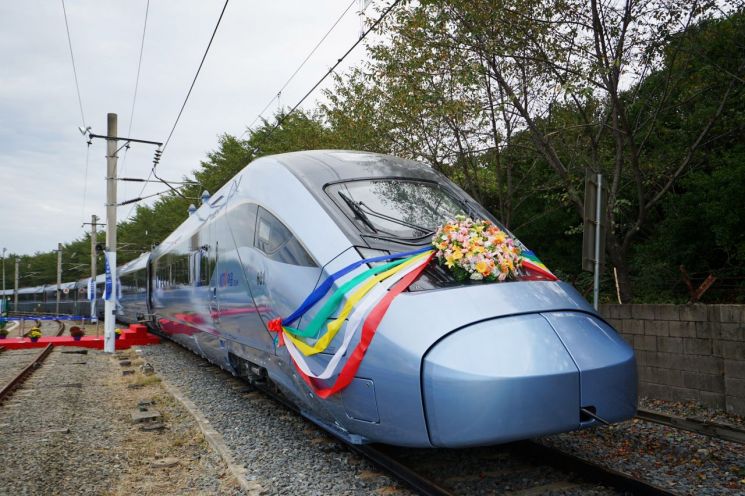
The 260 km/h class distributed power high-speed train ‘KTX-Eum’ with 114 cars has been operating since January last year on the Jungang Line, Gangneung Line, Yeongdong Line, and Jungbu Inland Line. In September, Hyundai Rotem also delivered the 320 km/h class distributed power train EMU-320. After mainline test runs, it was delivered to KORAIL and operates on existing high-speed rail lines such as the Gyeongbu High-Speed Line and Honam High-Speed Line alongside KTX-I and KTX-Sancheon.
The domestic railway parts industry is concerned that if Hyundai Rotem, which has a domestic parts localization rate of 87% for distributed power high-speed trains, loses the bid to foreign companies, the domestic railway parts industry ecosystem could collapse. Recently, the Emergency Measures Committee for the Railway Vehicle Parts Industry issued an ‘appeal’ stating, "Although Korea has advanced as a railway powerhouse through technological independence, if foreign companies are allowed to enter the market, the domestic parts industry will accelerate its decline," and warned, "There is a high possibility that the domestic parts industry will become dependent on overseas companies, leading to ecosystem collapse."
© The Asia Business Daily(www.asiae.co.kr). All rights reserved.

















