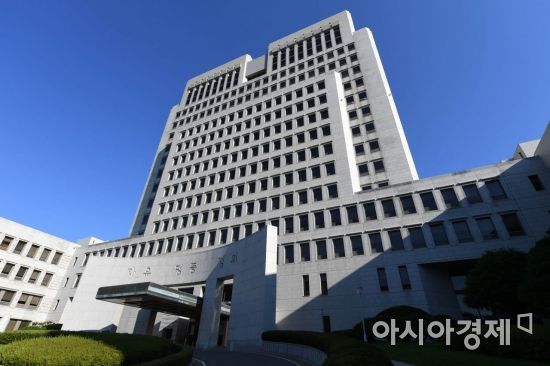
[Asia Economy Reporter Choi Seok-jin, Legal Affairs Specialist] The Supreme Court has ruled that even if the business area was not a reportable item when a restaurant business license was obtained over 40 years ago, failure to report an extension of the restaurant after related laws were amended is subject to punishment.
The Supreme Court's First Division (Presiding Justice Kim Seon-su) overturned the lower court's ruling that sentenced Mr. A to a fine of 10 million won on charges of violating the Development Restriction Zone Act, the Waterworks Act, the River Act, and the Food Sanitation Act, and remanded the case to the Uijeongbu District Court on the 26th.
Previously, the first and second trials recognized Mr. A's other charges as guilty, but acquitted him of violating the Food Sanitation Act for failing to report changes in the business area. The Supreme Court ruled that this should be considered guilty.
The court stated, "The lower court clearly held that Article 37, Paragraph 4 of the Food Sanitation Act imposes an obligation to report changes only when important reported items are changed, based on the premise that a business report has been filed. However, since only the defendant's father obtained the business license and there is no evidence that the defendant or his father filed a business report, it was judged that there was no obligation to report changes regarding the business area and acquitted the defendant of the charges. However, such a judgment by the lower court is difficult to accept as is."
Article 37, Paragraph 4 of the Food Sanitation Act stipulates the obligation to report to the head of the Ministry of Food and Drug Safety or local government for those intending to operate a business as prescribed by Presidential Decree. The latter part of Paragraph 4 states, "The same applies when important reported items prescribed by Presidential Decree are changed or when the business is closed," thereby imposing the obligation to report changes in reported items.
The court explained, "The defendant demolished the building previously used as a business site on March 25, 2016, and changed the business area by constructing a new building with an area of 262.97㎡. Therefore, to operate legally in the changed business site, the defendant was required to report the change in business area according to the laws at that time. This applies even if the initial business license was obtained on July 25, 1979, before the enforcement of the old Food Sanitation Act Enforcement Decree, which explicitly listed business area as a reportable item, and the report was deemed to have been made according to the amended decree afterwards."
Furthermore, "Despite this, the defendant continued to operate in the changed business area from April 2, 2016, to around December 29, 2017, without reporting the change, constituting a violation of Article 37, Paragraph 4 of the Food Sanitation Act. Nevertheless, the lower court upheld the first trial's acquittal on this charge. This judgment reflects a misunderstanding of the legal principles regarding the obligation to report changes under Article 37, Paragraph 4 of the Food Sanitation Act, which affected the ruling, and the prosecutor's appeal on this point is valid," the court added.
Mr. A's father obtained a general restaurant business license in 1979 near Paldangho in Namyangju-si, Gyeonggi-do, designated as a development restriction zone and water source protection area. At that time, the business area was not a required item on the license application.
Mr. A inherited the restaurant from his father in 2010 and was prosecuted for violating the Food Sanitation Act by demolishing the building between 2016 and 2017, expanding the area, constructing a new building without reporting to the authorities.
Additionally, Mr. A was charged with unauthorized change of use from a house to a restaurant without permission from the competent authority (violation of the Development Restriction Zone Act), unauthorized occupation by constructing a basalt walking path in the river zone (violation of the River Act), and violating the Waterworks Act by installing rain shelters on the first and second floors of his restaurant building.
While the first to third trial courts found Mr. A guilty of the other charges, opinions diverged only on the Food Sanitation Act violation.
The key issue was that after the 2003 revision of the Food Sanitation Act Enforcement Decree and Enforcement Rules, the previously non-reportable 'business area' became a reportable item. The question was whether those operating restaurants without reporting the business area before the amendment were required to report changes in area.
The first and second trial courts held that the Food Sanitation Act provision requires reporting changes only when a business report has been filed, and since Mr. A's father only obtained a business license without filing a business report and did not report the business area at the time of licensing, there was no obligation to report changes in area.
However, the Supreme Court's judgment differed.
The court noted that restaurant business under the Food Sanitation Act has shifted between a licensing system and a reporting system several times, and when transitioning from licensing to reporting, the Enforcement Decree's supplementary provisions included a deemed provision stating that those operating under previous licensing are considered to have filed a business report under the new system.
Because of this supplementary provision, even if a business report was not actually filed, it is treated as if it was, and thus the obligation to report changes applies, according to the Supreme Court.
The court stated, "The purpose of these reporting and punishment provisions is to enforce reporting by punishing those who operate businesses subject to reporting without filing a report or who continue to operate without reporting important changes such as business area, thereby ultimately prohibiting unreported business operations."
It concluded, "Therefore, if a business area is changed but the change is not reported according to Article 37, Paragraph 4 of the Food Sanitation Act and Article 26, Item 4 of the Enforcement Decree, and the business continues, it should be subject to punishment. This applies even if the business was reported before the old Enforcement Decree explicitly listed business area as a reportable item."
A Supreme Court official explained, "The area near Paldangho is designated as a development restriction zone and water source protection area, making it difficult to open new restaurants. However, due to its scenic beauty and high demand, many existing restaurants expand or rebuild, causing social issues. Through this ruling, the Supreme Court clarified that even in such cases, there is an obligation to report changes in business area according to the laws at the time of the change, preventing unauthorized expansions without reporting that evade administrative regulation by relying on past business reports."
© The Asia Business Daily(www.asiae.co.kr). All rights reserved.

















