WHO Secretary-General "The End is in Sight" Statement
Jeong Gi-seok Chairman "Prepare Exit Strategy Starting Now"
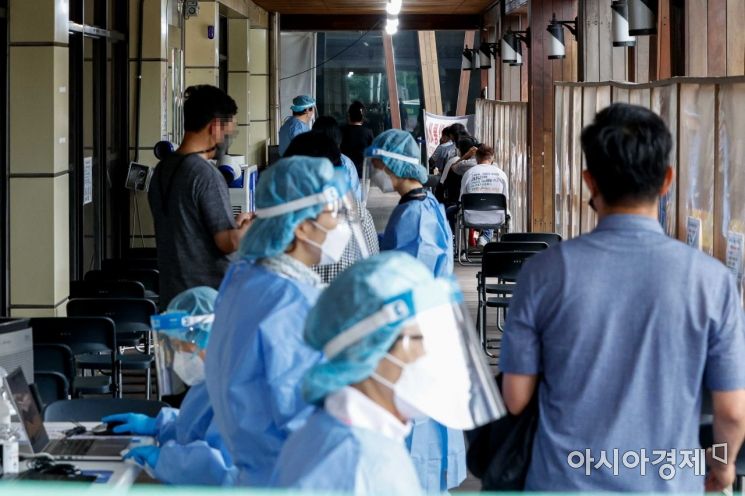
[Asia Economy Reporter Jo In-kyung] As the number of new COVID-19 cases, which had nearly reached 100,000 per day after the Chuseok holiday, has dropped back to 30,000 to 40,000, voices are emerging calling for a transition to a routine COVID-19 response system. Globally, with the number of new cases and deaths declining, expectations for the end of the COVID-19 pandemic are rising.
According to the Central Disease Control Headquarters on the 18th, as of midnight the previous day, the number of new COVID-19 cases increased by 43,457, bringing the total cumulative cases to 24,359,702. The daily new cases, which surged to 57,291 on the 13th and 93,967 on the 14th immediately after the holiday, have rapidly decreased to 71,471, 51,874, and 43,457 respectively. The nationwide new cases counted until 9 p.m. on the 17th stood at only 33,614, suggesting that the figure announced at midnight on the 18th is likely to be even lower than the previous day.
At a regular briefing on the 16th, Jeong Gi-seok, head of the Central Disaster and Safety Countermeasures Headquarters’ COVID-19 Special Response Team, suggested, "We should begin discussions on transitioning from the current emergency COVID-19 response system to a routine COVID-19 response system." This comes amid growing global expectations for the end of the COVID-19 pandemic, with WHO Director-General Tedros Adhanom Ghebreyesus stating the day before that "the end of the COVID-19 pandemic is in sight," emphasizing that South Korea should also prepare in advance for a full return to normal life.
Jeong expressed concern, saying, "As the pandemic ends globally, South Korea must not fall behind. Since most of our citizens' wealth is generated through trade, falling behind global trends would mean delays in recovery."
He also highlighted that other countries have already transitioned their COVID-19 measures to routine systems. The UK, Germany, France, Israel, the US, and Singapore have lifted indoor mask mandates except in certain facilities. France even declared the end of its health emergency last month on the 1st. Moreover, these countries have maintained stable case numbers without major outbreaks following the easing of restrictions.
Regarding indoor mask-wearing, Jeong emphasized, "South Korea mandates indoor mask use, but its strictness index?considering school and workplace closures?is very low compared to other countries. Few countries enforce indoor mask-wearing as strongly and inconveniently as South Korea does."
However, the recent spread of influenza (seasonal flu) is concerning, and an 'influenza epidemic advisory' was issued on the 16th, which could pose a variable on the path to true normalization. The health authorities point out the possibility of simultaneous outbreaks of flu and COVID-19, and that immunity among the population may drop to its lowest around late November, potentially triggering another resurgence.
Jeong urged, "While discussing the timing, speed, and extent of easing measures, the well-established principles of infection control must not be disrupted. Even if the anticipated seventh wave occurs this winter, daily life should not be shaken, nor should the public suffer."
© The Asia Business Daily(www.asiae.co.kr). All rights reserved.

















