[Seoul District News] Seodaemun-gu Announces Survey Results on 'Sinchon Yonsei-ro Vehicle Traffic' on the 2nd... Majority Support from Merchants and Visitors Near Yonsei-ro... Eunpyeong-gu to Host 'Classics Lecture' with Classical Translation Institute from September to November
[Asia Economy Reporter Park Jong-il] Seodaemun-gu conducted a survey last month through G&Com Research regarding the allowance of vehicle traffic in the ‘Sinchon Yonsei-ro Public Transportation-Only Zone,’ and the results showed a high level of support mainly among merchants and visitors to facilities near Yonsei-ro.
According to the results announced by the district on the 2nd, 67.1% (173 out of 258) of merchants supported the measure. Earlier, on the 5th of last month, 1,984 Sinchon merchants submitted a petition to the district office stating that “although the public transportation-only zone has been in operation for the past eight years, it has not led to revitalization of the commercial area, so it is now time for change,” and requested the allowance of vehicle traffic on Yonsei-ro.
Among visitors to Severance Hospital, Hyundai Department Store Sinchon Branch, and Changcheon Church located near Yonsei-ro, support for vehicle traffic was also high.
Among 422 visitors to Severance Hospital, 74.9% (316 people) supported the measure, and the hospital officially expressed a supportive stance.
For Hyundai Department Store Sinchon Branch, 71.9% (577 out of 802) of visitors and 84.6% (987 out of 1,166) of employees supported the measure.
Among 372 church members and visitors to Changcheon Church, 97.3% (362 people) expressed support. The department store and church conducted their own surveys.
In contrast, among 1,393 university students (Yonsei University), 71.9% (1,002 people) opposed the measure, showing a clear contrast.
This survey result only includes respondents who expressed a clear opinion for or against; those who did not respond or answered “no opinion (don’t know)” were excluded.
Based on these results, the district plans to request traffic review from the police and proceed with consultations with the Seoul Metropolitan Government.
Seodaemun-gu expressed its position regarding opposition to the traffic system change in Sinchon Yonsei-ro, mainly from university students and environmental groups.
The district explained that concerns about reduced pedestrian space and shrinking festivals and cultural performances are unfounded, as the current structure of Yonsei-ro?with a lane width of 3.5m and a sidewalk width of 6m?will be maintained.
They stated, “If large-scale events are necessary, prior notice will be given and traffic will be controlled accordingly,” adding, “It is inefficient to block general vehicle traffic on Yonsei-ro 365 days a year just because of performances or festivals.”
They also noted that busking and small to medium-sized festivals can continue to be held as they are now at locations such as Star Square in front of Sinchon Play Bus, the pedestrian rest area on Myeongmul-gil (wooden deck), Changcheon Cultural Park in front of Sinchon Parang Whale, and sidewalks.
Regarding criticism that this goes against climate crisis response, they mentioned that the Yonsei-ro public transportation-only zone does not significantly affect the overall reduction of vehicle traffic volume.
In other words, there are almost no cases where vehicles are not operated simply because they cannot pass through Yonsei-ro, and even if vehicles detour around Yonsei-ro via surrounding roads, pollutants such as exhaust gases are still generated.
In response to concerns that Sinchon Yonsei-ro will become a habitual traffic congestion road again, the district stated that even if vehicle traffic resumes, the current traffic signal system will be maintained, and the number of passing vehicles is expected to decrease by 42% compared to before the implementation of the public transportation-only zone.
Traffic volume analysis showed that before the public transportation-only zone was implemented, during rush hour, about 400 to 500 vehicles per hour entered Yonsei-ro from both directions, but after general vehicle traffic resumes, it is predicted that about 250 to 300 vehicles will enter from the Yonsei University side and about 250 vehicles from the Sinchon Five-way Intersection side.
This is because only vehicles turning right from the Yeonhui IC side heading toward the Yonsei University main gate and vehicles turning right from the Ewha Womans University side heading to Sinchon Five-way Intersection will be allowed to enter Yonsei-ro, while entry from the Sogang University direction or straight ahead toward Yonsei-ro from the Yonsei University main gate, which was possible before the public transportation-only zone, will continue to be prohibited as it is now.
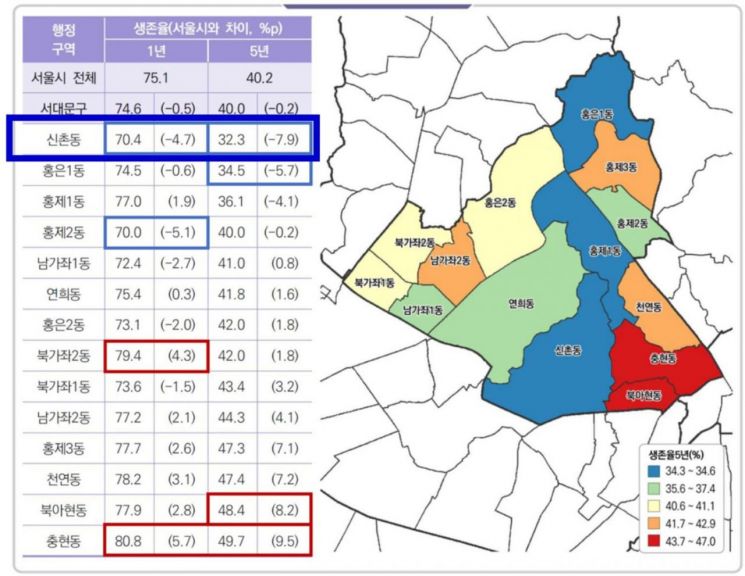
Regarding claims that the operation of the public transportation-only zone should be maintained because it helps revitalize the Sinchon commercial area, the district revealed that in Sinchon-dong, where Yonsei-ro is located, the five-year survival rate of commercial stores is 32.3%, the lowest among the 14 neighborhoods in Seodaemun-gu.
Additionally, the number of stores in Sinchon-dong decreased by 3.3%, from 3,715 in 2019 to 3,593 in 2021, which was the second largest decrease among the 14 neighborhoods in Seodaemun-gu.
Furthermore, analysis of store openings and closures in 2021 showed that while Seoul overall had 2,467 more openings than closures and Seodaemun-gu had 42 more openings than closures, Sinchon-dong had 322 openings and 413 closures, resulting in a net decrease of 91 stores, the largest among the 14 neighborhoods.
These statistics are based on data from the ‘Seoul Our Neighborhood Store Commercial Area Analysis Service’ and the ‘Seoul Small Business Policy Research Center Analysis.’ Sinchon-dong, where Yonsei-ro is located, has both a five-year survival rate and store growth rate below the Seoul average and is classified as an area requiring ‘commercial area decline management policy.’
The district stated that since the limitations of the public transportation-only zone for commercial revitalization have become apparent, it is time to seek new opportunities through various small business support policies as well as the ‘normalization of vehicle traffic on Yonsei-ro.’
Finally, the district emphasized that the main reason for promoting the traffic system change on Yonsei-ro is the merchants’ desire to revitalize the Sinchon commercial area, and that the basic consensus on the need for Yonsei-ro reorganization among candidates from all parties in the recent local elections shows that it is not being pursued for other reasons.
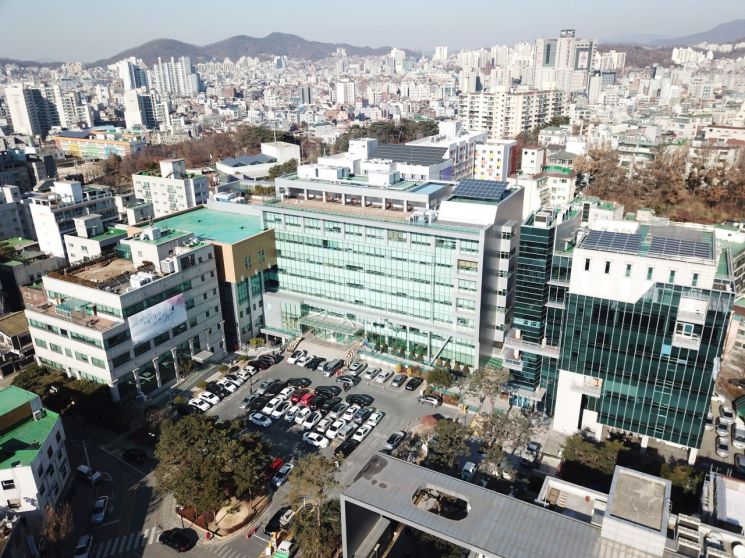
Eunpyeong-gu (Mayor Kim Mi-kyung) announced that it will operate a classical literature special lecture series titled ‘Time to Move the Heart with Classics’ from September to November in collaboration with the Korean Classics Translation Institute, a cultural facility in the area.
This program aims to enhance residents’ understanding of classical translation as part of the ‘Eunpyeong-gu and Korean Classics Translation Institute Business Agreement.’ It seeks to specialize classical content and promote tourism by widely publicizing the region.
The classical literature special lectures will be held 19 times both online and in-person, providing high-quality educational opportunities. Participation is free, and anyone, including Eunpyeong-gu residents and the general public, can join without restrictions on location or time.
A total of seven well-structured courses reflecting specialized classical content have been prepared. The online lecture starting on the 19th, ‘Reading Gyo-san (蛟山) Heo Gyun’s (許筠) "Han Jeong-rok (閒情錄)" ? Classical Literature Encountered on a Journey,’ is a unique attempt to approach classical literature from a modern perspective.
Other courses include ▲‘Stories of Chinese Culture through Chinese History and Food’ ▲‘The New World of Chinese Suzhou Literati Landscape Paintings Seen with Landscape Paintings and Classical Chinese Poetry’ ▲‘The Various Worlds of the Seungjeongwon Ilgi Seen through Miscellaneous Knowledge and Miscellaneous Affairs’ ▲‘Classical Literature Encountered on a Journey’ ▲‘Stories of Chinese Culture through Chinese Alcohol and Mountains’ ▲‘Why Did Yi Gyubo Tear Down the Soil Room (土室)?’
Applications will be accepted online on a first-come, first-served basis from the 5th to the 16th through the Classical Translation Education Institute’s academic management system. Certificates of completion can be issued online after the course.
For more details, visit the Classical Translation Education Institute’s website or contact the Classical Translation Education Institute or Eunpyeong-gu Office’s Culture and Tourism Division.
Kim Mi-kyung, Mayor of Eunpyeong-gu, said, “I hope many residents will have an enjoyable time learning anew about the classics.”
© The Asia Business Daily(www.asiae.co.kr). All rights reserved.


















