'Debt Excess' Fact Known: Limited Inheritance Approval Possible Within 6 Months
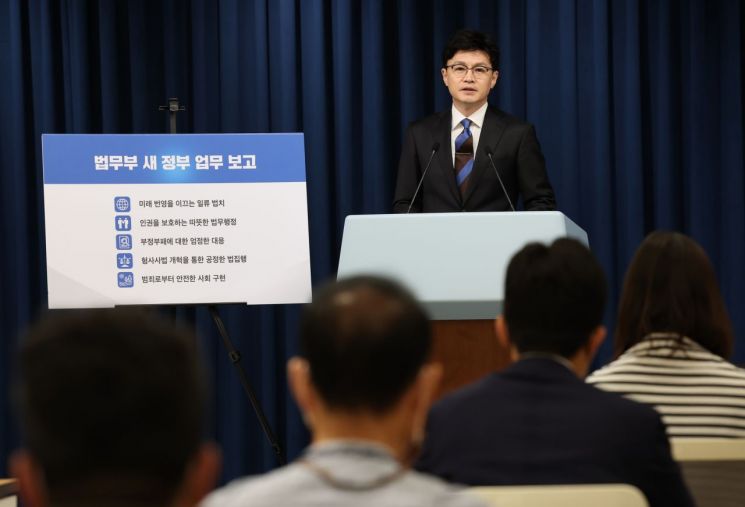 On the 26th of last month, Han Dong-hoon, Minister of Justice, is briefing President Yoon Seok-yeol on the contents of the departmental work report after delivering the report at the briefing room of the Presidential Office building in Yongsan, Seoul. [Image source=Yonhap News]
[Asia Economy Reporter Choi Seok-jin, Legal Affairs Specialist] A revision to the Civil Act aimed at preventing the "inheritance of debt," where minor children inherit their deceased parents' debts, has passed the Cabinet meeting.
If this revision passes the National Assembly and is implemented, minors who are deemed to have simply accepted inheritance because their legal representatives did not timely file for limited acceptance or renunciation of inheritance, despite the deceased parents' debts exceeding the inherited assets, will be able to file for limited acceptance within a certain period after reaching adulthood.
On the 9th, the Ministry of Justice announced that the partial revision of the Civil Act, allowing minor children to choose their method of inheritance after becoming adults, has passed the Cabinet meeting.
Under the current Civil Act, when the deceased parent (the decedent) passes away, the inheriting children can choose one of the following: "simple acceptance," which means inheriting both the decedent's assets and liabilities; "renunciation of inheritance," which denies all rights and obligations related to the inheritance; or "limited acceptance," which limits liability for the decedent's debts to the value of the inherited assets.
The problem arises when the legal representatives of minors fail to file for limited acceptance or renunciation within the prescribed period (three months from the date they become aware of the commencement of inheritance), causing the minor children to inherit all of the parents' debts. This has led to cases where individuals become credit delinquents before even starting social life or continue to suffer from debts after reaching adulthood, making normal economic activities impossible.
Accordingly, the revision adds Paragraph 4 to Article 1019 of the Civil Act concerning acceptance or renunciation of inheritance, allowing ▲ those who learn after reaching adulthood that the inheritance debts exceed the inherited assets to file for limited acceptance within six months from the date they become aware of this fact, and ▲ those who knew before adulthood to file within six months from the date they reach adulthood.
According to the supplementary provisions of the revision, the amended law will generally apply to cases where inheritance commences after the enforcement of the revised law.
However, to maximize protection for minors, the Ministry of Justice stated that even if inheritance commenced before the enforcement of the revised law, the following cases will be eligible for the benefits of the revised law: ▲ if the three-month period from the date of awareness of inheritance commencement has not passed at the time of enforcement, ▲ if a minor who simply accepted inheritance without knowing within three months from the date of awareness that debts exceed assets, and the three-month period from the date they learn of the debt excess has not passed, ▲ or if such a minor learns of the debt excess after the enforcement of the revised law.
The Civil Act revision disclosed by the Ministry of Justice in April had included a provision for retroactive application to all cases where inheritance commenced before the enforcement, but the scope of retroactivity has been somewhat reduced.
Minister of Justice Han Dong-hoon stated, "This 'debt inheritance prevention' bill continues efforts started by the previous government and is an essential policy to protect minors," adding, "Going forward, the Ministry of Justice will base its actions solely on the interests of the people, not political or factional logic, continuing good policies and boldly changing bad ones."
The Ministry of Justice said it will promptly submit the partial revision of the Civil Act containing these provisions to the National Assembly and make every effort to ensure its passage.
© The Asia Business Daily(www.asiae.co.kr). All rights reserved.

















