Interview with Jo Seung-rae, Democratic Party Lawmaker Who Led the Proposal of the 'Google Gapjil Prevention Act'
Fact-finding, Sanctions, and Case Accumulation Are Important
Broadcasting Commission Lost Enforcement Power, Responsibility Lies with the Democratic Party
They Must Work with Responsibility and Authority
App Market Only Maintains and Manages, Difficult to Accept 30% Commission Fee
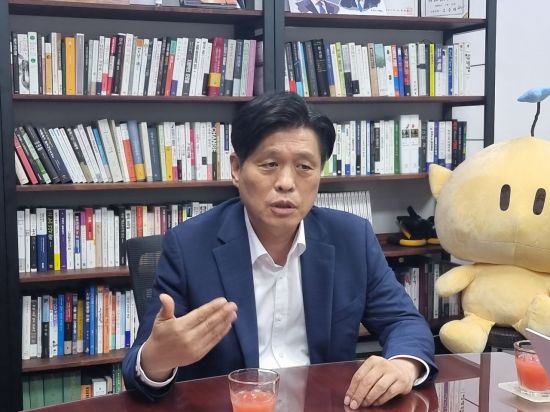 On the 14th, Cho Seung-rae, a member of the Democratic Party of Korea, is conducting an interview with Asia Economy at the National Assembly Members' Office Building in Yeouido.
[Asia Economy Reporter Minyoung Cha] Kakao, which had been providing web payment links within the KakaoTalk application (app) in defiance of Google's mandatory in-app payment policy, has surrendered by deleting the links. Google allowed the KakaoTalk app update through Google Play. This occurred about two weeks after the conflict between the two companies escalated. Although Kakao has backed down, this incident has sparked growing calls from the political sphere for the Korea Communications Commission to thoroughly investigate whether any laws were violated.
On the 14th, Cho Seung-rae, a member of the Democratic Party of Korea and the main proposer of the 'Google Gapjil Prevention Act' (photo), said in an interview at the National Assembly Members' Office Building in Yeouido, "It is now time for the Korea Communications Commission to accurately determine whether Google has violated the law," adding, "Since KakaoTalk, used by over 50 million people, has attracted public attention and the Korea Communications Commission announced plans to shift from a fact-finding survey to an investigation following a tripartite meeting (KCC, Google, Kakao), progress has been made." He emphasized that it is crucial to continuously accumulate cases of violations, conduct fact-finding investigations by regulatory authorities, and link these to actual sanctions.
Cho, who has publicly criticized the Korea Communications Commission for not taking strong action against Google, also blamed the ruling party for the commission losing its momentum to impose sanctions. He said, "Although KCC officials verbally express their commitment to work hard, they are only watching the situation cautiously," and added, "The ruling party should provide concrete guidelines and allow the KCC chairman to work with responsibility and authority instead of continuously undermining him."
The fundamental reason the political sphere seeks to impose sanctions on global app market operators like Google and Apple is the judgment that the 30% commission fee is excessive. Cho pointed out, "The digital economy involves initial costs, but as the scale grows, costs actually decrease, and app markets fall into this category," adding, "Charging a 30% commission just for maintenance and management is an unreasonable level."
Korea's unique platform ecosystem complicates legislative efforts in the National Assembly. The United States maintains minimal regulation on platform businesses due to the presence of global big tech companies, while the European Union (EU), where domestic platforms are weak, adopts a regulation-heavy approach. In Korea, domestic large platforms like Naver and Kakao compete with overseas big tech companies, necessitating both promotion and regulation. Cho emphasized, "Because Korea has domestic platforms, we need to reflect both the U.S. and European cases," and added, "This is why big tech regulation cannot be resolved domestically and must be addressed globally."
Efforts for international cooperation continue as well. The law banning mandatory in-app payments, passed in August last year as the world's first legislation regulating app market monopolies, attracted global attention. In the U.S., laws related to big tech sanctions are being discussed under the leadership of Republican Senator Marsha Blackburn. The EU announced in March this year the introduction of the 'Digital Markets Act (DMA),' which prohibits preferential treatment of affiliated businesses by big tech companies. At the 'CES 2022 event' in January, Cho met with officials and plans to hold an international conference this fall and attend a year-end meeting in Europe. Cho said, "It is important to establish standards for big tech regulation," and stressed, "We must carefully design domestic laws to fit the unique characteristics of Korea's IT platform ecosystem."
© The Asia Business Daily(www.asiae.co.kr). All rights reserved.

















