"Growth Accelerates When Humidity Is High and Temperature Exceeds 30°C"
"Issues May Arise Around Early to Mid-August During Summer Laying Season"
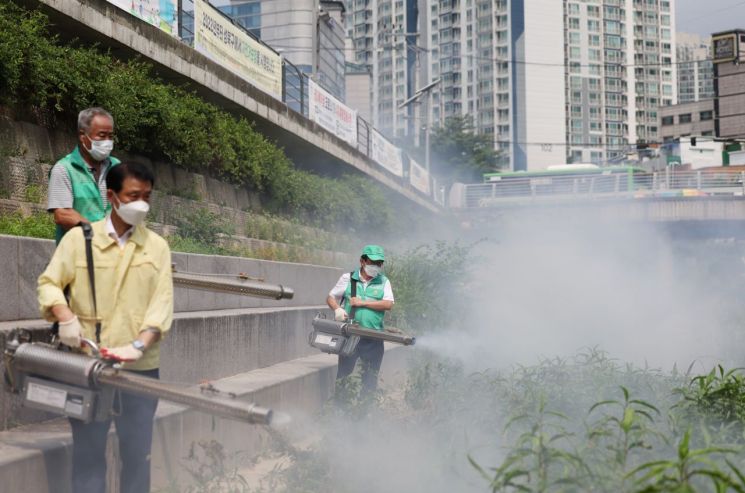 On the 5th, Lee Seung-ro, the mayor of Seongbuk-gu, and quarantine volunteers conducted disinfection along the Seongbukcheon promenade in front of Seongbuk-gu Office to prepare for the recent massive outbreak of lovebugs in the city.
 [Image source=Yonhap News]
[Asia Economy Reporter Kim Jung-wan] In some areas of Seoul and Goyang City in Gyeonggi Province, a large swarm of so-called 'love bugs' has appeared, causing inconvenience to residents. Experts predict that the next week to ten days will be the 'peak' period.
Professor Yang Young-chul of the Department of Health, Environment, and Safety at Eulji University recently appeared on YTN's 'Wise Radio Life' and commented on the 'love bug' outbreak, saying, "Last week, there was heavy rain followed by strong sunlight over the weekend, which raised the temperature significantly and maintained appropriate humidity levels. It seems that this has led to the current peak." He added, "For the next week, it will be peak time with many individuals visible," and "I think it will subside somewhat after about ten days."
Professor Yang analyzed the cause of the love bug outbreak, stating, "It is because the current environment is favorable for their growth." He explained, "When humidity is high and temperatures exceed 30 degrees Celsius, their growth rate accelerates significantly. That is why many adults have appeared in the past few days."
He also predicted, "As they enter the summer season and continue their activity and egg-laying, another outbreak could occur in about a month to 40 days," adding, "There could be another problem around early to mid-August."
However, he noted, "Love bugs emerge from their original habitats and fly into residential and commercial areas, but it is difficult for them to return to their habitats to lay eggs. Most of those flying in will likely complete their life cycle there."
He further explained, "Since local governments are conducting pest control operations, these bugs will be exterminated, and their reproduction through egg-laying can be suppressed. Those that live and mate at the source of the outbreak and do not move to commercial areas will lay eggs nearby. Although adults will appear again in about a month or 40 days, their numbers are expected to be low."
© The Asia Business Daily(www.asiae.co.kr). All rights reserved.

















