Once a 'Supoja' Who Dreamed of Being a Poet, Solves a 50-Year Math Problem
Korean National with U.S. Citizenship, Completed University in Korea
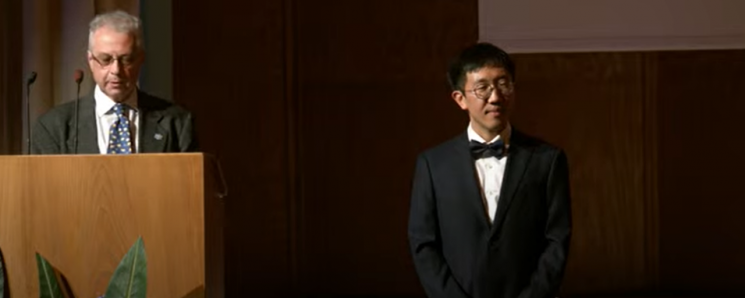 On the 5th, Huh Joon-yi, associate professor in the Department of Mathematics at the Korea Institute for Advanced Study, who won the Fields Medal organized by the International Mathematical Union (IMU) (right).
[Asia Economy Reporter Kim Bong-su] "We have resolved a 120-year grudge in the Korean mathematics community."
Heo Jun, the first Korean mathematician to win the Fields Medal, known as the "Nobel Prize of Mathematics," is a distinguished professor at the Korea Institute for Advanced Study (KIAS) and a professor at Princeton University in the U.S. In fact, he was a strong candidate who narrowly missed the award in the previous cycle in 2018.
Professor Heo especially seized the highest honor in mathematics in what was his last year eligible to receive the Fields Medal. The Fields Medal is awarded to young mathematicians under the age of 40, and he was born in June 1983.
Although Professor Heo is a Korean-American born while his parents were studying in California, U.S., he is Korean, having grown up in Korea from the age of two. He spent his childhood and formative years and completed his master's degree in Korea. He graduated from Bangil Elementary School and Isu Middle School in Seoul but dropped out of Sangmoon High School. The well-known story is that he quit Sangmoon High School to pursue becoming a poet and then passed the qualification exam. In 2007, he entered Seoul National University’s Department of Physics and Astronomy, majoring in astronomy.
Then, he met Professor Kim Young-hoon of Seoul National University’s Department of Mathematical Sciences and began a double major in mathematics, starting his path as a mathematician. Among Seoul National University students, he was known for studying "advanced mathematics," a course only taken by gifted students with exceptional intellect, and was praised for his calmness and strong concentration. Particularly, attending classes by Heisuke Hironaka, a Japanese professor emeritus at Kyoto University who won the Fields Medal in 1970, sparked his interest in algebraic geometry, marking a turning point in his life. In 2009, he earned a master's degree in mathematics from the same university.
Afterward, Professor Heo went to study in the U.S., but it was a challenging journey. While he was considered a genius mathematician in Korea, he was unknown in the international mathematics community. He sent applications to over ten graduate schools abroad but received admission offers from only one, facing cold treatment. However, this cold reception soon turned into admiration and praise.
In 2012, during his doctoral studies, Professor Heo solved the "Reed conjecture," a long-standing unsolved problem in mathematics that had remained unresolved for nearly 50 years, instantly becoming a star in the mathematics world. The Reed conjecture mathematically expresses a specific pattern of coefficients observed when calculating chromatic polynomials and was one of the challenging problems posed in 1968. He also solved another difficult problem, the "Rota conjecture," sweeping prestigious global science awards such as the Blavatnik Young Scientists Award (2017) and the New Horizons in Mathematics Prize (2019). The Rota conjecture was proposed in 1971 by American mathematician Gian-Carlo Rota. He also received the Ho-Am Prize, Korea’s highest academic award.
Before joining Princeton University last year, he spent six years as a long-term researcher and visiting professor at the Institute for Advanced Study (IAS) in Princeton, a place where world-renowned intellectuals like Einstein have worked. From 2020 to 2021, he was also a professor at Stanford University. He is also a distinguished professor at the Korea Institute for Advanced Study (KIAS).
Meanwhile, the Fields Medal is awarded by the International Mathematical Union (IMU) every four years at the International Congress of Mathematicians to young mathematicians who have made outstanding achievements. There is also the Abel Prize, which evaluates lifetime achievements. Since there is no Nobel Prize in mathematics and only 2 to 3 recipients are awarded each year, the Fields Medal is considered the highest honor in mathematics, even more difficult to receive than the Nobel Prize.
Korea’s status in the mathematics community has recently risen sharply. In February this year, the IMU confirmed the upgrade of Korea’s national mathematics rating from Group 4 to the highest Group 5. Since joining the IMU as a Group 1 country in 1981, Korea has become the fastest country to be promoted to Group 5. Currently, Group 5 countries include Korea, Germany, Russia, the United States, the United Kingdom, Israel, Japan, China, France, and a total of 12 countries.
© The Asia Business Daily(www.asiae.co.kr). All rights reserved.

















