Over Thousands of Fake Reviews Confirmed on Online Shopping Malls
'Empty Box Marketing' Bypassing 'Verified Purchaser' Authentication
Instructions to Write Reviews Given by Hiring 'Side Job Part-timers' on SNS
 Empty box marketing is an advertising method where consumers attract attention by receiving only empty boxes without paying for the products ordered from online shopping malls and then writing fake reviews. / Photo by Yonhap News
[Asia Economy Reporter Lim Juhyung, Intern Reporter Song Hyundo] So-called 'empty box marketing,' which attracts consumers' attention by posting fake reviews in the product review sections of online shopping malls, is rampant. This method was created to circumvent the terms of use of online shopping mall operators such as Coupang and Naver. Some companies leading empty box marketing have even shown meticulousness by partnering with advertising agencies to massively hire part-time workers to produce fake reviews.
The Fair Trade Commission (FTC) recently decided to impose corrective orders and fines totaling 140 million KRW on electronics manufacturer and seller OA Store, advertising agencies UN Media and Youth Distribution, applying the "Act on Fairness in Advertising and Labeling."
According to the FTC, these companies wrote and posted over 3,700 fake reviews using the empty box marketing method over about a year from May 2020 to May last year.
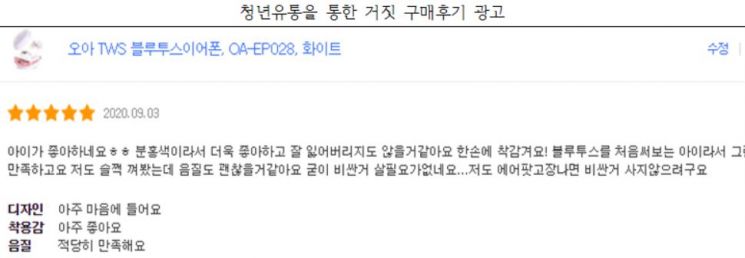
E-commerce companies such as Naver and Coupang require 'real purchaser verification' to prevent manipulation of product reviews. Consumers must enter the tracking number printed on the delivery box to post a review on the board. This system allows only actual consumers who purchased the product to write reviews.
However, companies engaging in empty box marketing evade this verification method by first having part-time workers purchase their products, then sending only empty packaging boxes without the products inside. The part-time workers who receive the boxes use the tracking number information on the box to write and post fake reviews, after which the companies reimburse the purchase amount and additionally compensate the workers for their effort.
To facilitate this, companies often collaborate with advertising agencies or distribution companies, as a large number of part-time workers to post fake reviews and a distribution network to send empty boxes are required. In one company that received a corrective order this time, the agency recruited part-time workers and managed the fake review writing process, while the distribution company registered itself as a seller on Naver and Coupang and handled empty box delivery and purchase refund tasks.
 Open chat rooms recruiting part-time workers for writing reviews registered on KakaoTalk on the 28th. / Photo by KakaoTalk
Part-time workers involved in empty box marketing are hired unofficially through social networking service (SNS) chat rooms such as KakaoTalk, rather than through typical job search websites.
From a search of KakaoTalk open chat rooms conducted by this outlet from the 27th to the 28th, chat rooms titled "Review side job recruitment," "Review writing part-time job," and similar were found. One chat room had over 200 participants.
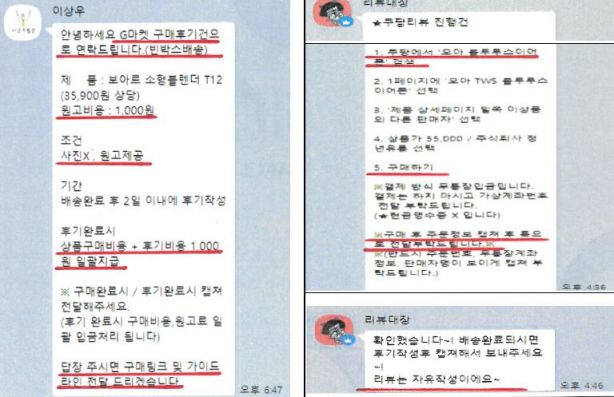 Instructions for writing fake reviews conducted as a 'side job' are mainly known to be carried out through social networking services (SNS). The photo shows the empty box marketing instructions from some advertising agencies disclosed by the Fair Trade Commission. / Photo by Fair Trade Commission
Because the authenticity of reviews is ambiguous, authorities face limitations in cracking down and imposing sanctions. The FTC cannot investigate and detect every suspicious case individually.
Previously, from April last year to February this year, the FTC monitored fake review advertisements conducted via SNS and other channels and found a total of 18,062 cases of false advertising. When the FTC requested advertisers to voluntarily correct these, a total of 31,829 advertisements?about 50% more than the detected cases?were corrected. This suggests that many more fake review advertisements than those detected by authorities have already spread on the internet.
Regarding this, the FTC stated, "'Empty box marketing' cases involve malicious methods and were conducted on a large scale, so we judged that strict sanctions are necessary. The reputation of products and brands formed through false review advertisements affects sales even in offline markets. We will continuously monitor acts that hinder consumers' proper purchasing choices and disrupt fair trade order, and impose strict sanctions upon detecting violations."
© The Asia Business Daily(www.asiae.co.kr). All rights reserved.



















