KRICT Develops Self-Healing Transparent Protective Coating Material
[Asia Economy Reporter Kim Bong-su] A transparent protective coating material that can self-repair within 30 minutes under sunlight when a car surface is scratched has been developed.
On the 28th, the Korea Research Institute of Chemical Technology announced that the research team led by Drs. Kim Jin-cheol, Park Young-il, and Jung Ji-eun developed a transparent coating material that self-heals with sunlight alone while maintaining the same durability and performance as existing protective coating materials.
Protective coating materials must be colorless and transparent to reveal the original color of the product, and they must have good durability to protect the surfaces of high-value products. In particular, automotive protective coatings should not be significantly affected by external changes such as temperature. Until now, it has been very difficult to satisfy all these conditions while providing self-healing functionality. For effective self-healing, molecular mobility must be free, which weakens durability, and the specific conditions that trigger self-healing can degrade the coating material’s performance. In the case of automotive coatings, a Japanese car company has commercialized a self-healing coating material, but it has not been widely used due to poor durability and difficulty in repainting.
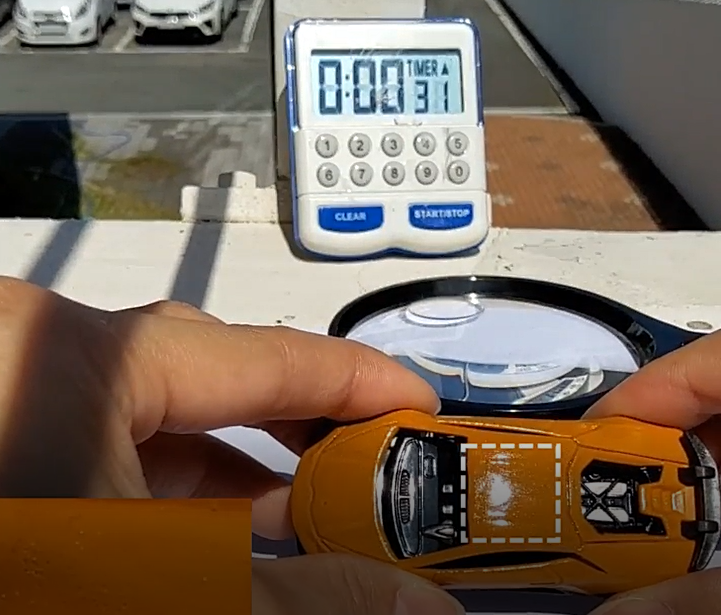
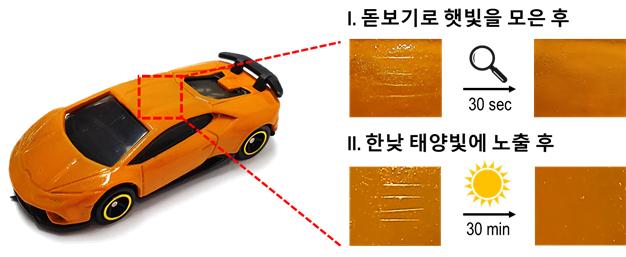
When the developed material is coated on a car, scratches on the surface can disappear by themselves after being exposed to midday sunlight for more than 30 minutes. The research team coated a car model with the new material, scratched the surface, and after about 30 minutes of exposure to midday sunlight, confirmed that the scratches completely disappeared and the coating surface was restored. They also confirmed that when light was concentrated using a magnifying glass, the scratches completely vanished after 30 seconds. When sunlight is absorbed, light energy converts into heat energy, raising the surface temperature. As the temperature rises, polymers repeatedly break and reform their original network structure, enabling self-healing.
The research team designed dynamic chemical bonds in which polymers repeatedly break and recombine by adding a specific substance (hindered urea) to existing commercial coating materials, and mixed in a transparent photothermal dye so that dynamic chemical bonding could actively occur when exposed to sunlight.
Although there have been previous attempts to study self-healing functions using photothermal dyes, they typically used colored inorganic materials, making industrial application difficult for coatings that must be transparent. Another drawback was the need for a large amount of light energy to produce the photothermal effect.
The photothermal dye used by the research team is a transparent organic compound that uses near-infrared wavelength light energy. Near-infrared is a long-wavelength energy source that accounts for less than about 10% of midday sunlight, which helps prevent excessive surface temperature rise during outdoor car operation. Additionally, the organic photothermal dye has no inherent color, does not affect the product’s color, blends well with various paints, and is cost-effective, making it advantageous for commercialization.
The self-healing coating material developed by the research team is expected to be used in the future for coatings on transportation devices such as automobiles, electronic and information devices like smartphones and computers, and building materials. It can also contribute to achieving carbon neutrality by reducing the use of harmful organic solvents that are heavily used during automotive repainting.
The research results were published as the cover paper in the May issue of the international scientific journal in the field of science and technology, ‘ACS Applied Polymer Materials.’
Dr. Kim Jin-cheol said, “The technology developed this time is a platform technology for synthesizing self-healing coating materials using inexpensive commercial polymer materials and photothermal dyes, and it is expected to be widely used in various application fields.”
© The Asia Business Daily(www.asiae.co.kr). All rights reserved.


















