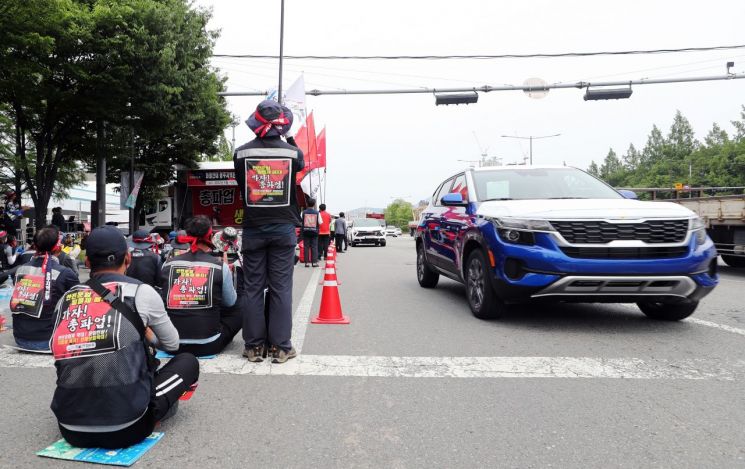
 On the afternoon of the 10th, the fourth day of the general strike by the Cargo Solidarity Headquarters of the Korean Public Service and Transport Workers' Union (hereinafter Cargo Solidarity), unlicensed finished vehicles being individually transported without using car carriers passed by the rally site of Cargo Solidarity union members in front of the Kia Motors production plant in Seo-gu, Gwangju.
 [Asia Economy Reporter Choi Dae-yeol] Due to the total strike by the Korean Confederation of Trade Unions (KCTU) Cargo Solidarity, which has led to a refusal of transportation, even regular employees have been deployed to handle delivery tasks to send new cars from Hyundai Motor and Kia to customers.
According to industry sources on the 10th, employees belonging to Hyundai Motor's Domestic Business Headquarters went to the Ulsan plant to start delivery work to move finished vehicles out of the factory and to the shipping center for customer delivery. This is called road delivery. Earlier, Kia had deployed regular employees starting from the 8th.
For finished car manufacturers to continuously produce vehicles, delivery work must be carried out to move finished cars from the factory to an external shipping center storage yard. This is because internal factory space is limited. Typically, new car delivery is done through Hyundai Glovis, an affiliate of Hyundai Motor Group, using car carriers loaded with new cars.
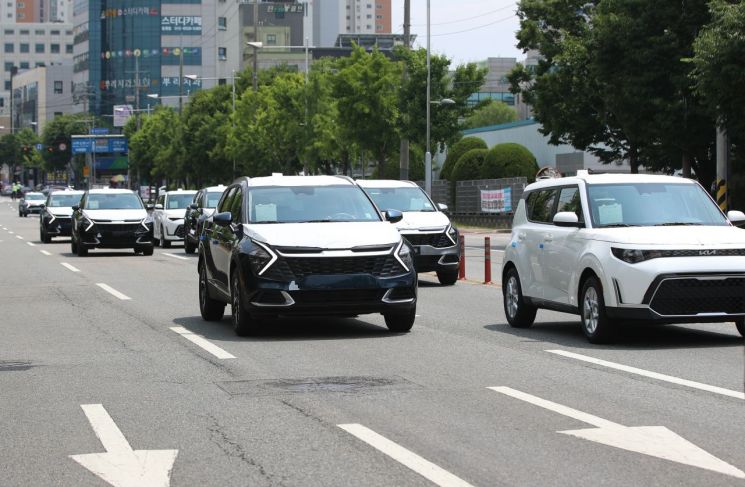 On the afternoon of the 9th, vehicles produced at Kia Motors Gwangju Plant in Seo-gu, Gwangju, were being moved to another garage without license plates. As it became difficult to mobilize car carriers due to the Cargo Solidarity strike, Kia took the desperate measure of having office workers drive the finished cars themselves after obtaining temporary operation permits.
 Due to the Cargo Solidarity strike, contracted delivery work with Hyundai Glovis is not being carried out. It is known that about 70% of the cargo workers belonging to Glovis's partner companies are members of the Cargo Solidarity union. Hyundai Motor and Kia are reported to have obtained temporary operation permits for this situation. This is why vehicles without even temporary license plates are seen on the streets.
The Ulsan plant road delivery requires driving directly about 100 km from outside the factory to the nearby Yeongnam and Chilgok centers. Hyundai Motor Group operates six plants domestically, but for now, only the Ulsan plant, which has the largest production scale, has deployed regular employees. It is known that employees at other plants handle the work themselves.
Hyundai Motor plans to extend the warranty coverage by an additional 2,000 km of driving distance under the vehicle engine and general parts system warranty for customers receiving vehicles moved through this road delivery. It is reported that Hyundai Motor's Ulsan plant is currently operating at about half its usual capacity due to parts supply disruptions and other issues.
© The Asia Business Daily(www.asiae.co.kr). All rights reserved.


















