April volume 41,694 cases, down 20.3% from March
Transition Team excludes transfer tax surcharge... Homeowners shift to sales
If shortage continues, rental chaos may occur after August
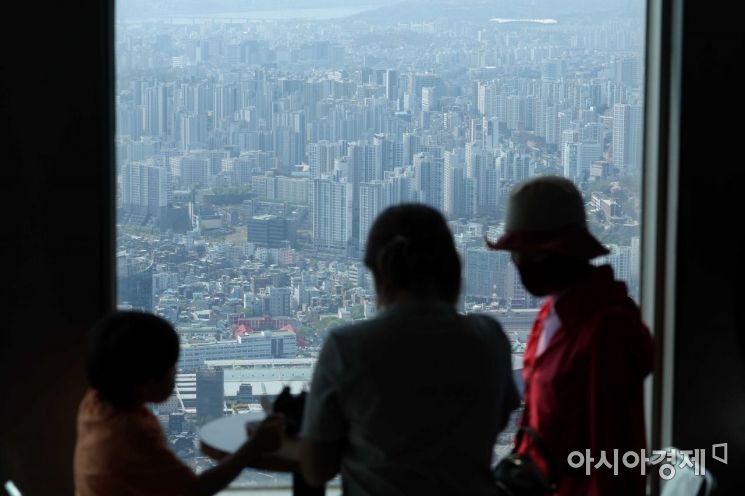 The volume of apartment sales in Seoul has turned to an upward trend for the first time in eight months. According to the Seoul Real Estate Information Plaza, there were 937 sales transactions in Seoul in March, a 16.4% increase compared to the previous month (805 transactions). This marks a rebound after seven consecutive months of decline from August last year (4,064 transactions) through February this year (805 transactions). It appears that the market, which had been frozen due to expectations of regulatory easing, is beginning to breathe again. A view of apartments from Namsan on the 11th. Photo by Moon Honam munonam@
[Asia Economy Reporter Kangwook Cho] The supply of apartment jeonse and monthly rental units in Seoul has sharply decreased by more than 10,000 units since the presidential election. This is the largest decrease in quantity among the 17 metropolitan cities and provinces nationwide. It is attributed to the depletion of rapid jeonse due to the recent resumption of jeonse loans and landlords withdrawing listings to sell their properties by taking advantage of the temporary exemption from the capital gains tax surcharge. Some are increasingly concerned that a so-called ‘rental crisis’ may occur after August, marking two years since the implementation of the Lease Protection Act (Imdaecha 3-beop), as the shortage of jeonse and monthly rental units continues.
According to real estate big data company Asil (Apartment Real Transaction Price) on the 18th, the supply of apartment jeonse and monthly rental units in Seoul stood at 41,694 units as of that day, down 10,592 units (20.3%) from 52,286 units on the 9th of last month when the presidential election was held. Jeonse units decreased by 6,378 units (19.9%) from 32,168 to 25,790, and monthly rental units decreased by 4,214 units (21.0%) from 20,118 to 15,904.
During this period, Seongbuk-gu recorded the highest decrease rate at -28.5%, followed by Gangdong-gu (-27.9%), Gwangjin-gu (-27.6%), Songpa-gu (-27.1%), and Dobong-gu (-24.1%). Gangnam-gu, which has many high-priced and reconstruction complexes, also recorded -20.8%, with 11 out of 25 districts decreasing by more than 20%. Twenty-two districts showed a double-digit decrease. The supply of apartment jeonse and monthly rental units in Seoul had increased to 52,398 units on March 5 due to the transaction freeze caused by loan regulations and interest rate hikes since the second half of last year.
The market points to the recent partial easing of jeonse loan regulations by commercial banks as one of the causes of the decrease in jeonse and monthly rental units. The head of a real estate agency in Seongbuk-gu said, "The accumulated listings have recently been depleted all at once," adding, "Recently, as banks have eased loan regulations, the number of customers looking for jeonse units has increased."
The official announcement by the Presidential Transition Committee to exempt multi-homeowners from the capital gains tax surcharge also seems to have had an impact. Multi-homeowners, burdened by capital gains tax, are using this benefit to convert some jeonse and monthly rental units into sales. In fact, during the same period, the number of apartment sales listings in Seoul increased by 6.4%. By growth rate, Seoul ranked third among the 17 metropolitan cities and provinces nationwide, following Gwangju (40.4%) and Incheon (7.0%). Eight out of 25 autonomous districts in Seoul, including Songpa (11.6%), Geumcheon (11.6%), Gangbuk (11.6%), and Seongbuk (11.4%), showed double-digit growth.
Some express concern that the sharp decrease in jeonse and monthly rental units may be a precursor to a jeonse crisis in the fall. As the Lease Protection Act reaches its two-year mark, new contracts not subject to the 5% rent increase cap will be possible from August. If landlords raise the previously suppressed jeonse prices by four years’ worth at once, jeonse and monthly rental prices could soar, causing the rental market to fluctuate again. This is because, with the sharp rise in official property prices this year, the tax burden on multi-homeowners has increased, making it inevitable for landlords to pass on the tax burden to tenants.
The new government is reportedly aware of these concerns and is considering measures such as providing tax benefits to landlords who sign long-term contracts with tenants or limit rent increases to 5% or less. In particular, revising the Lease Protection Act is expected to be a priority for review. Won Hee-ryong, the nominee for Minister of Land, Infrastructure and Transport, recently pointed out that "Although the Lease Protection Act was introduced to protect tenants' housing rights, its uniform application has resulted in actual performance falling short of expectations."
© The Asia Business Daily(www.asiae.co.kr). All rights reserved.

















