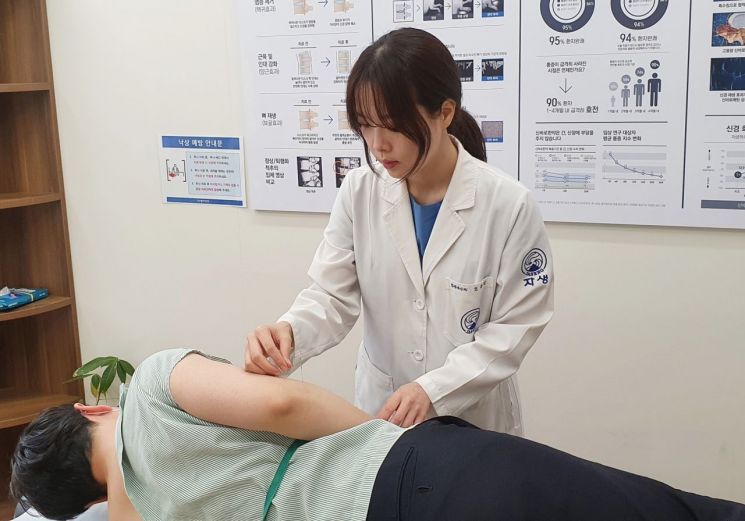
 Joye Jin Cho, a Korean medicine doctor at Jaseng Hospital of Korean Medicine, is performing acupuncture treatment on a patient with lateral epicondylitis.
[Asia Economy Reporter Lee Gwan-ju] The number of patients with tennis elbow (lateral epicondylitis) in South Korea has surged over the past several years. There were more female patients than male, and over half of the patients were middle-aged.
The research team led by Korean Medicine Doctor Cho Yoo-jin at Jaseng Spine and Joint Research Institute analyzed data from the Health Insurance Review and Assessment Service (HIRA) from 2010 to 2018 to examine the characteristics and medical utilization status of patients with lateral epicondylitis in South Korea, the team announced on the 14th.
The team set the study population as 213,025 patients who were diagnosed with lateral epicondylitis (disease classification code M771) and used medical services at least once over the nine years. Compared to 2010, the number of patients visiting medical institutions for lateral epicondylitis in 2018 increased by approximately 45.4%, and the total cost rose by 131.4%. The gender ratio showed 46.34% male and 53.66% female, indicating that females were 1.16 times more prevalent. By age group, 45-54 years accounted for 39.93%, 55-64 years for 23.12%, and 35-44 years for 21.07%, with middle-aged groups (45-64 years) making up more than half.
To examine the seasonal trend of lateral epicondylitis, the team analyzed the number of medical visits for lateral epicondylitis according to the average monthly temperature over nine years. They observed that the number of patients increased as the average monthly temperature decreased. The team interpreted this as cold weather slowing nerve responses that cause muscle contraction, increasing the risk of joint pain and injury.
The team also analyzed the medical utilization details of lateral epicondylitis patients. Among Korean medicine treatments, acupuncture was the most frequently performed with 313,109 cases. Following acupuncture were infrared therapy and cupping therapy. The number of patients visiting Korean medicine institutions for lateral epicondylitis rose from 2,354 in 2010 to 4,397 in 2018, an 86.8% increase, showing a more pronounced rise than the overall patient increase. In Western medical institutions, physical therapies such as deep heat therapy and superficial heat therapy accounted for the largest proportion. The most frequently prescribed injections were subcutaneous and intramuscular injections, and nerve block procedures were the most commonly performed surgeries.
Lateral epicondylitis refers to damage on the outer side of the elbow caused by active movements of the wrist or arm. It is often called tennis elbow because it frequently occurs in people who enjoy racket sports like tennis. It is distinguished from golfer’s elbow (medial epicondylitis), which causes pain on the inner side of the elbow. It occurs widely not only in athletes but also in people who frequently use their arms, such as housewives and chefs.
The research team stated, “This study is significant as the first paper to distinguish the characteristics, treatment types, and medical costs of lateral epicondylitis patients in South Korea between Korean and Western medicine.” They added, “By examining the demographic characteristics of patients with lateral epicondylitis and the treatments they received, this study can serve as basic data for national health policy decisions such as health insurance fees and budget allocation.”
The paper was published in the March issue of the SCI(E)-level journal Healthcare.
© The Asia Business Daily(www.asiae.co.kr). All rights reserved.

















