Medical Response Practically Limited
Government Reviews 'Emergency Plan' Ahead of Second Phase Easing of Quarantine Measures
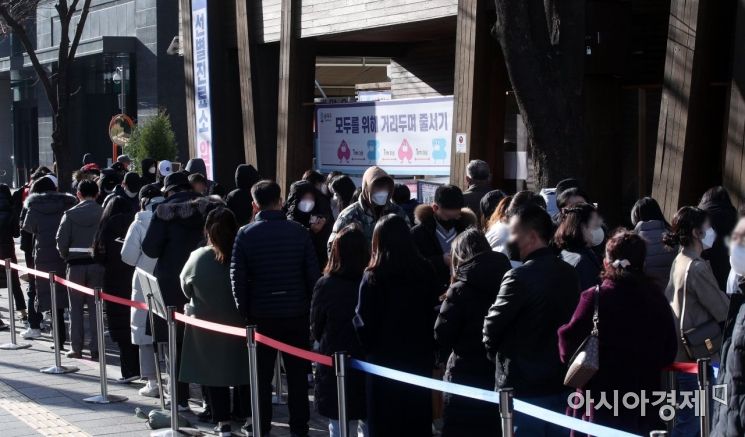 On the 24th, citizens lined up in a long queue at the screening clinic of the Songpa-gu Public Health Center in Seoul for diagnostic testing. On that day, the number of new confirmed cases reached 4,116, marking the highest number since the COVID-19 outbreak began in January last year. The number of critically ill patients also hit a record high at 586. Photo by Hyunmin Kim kimhyun81@
[Asia Economy Reporter Lee Chun-hee] The number of new COVID-19 cases has exceeded 4,000 for the first time. As confirmed cases surge, the healthcare response capacity is reaching its limits, prompting the government to consider an "emergency plan" to temporarily suspend the "gradual recovery to daily life (With COVID-19)" policy.
The Central Disaster and Safety Countermeasure Headquarters announced on the 24th at midnight that the number of confirmed COVID-19 cases increased by 4,116 to a total of 425,065. This is the first time daily confirmed cases have surpassed 4,000. A cluster infection occurred in a religious facility-based village in Cheonan, Chungnam, with 223 related confirmed cases reported in just one day, causing a sharp rise in cases. The weekly average of locally transmitted cases also rose to 3,164.
The healthcare response capacity is approaching its limit. As of 5 p.m. the previous day, the intensive care unit (ICU) bed occupancy rate exceeded 70%, with 806 out of 1,135 beds in use. In the metropolitan area, the occupancy rates were high: Seoul at 86.4%, Incheon at 81.0%, and Gyeonggi at 81.2%, with 582 out of 695 beds occupied, resulting in an overall occupancy rate of 83.7%. Excluding beds in preparation for admission and discharge, all available beds are effectively in use.
The authorities plan to double the number of ICU beds in the metropolitan area compared to the current level, but considering the time required to secure facilities and personnel, full bed readiness is expected to be possible no earlier than the end of the year. Additionally, the authorities issued an administrative order to secure 267 semi-critical care beds in non-metropolitan areas on the same day.
Considering that the surge in confirmed cases and the increase in severe and fatal cases occur with a 2-3 week lag, the government’s anticipated timing for easing the second phase of quarantine measures?around mid-December, six weeks after implementing With COVID-19?will likely be the most critical point. In the worst case, the second phase of quarantine measures may be postponed, or the emergency plan may be activated.
Prime Minister Kim Boo-kyum presided over the Central Disaster and Safety Countermeasure Headquarters meeting that morning and emphasized twice, "Looking at the metropolitan area alone, it is an urgent situation where the activation of the emergency plan must be considered at any time." The authorities plan to strengthen immediate healthcare response capacity while actively promoting home treatment. Prime Minister Kim stated, "If mild or asymptomatic patients occupy hospital beds indiscriminately, patients who truly need intensive care will not even be able to get to the hospital and their lives will be at risk," and announced plans to expand home treatment.
© The Asia Business Daily(www.asiae.co.kr). All rights reserved.

















