Interview with Yuhan Jong, Head of Korea Branch at International Copper Association
High Efficiency and Recycling of Copper Gain Attention Alongside Renewable Energy Expansion
Coronavirus Completely Eliminated on Copper Surface Within 4 Hours... Antibacterial Properties Highlighted
"With an Average 35% Recycling Rate, Copper Will Establish Itself as an Essential Material for Renewable Energy"
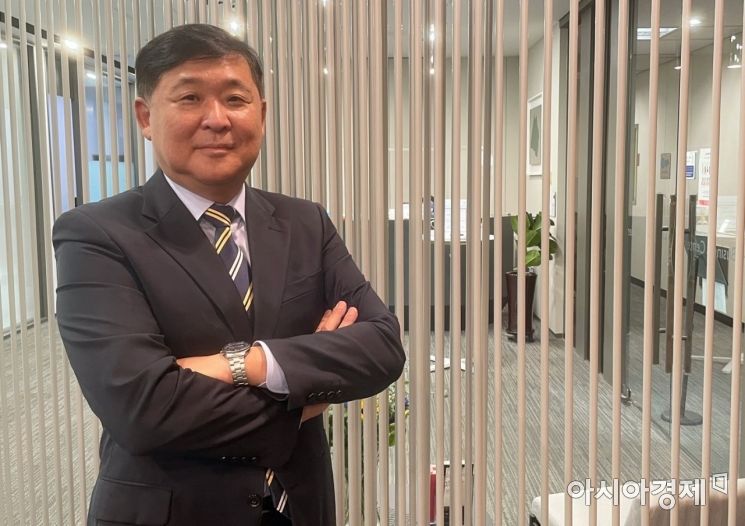 Yoo Han-jong, head of the Korea branch of the International Copper Association, explained, "With the accelerated industrial changes triggered by COVID-19, the demand for resources and recycling requirements have expanded, making copper, a highly efficient essential raw material, an indispensable component." Photo by Kim Hee-yoon
[Asia Economy Reporter Kim Heeyoon] The demand for copper in the eco-friendly industry, which has rapidly grown due to the prolonged COVID-19 pandemic, is steadily increasing worldwide. Industry experts predict that global copper demand, applied across industries such as renewable energy, electric vehicles, power storage facilities, and power grids as electricity replaces fossil fuels, will grow at an average annual rate of about 3% over the next five years. Amid the rising importance of copper due to new demand, Yuhan Jong, head of the Korea branch of the International Copper Association, explained, “As industrial changes accelerate, the demand for resources and recycling requirements are expanding, making copper, a highly efficient essential raw material, an indispensable material.”
The International Copper Association (ICA), headquartered in the United States and composed of regional offices including Asia, is a non-profit organization whose Korean branch is now in its 10th year since establishment. It supports the copper industry, especially public interest projects related to energy, and operates programs for technology discovery, development, and policy support.
Copper Recycled at an Average of 35%... Spotlighted as a Material for Renewable Energy
Recently, a significant amount of copper is used as a raw material in solar power and wind power, which constitute a large portion of renewable energy projects actively promoted worldwide, including in Korea. Head Yuhan stated, “The cell connections in solar power generation are made of copper lead frames, and wind power requires about 4 to 6 kg of copper per kW,” emphasizing, “Copper has a top-grade electrical conductivity of 59 MS/m, which increases energy efficiency and reduces manufacturing and maintenance costs compared to other materials.”
In Europe, the transition to renewable energy has been actively pursued since the Paris Climate Agreement in 2015. The EU expects copper demand within Europe to increase to about 22.5 million tons by 2050. The International Copper Association focuses on the high efficiency and eco-friendliness achieved through copper use, as demonstrated by the European example. Head Yuhan pointed out, “In many parts of the world, low-cost products that ignore environmental concerns are mass-produced, and these products are buried or discarded after use. Additionally, raw materials are repeatedly mined and products manufactured to make new products, causing continuous resource and environmental problems. To solve these issues, recyclable resources like copper must be utilized through policy.” In fact, more than two-thirds of the 550 million tons of copper mined since the 1900s is reused. The association added that commercial copper products contain an average of over 35% recycled copper.
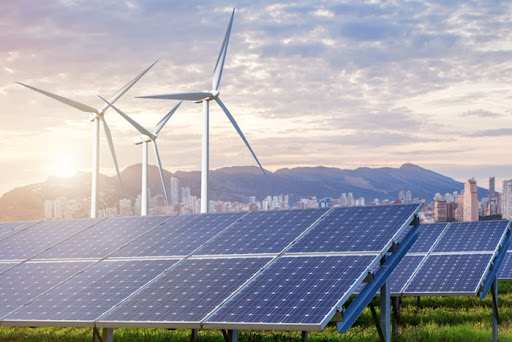 Copper is attracting attention as a key material, as it is used in large quantities as a raw material in solar power and wind power generation, which make up a significant portion of renewable energy projects being actively promoted recently in South Korea and around the world. Photo by Asia Economy DB
Proven Up to 2.2% Improvement in Motor Efficiency... Equivalent to Saving About 100 Nuclear Power Plants
Energy efficiency improvement through copper is proven by the example of the minimum efficiency standards for motors. Head Yuhan said, “According to the International Efficiency (IE) standards introduced in Korea in 2018, using copper rotors in IE2 (high efficiency) and IE3 (premium) induction motors resulted in efficiency improvements ranging from a minimum of 0.7% to a maximum of 2.2%. The association is strengthening technical support to help domestic small and medium-sized enterprises mass-produce high-efficiency induction motors.”
Motors are the electrical devices that consume the most electricity worldwide, accounting for over 54% of domestic electricity consumption. According to research by the Korea Electrotechnology Research Institute, increasing motor efficiency by 3% can save 108 GW, which is equivalent to reducing the need for 108 nuclear power plants.
Antibacterial Function Also Noted... COVID-19 Virus Completely Eliminated Within 4 Hours
Copper has recently gained new attention as an antibacterial material in response to COVID-19. Last year, the U.S. Centers for Disease Control and Prevention and the National Institutes of Health announced research results showing that half of the COVID-19 virus on copper surfaces is eliminated within one hour, and it is completely eliminated within four hours. Encouraged by this social interest, various products such as copper antibacterial films used on elevator buttons and public facility handles have been released in the market. However, concerns are growing about products emphasizing antibacterial properties despite having minimal copper content.
Head Yuhan stated, “In ancient Egypt, copper was used to purify contaminated water, and in Greek and Roman times, it was used for treatment and disinfection, making copper a natural antibacterial agent long favored by humanity. The problem with indiscriminately released antibacterial copper products recently arises from the lack of official certification bodies and technical standards. Therefore, institutional measures should be established, and the use of copper with proven safety should be expanded, especially in public facilities.”
As copper demand structurally increases centered on antibacterial copper and high-efficiency, eco-friendly industries, Head Yuhan said, “Focusing on the domestic market, the association plans to support technological development of copper applied to high-efficiency renewable energy sources and standardize copper technology used in solar and wind power generation. We will promote various business programs to contribute to the domestic copper industry, including expanding related infrastructure and exchanging technology with leading overseas companies.”
© The Asia Business Daily(www.asiae.co.kr). All rights reserved.


















