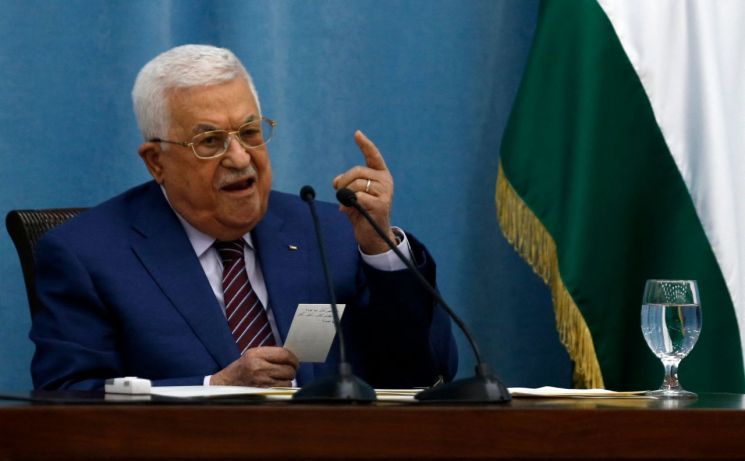
[Asia Economy Reporter Seongpil Cho] Mahmoud Abbas, the head of the Palestinian Authority (PA), warned Israel that if it does not withdraw from the occupied territories within one year, he will not recognize Israel as a state.
According to multiple foreign media including Reuters, Abbas urged Israel to withdraw from the West Bank, Gaza Strip, and East Jerusalem within one year during a pre-recorded virtual speech at the United Nations General Assembly on the 24th (local time). Abbas stated, "If they do not withdraw, there is no reason for us to recognize Israel according to the borders established in 1967," and questioned, "Why should we continue to recognize Israel?"
Abbas's warning is interpreted as a declaration that if Israel fails to keep its promise to withdraw from the occupied territories, he will abandon the 'two-state solution' that calls for peaceful coexistence between the two sides and demand equal relations. Abbas also indicated that if Israel does not keep its promise, he will challenge the legality of Israel's occupation of Palestinian territories at the International Criminal Court (ICC). Furthermore, he called on UN Secretary-General Ant?nio Guterres to convene a Middle East peace conference involving the international community.
Gilad Erdan, Israel's ambassador to the UN, criticized Abbas's remarks, saying, "If you truly want peace and negotiations, you do not issue ultimatums filled with threats and delusions at the UN." Recently, Israel's Defense Minister Benny Gantz and President Isaac Herzog, who oversee Palestinian territorial issues, have contacted Abbas. This has led to cautious speculation that peace talks between the two sides, which were suspended in 2014, might resume.
However, Israeli Prime Minister Naftali Bennett recently drew a line, stating that he will not recognize Palestine as a state and will not meet with Abbas. Bennett particularly criticized the PA for filing war crime charges against the Israeli military and for paying salaries to those designated as terrorists.
Previously, Israel achieved a major victory by defeating the Egyptian, Jordanian, and Syrian armies within six days during the Third Middle East War, triggered by Egypt's blockade of the Straits of Tiran and the prohibition of Israeli ship passage in 1967. As a result of the war, Israel occupied the Sinai Peninsula, the eastern part of the Suez Canal, the Golan Heights, and other areas. Although Israel returned some of the occupied territories, it has continued to occupy the West Bank, Gaza Strip, and East Jerusalem as buffer zones.
Israel and the Palestine Liberation Organization (PLO) signed an agreement in Oslo in 1993 recognizing Palestinian autonomy and Israel's existence. Furthermore, in 1995, the two sides agreed in a second accord on the return of Israeli-occupied Gaza Strip and West Bank territories and the establishment of a Palestinian autonomous state. However, Israel did not fulfill its promises to withdraw military forces from the occupied territories, return the territories, or expand Palestinian autonomy. Instead, it built settlements in the West Bank and other areas, relocating large numbers of Jews, which provoked Palestinian opposition. Amid these conflicts, protests by Palestinian residents at the separation barrier have continued without pause, and violent clashes have persisted during Israel's suppression of the protests.
© The Asia Business Daily(www.asiae.co.kr). All rights reserved.

















