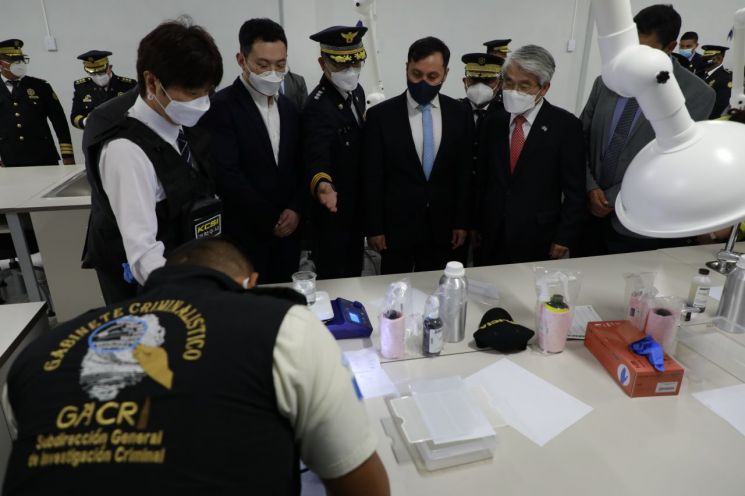
 A demonstration using forensic equipment and techniques of the Korean police is being conducted at the Police Duty Training Center in Guatemala, established through cooperation between the National Police Agency and the Korea International Cooperation Agency (KOICA).
 [Photo by National Police Agency]
[Asia Economy Reporter Lee Gwan-ju] The excellent policing capabilities of the Korean police are spreading worldwide. Not only internationally recognized cyber investigation and forensic investigation techniques, but also foreign police officers' enthusiasm to learn Korea's 112 emergency reporting system is strong. This "security Hallyu" is leading to practical effects such as enhancing the status of the Korean police in the international community, strengthening international cooperation, protecting overseas Koreans and tourists, and revitalizing domestic security industry exports.
The 'Police Duty Training Center' Established by the Korean Police in Guatemala
On the 16th (local time), an opening ceremony was held for the Police Duty Training Center in Guatemala, one of the "three Central American countries," to transfer Korean security technology. The opening ceremony was attended by high-ranking local officials including Guatemala's Minister of the Interior Gendry Reyes and the Chief of Police. Although President Alejandro Giammattei, who originally planned to attend the ceremony in person, regrettably could not attend due to local schedules, it suggests the high interest of the Guatemalan government. President Alejandro Giammattei of Guatemala expressed gratitude to the Korean government, saying, "This project will be an important opportunity to strengthen security cooperation between Korea and Guatemala."
The training center was designed to fully transfer Korean policing techniques. In particular, the virtual crime scene training room was benchmarked after the Korean National Police Agency's forensic training center to provide the same education as in Korea, and the latest domestic forensic equipment such as ultraviolet (UV)-LED light sources used for fingerprint development was supplied to support optimal evidence analysis. In addition, training was conducted in eight fields including forensic investigation, educational administration, and anti-corruption.
Security Hallyu Spreading Worldwide: "Let's Learn from the Korean Police"
Despite the global COVID-19 pandemic, the global interest in learning from the Korean police continues. From this month, 35 countries have agreed to participate in the "Advanced Security System Transfer Project" conducted by the National Police Agency. The participating countries cover almost all continents except North America, including 10 Asian countries (Philippines, Cambodia, Mongolia, Uzbekistan, Pakistan, Sri Lanka, Kyrgyzstan, Nepal, Turkmenistan, Afghanistan), 10 Latin American countries (Mexico, Argentina, Chile, Colombia, Peru, Paraguay, Ecuador, Trinidad and Tobago, Costa Rica, Honduras), 4 African countries (Nigeria, Morocco, Gabon, Tunisia), 7 European countries (Portugal, Serbia, Latvia, Turkey, Greece, Czech Republic, Poland), and 4 Middle Eastern and Oceanian countries (Saudi Arabia, Oman, Jordan, Fiji).
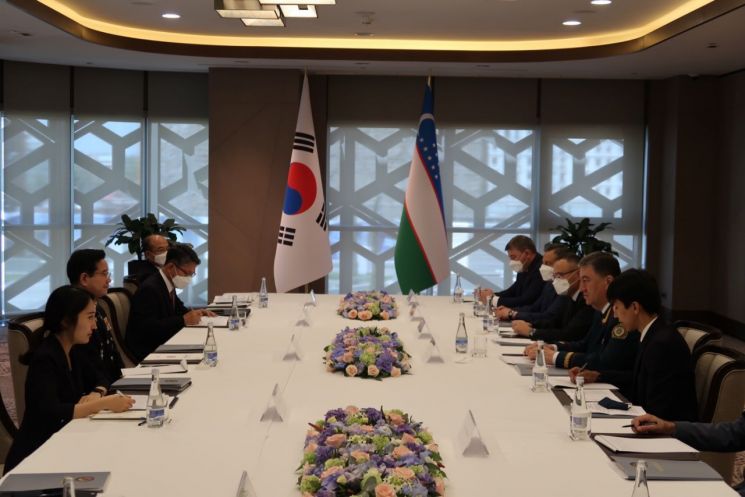 Commissioner General Kim Chang-ryong of the National Police Agency is holding a meeting with the Minister of Internal Affairs and the Chief of Security of Uzbekistan.
 [Photo by National Police Agency]
This project is conducted through video lectures and real-time video conferencing. The video lectures provided by the Korean police cover six fields: forensic investigation, emergency call response, drug investigation, crimes against women, digital forensics, and cyber investigation. Four hours of pre-produced content per field is provided, and considering local communication conditions, real-time video lectures will be offered to 14 countries.
Additionally, the police have carried out various security Hallyu projects this year, including signing a memorandum of understanding to strengthen forensic investigation capabilities of Vietnamese investigative agencies, system education such as recruitment and training of new police officers for senior Philippine police officers, and integrated training on the 112 emergency reporting system in Honduras. In June, Commissioner General Kim Chang-ryong also visited Uzbekistan and signed a comprehensive security cooperation agreement.
Breaking Through COVID-19... Expanding Target Countries and Project Scope of Security Hallyu
The police are currently identifying and selecting 12 new official development assistance (ODA) security projects for next year and discussing them with related agencies. Among them, 10 projects independently promoted by the police have passed through the Office for Government Policy Coordination and are currently under review by the Ministry of Economy and Finance. Two projects planned to be promoted in cooperation with the Korea International Cooperation Agency (KOICA) are undergoing one-on-one consultations with the Ministry of Foreign Affairs. The independent projects will be officially launched next year after final approval through the National Assembly budget review, and the KOICA cooperative projects will begin in 2023.
To expand the spread of "security Hallyu," the police plan to significantly increase ODA projects next year. The target regions will be expanded to Southeast Asia (Vietnam, Philippines, Thailand), Central Asia (Mongolia, Uzbekistan), Eastern Europe (Ukraine), Africa (Angola, Democratic Republic of the Congo, Ethiopia, Sudan), and South America (Colombia). The project fields will also diversify beyond forensic investigation and cyber investigation to include traffic, drugs, and 112 emergency services. One notable project is supporting the establishment of a simulation-based police training facility in Uzbekistan. Since Korean police security techniques in shooting, investigation, and initial response will be fully transferred, it is expected to have a significant impact.
Why Security Hallyu? Strengthening International Cooperation, Protecting Overseas Koreans, and Fostering New Industries
Most security Hallyu projects are conducted as official development assistance (ODA). This involves investing Korea's budget to enhance policing capabilities worldwide. Some may question, "Why should we spend our money to support foreign countries?" The answer is clear: raising the status of the Korean police in the international community and cooperating with countries worldwide ultimately benefits our own citizens.
The first reason is the globalization of crime. Crimes such as international terrorism and cybercrime occur without borders, and fugitives who commit crimes domestically and flee abroad are continuously appearing. A recent social issue is voice phishing organizations, which mostly operate bases overseas in China or Southeast Asia. In this reality, strengthening international cooperation is not optional but essential. The activities of the "Korean Desk," where Korean police are dispatched to Southeast Asia, illustrate this well. Thanks to these efforts, the police successfully repatriated 75 fraud offenders who fled abroad in the first half of this year.
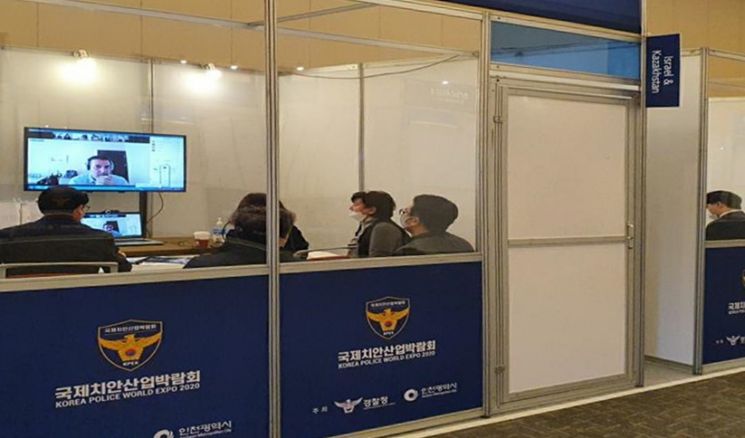 At the International Security Industry Expo held last October, domestic company representatives are conducting video export consultations with overseas buyers.
 [Photo by National Police Agency]
Security cooperation also plays a major role in protecting overseas Koreans. Approximately 2.7 million Koreans live abroad. Including overseas Koreans, this number rises to 7.5 million. Security cooperation can actively assist local police when our citizens abroad become victims of crime, preventing secondary damage and providing practical help. Although overseas travel is currently restricted due to COVID-19, once travel resumes, it will play a significant role in protecting tourists. In fact, in July 2019, six Korean police officers were dispatched to Croatia for the first time and conducted joint patrols with local police in major tourist areas.
From an economic perspective, security Hallyu is also noteworthy. The spread of our policing technology overseas means expanding export opportunities for domestic security industry companies. Whenever Korean police forensic equipment, reporting systems, and training equipment are introduced abroad, our equipment is exported as well. Korean policing technology is already gaining global attention. At the International Security Industry Expo held entirely online last October, 1,248 overseas visitors and buyers from 82 countries participated, resulting in 330 export consultations and export contracts worth 45.2 billion KRW.
© The Asia Business Daily(www.asiae.co.kr). All rights reserved.



















