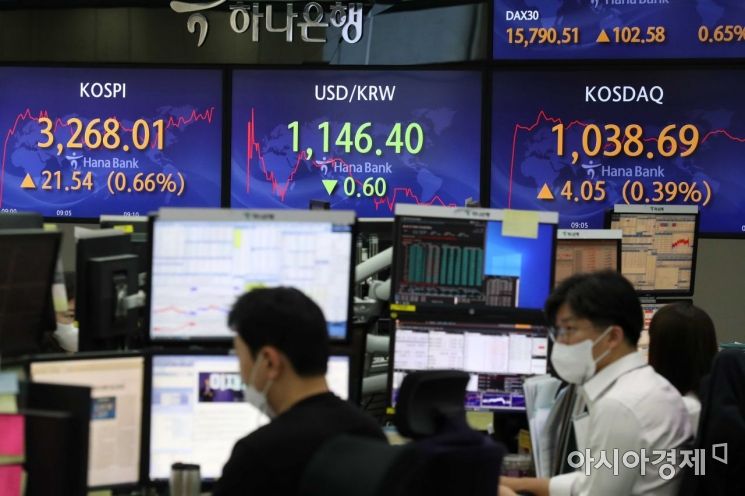
 On the 13th, dealers are working in the Hana Bank dealing room in Euljiro, Seoul, where the KOSPI index showed an early morning upward trend. The index started at 3,253.24, up 6.77 points (0.21%). Photo by Moon Honam munonam@
[Asia Economy Reporter Junho Hwang] On the 29th, the stock market opened higher amid net buying by individuals and institutions. This is analyzed to be influenced by the U.S. Federal Open Market Committee (FOMC) and the calming trend in the Chinese stock market.
On that day, the KOSPI opened at 3,248.49, up 11.63 points (0.36%). As of 9:12 a.m., it maintained an upward trend (0.24%). At this time, individuals and institutions were net buyers of 35.5 billion KRW and 37.4 billion KRW respectively. Foreigners were also net buying at 73.1 billion KRW. Among all listed stocks, 546 stocks were rising, 232 were falling, and 127 were unchanged.
Among the top market capitalization stocks, Samsung Electronics was steady, while major stocks showed noticeable gains. SK Hynix rose 0.88%, Kakao 0.34%, and Samsung Biologics jumped 1.21%. Among the top market cap stocks, only NAVER (0.34%) showed a weak trend.
By sector, the food and beverage industry (1.05%) showed a rise of over 1%. Although slightly less, pharmaceuticals, finance, transportation equipment, machinery, and distribution sectors also increased.
The KOSDAQ also opened at 1,040.45, up 4.77 points (0.46%). As of this time, it recorded 1,041.97, up 0.53%. Individuals were net buyers of 64.2 billion KRW, while foreigners and institutions were net sellers of 27.3 billion KRW and 24.6 billion KRW respectively. Among all stocks, 869 were rising and 405 were falling.
Among the top market cap stocks, Seegene, a COVID-19 diagnostic device company, traded at 73,300 KRW, up 1.81%. Kakao Games also formed a current price of 95,100 KRW, up 1.17%. By sector, chemicals rose 1.97%, pharmaceuticals 1.06%, and media and publishing 1.00%, showing noticeable gains.
The market's strength on this day is analyzed to be influenced by the FOMC results determining U.S. monetary policy direction and the calming of the Chinese stock market. At the FOMC, progress was made toward tapering (reducing asset purchases), and the U.S. Federal Reserve decided to introduce the Standing Repo Facility (SRF), a market support measure allowing banks to replace liquidity even as the Fed reduces it.
Seosangyoung, a researcher at Mirae Asset Securities, said, "The SRF is a policy that allows banks holding government bonds to exchange them for reserves at any time during stress situations, stabilizing short-term interest rate volatility," adding, "Since the central bank reduces liquidity but banks can replace it, the nature of the policy corresponds to quantitative easing."
However, he analyzed, "Concerns have increased that the tapering speed could accelerate due to confidence in the economy and spreading inflationary pressures," adding, "Accordingly, the U.S. dollar showed strength, short-term interest rates rose, and after an initial index decline, the market stabilized as analysis of the system was completed."
The 'plunge in the Greater China stock markets,' which had been a downward pressure on the stock market, is also entering a recovery phase as the Chinese government intervenes to calm the situation. Han Ji-young, a researcher at Kiwoom Securities, said, "The calming of the Greater China stock market plunge, which had exerted downward pressure on Asian markets this week, and the offshore market's won-dollar exchange rate falling again to the 1,140 KRW level are positive factors for the domestic stock market." She added, "In the domestic stock market, where the earnings season is in full swing, differentiated stock price movements are expected according to changes in future earnings outlooks between sectors and individual stocks."
© The Asia Business Daily(www.asiae.co.kr). All rights reserved.

















