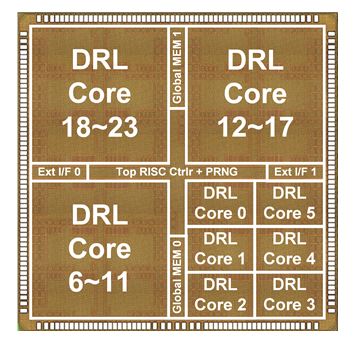
 OmniDRL chip. It processes floating-point operations of deep neural networks used in DRL (Deep Reinforcement Learning) with low power consumption through processing-in-memory, and it was developed to enable not only inference but also training at the edge while maintaining a high compression rate.
[Asia Economy Reporter Seulgina Cho] Domestic researchers have developed a semiconductor chip that enables mobile devices to process deep reinforcement learning (DRL), an artificial intelligence (AI) learning method. This is the same AI learning method applied in the Go AI program 'AlphaGo' developed earlier by Google DeepMind.
The Ministry of Science and ICT announced on the 16th that Professor Yoo Hwe-jun's research team at the Korea Advanced Institute of Science and Technology (KAIST) developed the AI semiconductor technology called 'omniDRL'.
Unlike supervised learning, which trains AI using pre-made data-answer pairs, deep reinforcement learning allows AI to derive optimal answers by itself through trial and error experiences in a given environment, with humans providing feedback on the results. Because neural networks are intricately connected and large-scale data must be processed, it required multiple high-performance computers with large-capacity memory working in parallel. Therefore, implementing deep reinforcement learning on mobile devices such as smartphones with limited computing power was difficult.
In response, the research team developed a deep reinforcement learning accelerator semiconductor chip usable on mobile devices by using a new concept semiconductor (PIM). They increased the compression rate compared to existing semiconductors to speed up data transfer, and calculations can be performed without decompression even in a compressed state. Additionally, they used SRAM (Static RAM)-based PIM (Processing-In-Memory) semiconductor technology that integrates processing (processor) and storage (memory) functions.
Notably, while existing PIM semiconductors could only perform integer calculations, this research developed the world's first technology capable of floating-point calculations. When 'omniDRL' was applied to the 'humanoid robot adaptive walking system,' which is mainly used for performance comparison studies of deep reinforcement learning algorithms, the research team explained that adaptive walking was possible at a speed more than seven times faster than when 'omniDRL' was not connected.
Professor Yoo said, "This research is significant in that it enabled inference and learning of deep neural networks on a single semiconductor while maintaining high compression, and especially developed AI semiconductor technology capable of floating-point calculations, which was previously considered impossible." He added, "It is expected to be applicable in various fields such as intelligent robot control, autonomous drones, and gaming."
Song Kyung-hee, Director of AI-based Policy at the Ministry of Science and ICT, stated, "While continuing to support the 1 trillion won scale AI semiconductor research and development project launched last year, we plan to actively expand investment in the AI semiconductor field, including the full-scale promotion of a 400 billion won PIM semiconductor technology development project starting next year."
This research was presented at the 'IEEE Symposium on VLSI Technology and Circuits,' one of the top conferences in the semiconductor field, held from June 14 to 19. Among over 200 presented papers, it was also selected as a highlight paper for excellence.
© The Asia Business Daily(www.asiae.co.kr). All rights reserved.

















