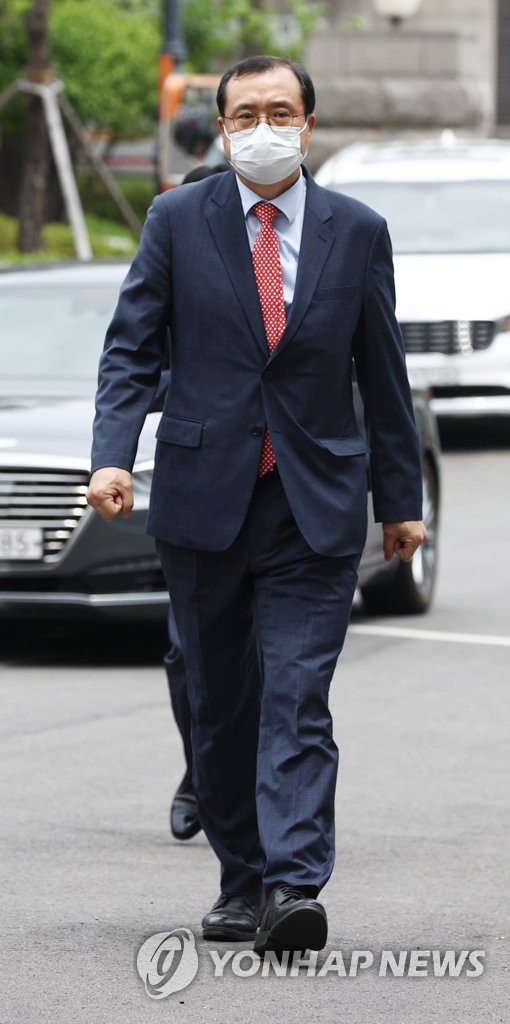
 On the afternoon of the 10th, former Busan High Court Chief Judge Im Seong-geun is attending the first hearing of his impeachment trial case held at the Constitutional Court in Jaedong, Jongno-gu.
[Asia Economy Reporter Choi Seok-jin] At the first hearing of the impeachment trial request case against former Busan High Court Chief Judge Im Seong-geun, who was impeached on charges of improperly intervening in three trials while serving as the Senior Criminal Presiding Judge at the Seoul Central District Court during former Chief Justice Yang Seung-tae’s tenure, both the petitioner and the respondent engaged in heated debates over the legality requirements of the National Assembly’s impeachment motion and the Constitutional Court’s impeachment trial.
The Constitutional Court held the first hearing of the impeachment trial request case against former Chief Judge Im at 2 p.m. on the 10th at the Grand Bench in Jaedong, Jongno-gu, Seoul.
Respondent Former Chief Judge Im Seong-geun and Prosecutor Yoon Ho-jung, Chairman of the Legislation and Judiciary Committee, Attend
Former Chief Judge Im, who did not attend the preparatory hearing on March 24, appeared in person at this hearing to present his opinion.
Upon arriving at the Constitutional Court in the afternoon, he did not respond at all to reporters’ questions about his feelings and entered the courtroom.
Yoon Ho-jung, Chairman of the National Assembly Legislation and Judiciary Committee (Floor Leader of the Democratic Party), who also missed the previous preparatory hearing due to National Assembly schedule, attended in person at this hearing and read out the summary of the impeachment charges.
Before entering the courtroom, Chairman Yoon told reporters, "This is my first time attending the impeachment trial as an impeachment prosecutor, and I am here to explain the summary of the charges to the justices."
He added, "Since this is the first time in history that the National Assembly has passed an impeachment motion against a judge, I will faithfully explain the purpose of this," and "I believe judicial independence is properly realized when the independence of judges’ rulings is upheld," further stating, "We expect the Constitutional Court to properly embody the spirit of our Constitution, and we will approach the trial with this in mind."
Regarding the criticism that there is no practical benefit to the impeachment trial since former Chief Judge Im has already lost his status as a judge, Chairman Yoon responded, "This question is outside the common knowledge of the legal community," and "The constitutional issue is not affected by whether the judge’s position is maintained or not."
He continued, "Because the judiciary is protected by the Constitution, the general understanding in the legal community is that there is a legal benefit to ruling on this case regardless of whether the judge resigns or not, as the independence of the judiciary has been compromised in this case."
Debate Over Procedural Defects in National Assembly’s Impeachment Process and Legality of Impeachment Trial Requirements
At the hearing, after the petitioner read out the summary of the charges, the respondent presented his opinion. Subsequently, both sides exchanged arguments and opinions mainly on the issues selected as points of contention during the previous preparatory hearing and the written submissions they had filed. The procedure for admitting evidence was also conducted.
In particular, the intense debate focused less on the factual details of the trial intervention acts that formed the basis of the impeachment charges against former Chief Judge Im, and more on procedural defects and whether the requirements for the impeachment trial were met.
Previously, on March 24, the Constitutional Court held a preparatory hearing attended by presiding Justice Lee Seok-tae, and three other justices?Lee Mi-sun and Lee Young-jin?along with former Constitutional Court Justice Song Doo-hwan (attorney), representing the petitioner, and former Constitutional Court Justice Lee Dong-heup (attorney), representing the respondent, to organize the issues and evidence of the trial.
The petitioner emphasized, "Former Chief Judge Im’s intervention in trials is an unconstitutional and illegal act that cannot be tolerated, as a senior judge who must uphold judicial independence has violated the principle of judicial independence."
The respondent first pointed out problems with the National Assembly’s impeachment motion procedure. They argued that the National Assembly bypassed procedures such as preliminary investigation, questioning, and debate on the grounds for impeachment as stipulated in the National Assembly Act, and pushed through the impeachment motion against the respondent with a majority vote.
They also stressed, "Under our Constitution, the purpose of the impeachment trial is to remove high-ranking officials who violate the Constitution or laws, thereby depriving them of their authority and securing the normative power of the Constitution."
They added, "While constitutional complaints primarily aim to confirm the illegality of public authority’s actions and clarify the limits of authority and duties by determining whether they violate the Constitution, the impeachment trial system warns and prevents constitutional violations by stipulating the possibility of impeachment for legal violations, and simultaneously guarantees the Constitution by asserting legal responsibility when public officials violate the Constitution in performing their duties."
Since Article 53 of the Constitutional Court Act (Content of Decision) stipulates that "If the impeachment trial request is justified, the Constitutional Court shall issue a decision to dismiss the respondent from the public office," if the Constitutional Court accepts the impeachment trial request, it must order "the dismissal of respondent Im Seong-geun from the judiciary." However, since former Chief Judge Im has already lost his status as a judge due to term expiration, the respondent argues there is no benefit to the impeachment trial.
The petitioner strongly rebutted this argument.
Regarding procedural violations under the National Assembly Act, the petitioner said, "This case has characteristics different from other impeachment cases," pointing out, "There have been investigations by investigative agencies over several years and prolonged court trials, during which various related evidence has been accumulated."
They argued that there was no need for a separate fact-finding investigation.
The petitioner further stated, "There have also been countless media reports, so while the exact facts should be judged by reviewing investigation records, when considering the various records attached to the impeachment resolution by individual lawmakers and the facts known to the public through media reports, it is questionable whether serious preliminary investigation and debate were absolutely necessary."
Regarding the claim that there is no benefit to the trial, the petitioner emphasized, "Impeachment trials are fundamentally procedures to protect and maintain constitutional order, so it is not a matter of whether the benefit is exceptionally recognized or not, but rather that there is benefit in principle."
Just as constitutional complaint cases may exceptionally make unconstitutionality judgments for the objective protection of constitutional order even when subjective rights protection interests are lost due to the end of basic rights infringement, impeachment trials are also systems for maintaining constitutional order.
Both sides also engaged in fierce debate over the principle of ne bis in idem.
The respondent argued that since he was acquitted in the first instance of the criminal trial and disciplinary actions had already been taken for the same reasons related to baseball players among the grounds for impeachment, this violates the constitutional principle of ne bis in idem.
In response, the petitioner argued that abuse of authority under criminal law and constitutional violations are different. They countered that the acquittal in the first instance criminal trial, despite almost clarifying the facts, was simply the result of strictly applying the principle of legality in criminal procedure, and that former Chief Judge Im’s unconstitutional acts were acknowledged.
They also argued that dismissal, removal, and other disciplinary types under the National Public Officials Act have different meanings and legal effects.
Former Chief Judge Im Seong-geun Directly Presents Opinion... "Did Not Violate Judicial Independence"
Meanwhile, at the hearing, respondent former Chief Judge Im also directly presented his opinion.
Former Chief Judge Im first stated, "Since becoming a judge on March 1, 1991, I left the judiciary on February 28 upon the expiration of my term," and added, "I have always tried to conduct trials by listening carefully to the parties involved, keeping in mind the words of Dasan Jeong Yak-yong."
He expressed his feelings, saying, "Nevertheless, I am deeply distressed to stand here today due to events that occurred six years ago when I served as Senior Criminal Presiding Judge at the Central District Court."
He apologized, saying, "I apologize for causing much burden to the Constitutional Court and the judiciary, and for troubling those who cared for me and the public."
Former Chief Judge Im claimed that his actions were part of his duties as Senior Presiding Judge and not interference in trials.
He recalled, "In today’s society, judges are often criticized beyond the scope of legitimate criticism and personally attacked simply because their opinions differ regarding certain trials, and this was also the case when I served as Senior Presiding Judge."
He added, "Regardless of who is to blame, even if the cause is the decline in public trust in the judiciary, I tried to find ways for judges not to be intimidated and to conduct trials, and I also felt heartache when fellow judges were personally attacked."
He emphasized, "I considered it my duty as a senior judge before being a Senior Presiding Judge to worry about whether judges under my jurisdiction might be unfairly criticized by civic groups or public opinion, and to resolve such issues either before or after they occurred."
He stated, "All three cases that became grounds for impeachment occurred against this background, and my actions did not violate political neutrality or interfere with judicial independence to promote the establishment of a Supreme Court," and requested, "Please note that junior judges have testified to the same effect."
Finally, he concluded, "I hope this case will serve as an opportunity to restore public trust in the judiciary by clearing up misunderstandings caused by exaggeration or misinformation, and by revealing that my actions did not infringe upon judicial authority."
Second Hearing Date Changed from 15th to Next Month 6th
Former Chief Judge Im is accused of improperly intervening in three trials: the defamation case involving former Sankei Shimbun Seoul Bureau Chief Kato Tatsuya related to reports on former President Park Geun-hye’s whereabouts on the day of the Sewol ferry disaster; the gambling charges against Oh Seung-hwan and Im Chang-yong; and the arrest and injury charges against Minbyun lawyers during the Ssangyong Motor protests.
The first instance criminal trial acquitted him based on the legal principle that "there is no abuse of authority without authority," but the National Assembly passed an impeachment motion, claiming his actions were unconstitutional.
Meanwhile, Chief Justice Yoo Nam-seok of the Constitutional Court accepted the petitioner’s argument that the preparation period was too short and changed the second hearing originally scheduled for the 15th to the 6th of next month.
© The Asia Business Daily(www.asiae.co.kr). All rights reserved.

















