Wholesale Price of 1kg Green Onion 5,403 Won
Surges 145.15% in One Year
Eggs Up 21%, Rice Up 16%
Government: "Inflation Rate to Slow in Second Half, Rise in Agricultural, Livestock, Fishery Products and Petroleum to Ease"
Distancing from Inflation Concerns
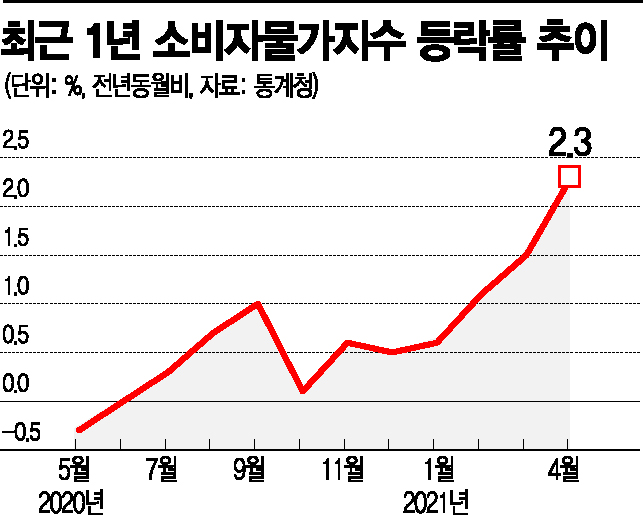
[Asia Economy Reporters Eunbyeol Kim, Yuri Kim] Last month, the consumer price inflation rate exceeded 2%, rekindling concerns about inflation. The 'annual inflation rate of 2%' is the target for price stability, and if this benchmark is exceeded over the medium term (more than one year), it serves as a basis for policy shifts such as raising the base interest rate, making it a significant figure. While the government and the Bank of Korea expect high prices to continue for the time being, they draw a line on inflation concerns by stating that prices will stabilize in the second half of the year.
Perceived Inflation Is Already Present
The economy felt through the shopping basket has already entered an inflation phase. Prices of food ingredients such as agricultural, marine, and livestock products have surged compared to the same period last year, burdening the common people's economy.
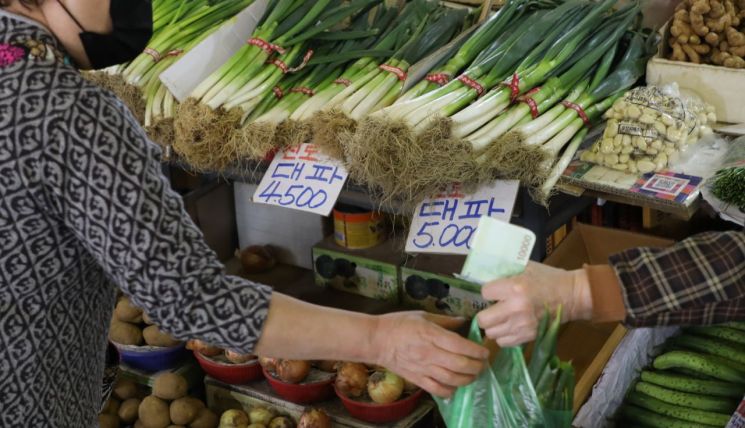
According to the Korea Agro-Fisheries & Food Trade Corporation (aT), as of the 3rd, the average retail price of 1kg of green onions was 5,403 won. Compared to a week ago (April 27, 6,155 won) and a month ago (6,362 won), prices seem to be gradually stabilizing, but they have surged 145.15% compared to a year ago (2,204 won). Although prices have improved from early March when they soared to the mid-7,000 won range and were called 'golden green onions,' sparking a trend of growing green onions at home called 'Patech,' the perceived price of green onions remains elevated from the 2,000 won range to 5,000?6,000 won.
The situation with eggs is similar. The average retail price of 30 medium-sized special eggs, after applying the consumption coupon introduced by the government on January 28 to stabilize table prices, is 6,610 won. Without the coupon, the price rises to 7,290 won. Even with the coupon applied, the price is 21.49% higher than a year ago (5,441 won). It is also similar compared to the average price (5,347 won). Without the coupon, the price increased by 33.98% compared to a year ago.
Egg cartons with the consumption coupon still sell out quickly at large supermarkets. A housewife in her 40s living in Mapo-gu, Seoul, said, "I go grocery shopping at a large supermarket every weekend evening, but the shelf for one-carton packs is always empty when I come," adding, "I have no choice but to buy 10-egg packs, but since eggs are a frequently used item on the table, it is indeed a burden." The situation is no different for rice (regular) 20kg. As of the 3rd, the average retail price is 59,798 won, slightly stabilized compared to a month ago (60,255 won), but it has risen 15.93% compared to a year ago (51,579 won). Fuji apples are priced at 34,140 won for 10 pieces, up 64.63% from a year ago (20,738 won).
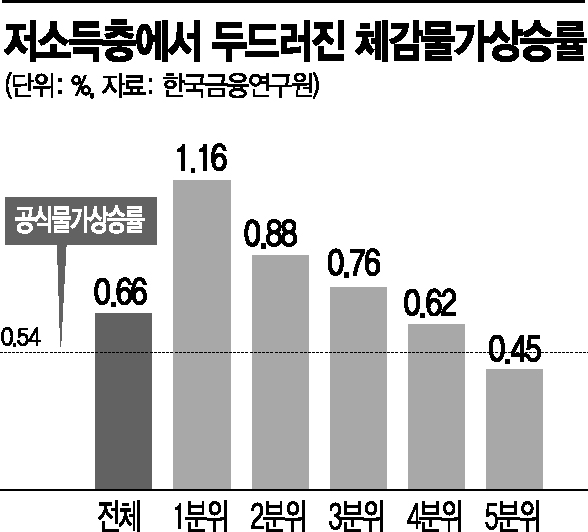
Due to the COVID-19 pandemic, the proportion of food expenses in people's spending increased, and coincidentally, food prices rose, causing the perceived inflation rate to be higher than the official inflation rate. According to analysis by senior researchers Sungwook Park and Min Jang of the Korea Institute of Finance, last year's perceived inflation rate in Korea was 0.66%, 0.12 percentage points higher than the official consumer price inflation rate (0.54%).
Perceived inflation was particularly pronounced among low-income groups. Senior researcher Min Jang explained, "Last year's perceived inflation rate for the lowest 20% income group was 1.16%, about twice the official consumer price inflation rate (0.54%), while the highest 20% income households had a rate of only 0.45%. This resulted from prices in sectors where higher-income groups spend money, such as travel and upscale restaurants, plummeting, while prices of essential goods rose."
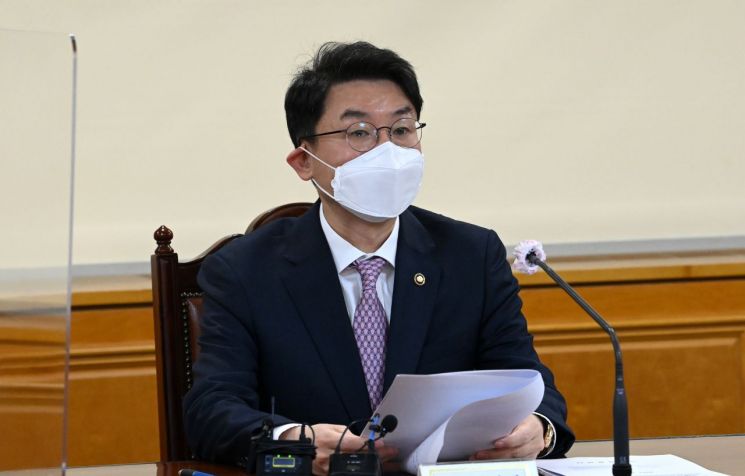 Lee Ok-won, First Vice Minister of Strategy and Finance, is presiding over the macroeconomic financial meeting held at the Seoul Banking Hall on the 4th.
 [Photo by Yonhap News]
Government: "Annual Inflation Rate Will Not Reach 2%"
However, the government and major institutions forecast that the consumer price inflation rate will slow down in the second half of the year, distancing themselves from inflation concerns. Reasons include the reduction of the base effect and the slowdown in price increases of agricultural, livestock, marine products, and petroleum products. Inflation rates are generally compared to the same period last year, and since consumer prices in the second quarter of last year, heavily impacted by COVID-19, recorded -0.1%, this year's second-quarter inflation rate is expected to appear relatively high. Prices of agricultural, livestock, marine products, and petroleum are also not expected to rise sharply.
Lee Eokwon, First Vice Minister of Strategy and Finance, said at the macroeconomic and financial meeting on the 4th, "(The April inflation rate) was largely influenced by increased volatility on the supply side, such as oil prices and agricultural and livestock products, rather than demand-side factors," adding, "Of the 2.3% inflation rate, agricultural, livestock, and petroleum prices contributed 1.5 percentage points, about 65% of the total inflation."
The Statistics Korea also assessed that the rise in prices due to increased demand as the economy recovers is not yet significant. The Bank of Korea (between 1.3% and 2%), the International Monetary Fund (IMF, 1.4%), and investment banks (IB, 1.5%) all forecast Korea's inflation rate this year to be in the mid-1% range.
The government has introduced measures such as stabilizing agricultural and livestock product prices and releasing discounted raw materials, wary that excessive inflation concerns could dampen the barely recovering economic sentiment. Inflation debates have resurfaced in the U.S. as well; Warren Buffett, chairman of Berkshire Hathaway, said "very high inflation is coming," but the Federal Reserve (Fed) views the price increases as temporary.
© The Asia Business Daily(www.asiae.co.kr). All rights reserved.



















