[Asia Economy Reporter Jeong Hyunjin] The proportion of young people employed in regular positions decreased by 2 percentage points compared to seven years ago. As opportunities for youth in the industrial sector shrink, there are negative effects of retirement age extension and wage increases on the proportion of youth employment, leading to calls for enhancing employment flexibility.
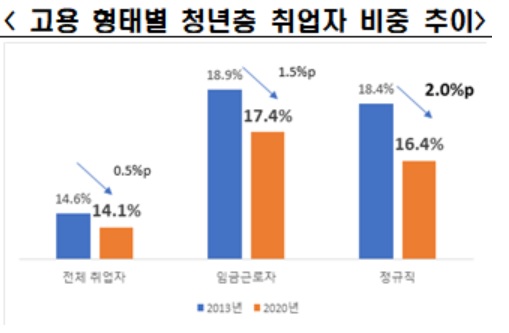
On the 13th, the Korea Economic Research Institute under the Federation of Korean Industries revealed in its report titled "Analysis of Employment Trends of Youth by Industry and Implications" that the overall proportion of employed youth decreased by 0.5 percentage points from 14.6% in 2013 to 14.1% last year. According to the analysis, the proportion of youth in regular employment dropped the most among all employment types, falling from 18.4% to 16.4%, a 2 percentage point decrease during the same period. The proportion of wage workers, including non-regular workers, also declined by 1.5 percentage points.
By industry group, the proportion of employed youth decreased in 12 out of 19 industries. The largest decline was in the health and social welfare services sector, with a 6.4 percentage point drop. The industry with the biggest decrease in the proportion of youth in regular employment was arts, sports, and leisure-related services, which fell from 31.4% in 2013 to 22.5% last year, a decrease of 8.9 percentage points. The Korea Economic Research Institute attributed this to the impact of COVID-19.
The institute also noted that in the accommodation and food service industry, which has the highest overall youth employment proportion at 26.6%, the increase in the proportion of youth in regular employment was only 2.0 percentage points, less than the 5.4 percentage point increase among wage workers. They pointed out that this reflects the vulnerable employment situation where youth are relatively more employed in non-regular jobs such as part-time or short-term work.
Overall, as the quality of youth jobs deteriorates, the Korea Economic Research Institute stated that retirement age extension and wage increases significantly reduce the proportion of youth employed by industry. Analyzing factors affecting changes in youth employment proportion among all employed persons, it was found that extending the retirement age (upper limit of working age) by one year reduces the youth employment proportion by about 0.29 percentage points. An increase of 1,000 KRW in average hourly wage decreases the youth employment proportion by 0.45 percentage points.
When focusing on wage workers excluding the self-employed, extending the retirement age by one year reduces the youth employment proportion by 0.41 percentage points, and a 1,000 KRW increase in average hourly wage reduces it by 0.48 percentage points. When limiting the analysis to regular workers, the decrease in youth employment proportion was the largest: 0.42 percentage points for a one-year retirement age extension and 1.17 percentage points for a 1,000 KRW increase in average hourly wage.
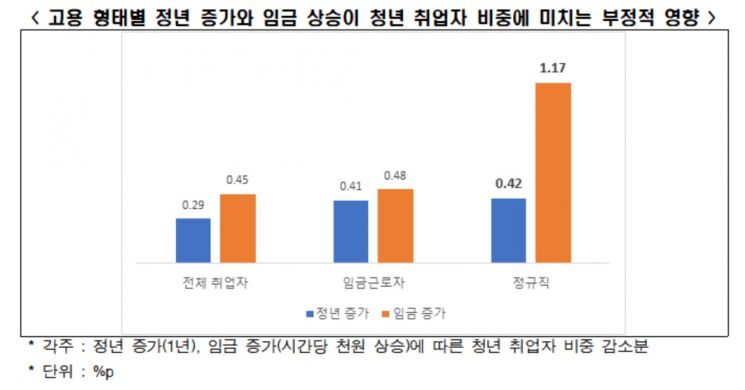
The Korea Economic Research Institute analyzed that "the youth employment proportion in regular positions is more sensitive to changes than among all employed persons or wage workers because once regular workers are hired, high employment protection makes dismissal difficult, causing companies to be more reluctant to hire additional young regular workers."
Accordingly, the institute pointed out the need for a cautious approach to retirement age extension and wage increases to expand youth employment in the future. Especially regarding retirement age extension, if it is mandated considering aging, wage system reforms such as the introduction or expansion of job-based pay or wage peak systems should be pursued simultaneously. They also added that minimum wage increases should be restrained or implemented gradually.
Researcher Yoo Jinseong of the Korea Economic Research Institute said, "To solve youth employment issues, institutional improvements for job creation must fundamentally precede," adding, "It is necessary to relax employment protection in regular positions and enhance employment flexibility to increase companies' capacity to create jobs."
© The Asia Business Daily(www.asiae.co.kr). All rights reserved.


















